

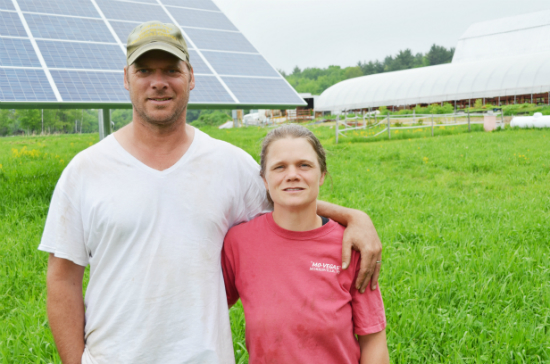
by Timothy McQuiston, Vermont Business Magazine Christa squeezes a lump of potting soil in her hand. It’s too crumbly. She suggests adding more water to the big tub of seed starter. Better wet than dry, she says; tilt the press, she tells her associate, to let the water runoff if necessary before making the cubes.
The device making the cubes looks like, at one end, an old-fashioned ice cube maker from grandma’s refrigerator attached to a pole and handle similar to what’s used to cut holes in a putting green. The cubes of soil have a dimple in them into which, on this day, tiny seeds of basil are being dropped in by hand. All the workers are young women.
Christa Alexander, 39, is the boss and owner with her husband Mark Fasching at Jericho Settlers Farm, an organic CSA which sells vegetables, herbs, meat, eggs, solar electricity and fine art in Jericho Center.
The fine art is her mom’s business, Emilie Alexander. The Emile A Gruppe Gallery carries the work of Emilie’s father, as well as that of local artists.
The electricity is generated by six AllSun trackers made and installed by AllEarth Renewables in Williston. The Faschings lease-to-own the panels from Green Lantern Capital in Waterbury. The solar panels help set them apart from other farms and other CSAs, Mark said.
For now, the electric covers Christa’s parents house, their own house down the street, the farming operation, including the walk-in refrigerators, and there is enough left over from the net metering arrangement that they can ‘sell’their credit. One such customer is the Jericho Center Country Store, a mile or so north of the farm.
The panels, which only went into service in January 2012, should average about 42,000 kilowatt hours a year. But last year they produced about 54,000. The farm actually buys their electricity from Green Lantern. The Faschings will own them in five years, at which time they’ll really be able to make hay, electric-wise.
‘There’s also a 6 cents solar adder. So for every kilowatt hour we generate, whether it goes on to the grid or whether we’re using it, we get 6 cents for that. So that credit builds up and we can apply it to months where we, say, we under-produced solar and we had to pull from the grid. They (GMP) could apply the credit to our account. As it is, the panels produce more than the farm needs, so we’ve never had to pull from the grid for the farm needs. So all that credit we can then apply to any other person who’s a customer of Green Mountain Powerâ ¦ You talk to people and come to an agreement with them to sell them your credit basically. So say I have $2,000 worth of kilowatt hours on my credit, I can then say I want this house to take some of that credit, and Jericho Center Country Store said they wanted some of that credit.’
Her parents and the store pay the farm for the credit, as the Faschings have already bought it electricity from Green Lantern.
‘I’m like reselling it, basically,’Christa said. ‘So it’s a little convoluted,’Christa said, laughing at her own joke, because it’s more than a little convoluted, which is just another day on the integrated, CSA farm.
‘It’s more convoluted than an offshore bank in the Bahamas or something,’Mark, 46, said.
It seems very complex, as hoop houses and crops and cover crops and chickens for laying and chickens for broiling and sheep and pigs and black angus cattle are moved and rotated. It’s all done with the casualness of familiarity for the couple who have only one full-time employee and several seasonal workers.
The Faschings have fields at the farm, across the street, at another Jericho field, down the street at the original Barber Farm and in Richmond Center, which was flooded in the famous spring flood of 2011 and nearly replicated this spring.
The land required for grass fed and finished livestock is immense. The animals are rotated and cover crops planted. Electric fences keep the larger animals in their place. On occasion a chicken will scratch his way under a fence and into a neighbor’s back yard. The manure can be used to fertilize the fields before the animals move on, sometimes to fertilize the grass, and in other cases, as where the hoop houses are at the farm, for vegetables.
The entire operation is about 150 acres. The beef is done in partnership with a friend. They also do pasture-raised pork and chickens. Chickens, by the way, eat grain, as we all know, but they also eat grass. Where they’ve been looks like it’s been cut down by a really bad lawn mower.
The hens keep laying year-around and are a bit more productive in the winter, laying inside a hoop house, because they don’t like to be moved around. Their production slumps in November, but the Faschings are able to trick them into thinking the sun is not sinking by keeping the lights on. The chickens are a cross between Rhode Island reds and white leghorns, but all the hens are red.
The cattle and sheep grazing down at the impossibly picturesque Barber Farm helped keep that property in agriculture. Vermont Life did a cover piece on it last year, featuring the Faschings.
On the vegetable side, they have about 15 acres in production, not including the cover crop.
‘That’s about half the business,’Christa said. The CSA is available to members the whole year. CSA members can very narrowly define what they went to buy. The Faschings sell some of what they produce, including sheep pelts, at the farm stand, some they wholesale, they also sell direct at the Burlington farmers market. Mesclun, mustard greens and the rest might show up at City Market, Healthy Living, Sweet Clover Market, the whole Farm House restaurant group, the lunch room at dealer.com, and of course, they’re available to the CSA.
The farmer’s market is more about promotion than retail sales. As they sell a head of lettuce, they might also up-sell the customer on a CSA membership or some beef, and they’ll encourage them to come out and visit the farm. Meat, vegetables and eggs are available year around, and bread and cheese are supplied by other producers.
‘We’re trying to make them more of a customer than just a Saturday shopper, ideally,’Christa said. ‘CSAs have become more and more competitive in the last five years or so. There are probably triple the number of CSAs in this area.’
‘Mostly in the summer,’Mark added.
So Jericho Settlers Farm is taking advantage of their 12-month operation.
‘Instead of getting more customers, we’re trying to get our customers to buy more from us, so we expanded into the winter and the spring,’Christa said.
Like any business, some products have higher margins than others.
‘Vegetables, eggs and pork,’Christa said, have the highest margin. ‘People always think, ‘Oh, they must make a killing off grass fed lamb and beef because all they eat is grass,’right? But they’re a very low-margin animal. Well, for beef it takes two years to get a product. You have to support the mother herd during that time. And hay is really expensive, whether you’re making it yourself or buying it in. We don’t have enough land to make all the hay we need. Until you get all your winter hay needs, it gets pretty expensive. And then sheep, you know, they have one or two offspring a year, but the carcass size is like 40 pounds. So, again, you’re supporting a flock for a 40-pound carcass, which isn’t a lot of money.’
It’s also labor intensive, as the livestock has to be moved from field to field. Grass has to be fertilized to produce nutritious hay. Cover crops to restore or retain nutrients have to be planted, even where manure from the animals is abundant. A dormant field produces poor hay and will get overrun by weeds. Many fields dotting the landscape of Vermont are too small to make it worthwhile to make them cost-effective to hay, especially for the big, round bails which are most useful to farmers.
The cost of hay is more expensive in Chittenden County than, say, Addison. Some farmers even buy it from out-of-state.
The smaller parcels of land, say five acres, also aren’t of much use for grazing to the Faschings, because of the effort required to move the animals and the cost of high-tensile fencing (to keep the animals safe and to respect neighbors) and water. Even at the expansive Barber Farm, they had to dig a well. Five acres would only support three to five head of cattle and maybe five to 10 lambs, depending on the quality. Even with a larger field that’s been abandoned, it could take five years to restore it to production, which would be a long commitment before even being able to use it.
‘It takes as much work to move 50 sheep as it would 200,’ Christa said, but they don’t have the land base for that many animals. Still, the beef and sheep are important to the overall operation. ‘We enjoy them and they’re an important part of the system.’
Except for the chickens, which are handled by on-site by a certified processor who comes to the farm, the animals are sent to a USDA approved slaughterhouse for processing.
They call the hens product ‘solar eggs,’because of the solar electric and the natural light that warms the greenhouses. Hens will lay productively for about two years. After that they’ll be culled and sold as stew hens. Sometimes Bhutanese and Vietnamese families will come by to purchase them live.
The broilers, which are white and plump, ‘are pretty lazy. They don’t forage like a hen does. They don’t run all over the place. You kind of have to encourage them,’Christa said.
They get to five pounds in about eight weeks. They sell them as whole chickens to all the same markets and CSA. ‘People can buy just a chicken share.’
Mow It Down and Till It In
The Faschings have to be expert farmers, of course, but they also have to be skilled at running a complex business.
Jericho Settlers Farm generates about $750,000 a year. Half is retail and half is wholesale. The self-serve farmstand generates about as much revenue as the farmers market.
Vetch is a common cover crop they use at the Barber Farm.
The operation took a big leap when the Barber Farm fields were added a few years ago. While it’s leveled off some, the business is growing and they expect to add two more year-round employees. With the seasonal employees, there are about 10 workers.
There is a pick-your-own garden for CSA members right at the farm, with lettuces, cherry tomatoes, herbs and the like. There’s also a kids’garden right there. The larger veggie production is at other parcels the Faschings run and larger tomatoes are also grown in the hoop houses.
Only one hoop house is heated, but the winter greens like spinach are planted into the ground and within the house they can survive even as the temperature inside might get down to 10 degrees.
The hoop houses are rotated just as the fields and animals are, as the soil is restored according to need and even to organic regulations. Cover crops include vetch, oats, field peas or other cereal grains. The green matter absorbs the nutrients which are then tilled back into the ground to create a suitable soil for the vegetables.
It doesn’t all go well; the new potatoes were late because of the inclement spring and will probably get yanked out, because the tomatoes that are waiting for the space are much more valuable. Four houses will be used for tomatoes and one for cucumbers.
All the crops in the hoop houses were behind because it was so cloudy. In the fields they had to irrigate in early May, which Christa said never happens. By late May a deluge swamped the fields.
One area of opportunity is the off-season greens, winter and spring. The demand for fresh greens is great and the local production is low.
‘We’re looking to increase that capacity quite a bit,’Christa said, which means for winter hoop house production.
Christa and Mark work 60 or 70 hours a week already.
‘This time of year I’ll work from 7 in the morning until 8 at night. And then sometimes I’ll stay up for another three hours and do my books,’Christa said, laughing. She and Mark cracked themselves up frequently during a tour of the operation. The Faschings are good sports about the media and they have two photogenic kids.
If you listen, you can hear the hard ‘R’in Christa’s subtle Vermont accent. Mark, on the other hand, is from Washington State and has the indistinguishable accent of the West Coast. He had worked on a dairy out there. The marriage and working together here has succeeded by utilizing individual strengths.
‘I’m more of a risky person,’Mark said.
‘I’m risk averse,’Christa said, despite being the loquacious one.
‘My foot is always on the gas and hers is always on the brake pedal. So that works well.’
‘I enjoy figuring out things from the numbers perspective and Mark is really in tune with trends and marketing... He’s always ready to jump in a try something new. And I’m like, let’s see if it makes money first. But you don’t always have enough information to know if it’s going to money, so sometimes you just have to jump in and see how it goes.’
Christa’s parents still own the property, which was first settled in 1783. Except for the gallery and the house, the Faschings own everything on it. At some point they’ll own all of it, but that transition hasn’t happened yet.
Christa and Mark have been working the farm since 2002, initially part-time. She had ventured out West and brought Mark home in 1999. Christa then worked for the state and Mark for the Vermont Land Trust.
‘It was scary to make that jump from two fulltime jobs. She worked for the state with good benefits, retirement. And I worked for the Vermont Land Trust.’
‘The business grew really fast,’Christa said, ‘and the feedback was great.’
The timing was right, what with the emphasis on local food and the popularity of CSAs, to make that leap, so they had to make a decision whether to hire people to run the farm, ‘or hire ourselves,’ Christa said.
‘We quit our other jobs and jumped in.’
Quick Facts
Christa Alexander put together these facts about the farm:
* solar panels generate 50,000 kwh per year
* the farm uses about 25 percent of this and the rest goes to the grid to be utilized by our "net metering partners,’our house, my parents' house and the Jericho Center Country Store
* We produce about 20 finished beef animals each year, which we raise in partnership with our friend Chuck Lacy. They are 100 percent grass fed and finished, of the Devon breed. We sell them all retail, to CSA, farmstand, and farmers market customers. Some customers purchase whole and half animals custom processed.
* We produce about 30 lambs each year for meat, also 100 percent grass fed and finished, also all sold retail.
* Our laying hen flock averages 1,500 hens and produces about 32,000 dozen eggs per year, all are sold within 25 miles of the farm, about 2/3 wholesale and 1/3 retail. Wholesale buyers include Farmhouse Tap and Grill, The Kitchen Table Bistro, City Market, Healthy Living, On the Rise Bakery and Sweet Clover Market. The hens are raised on pasture during the grazing season and used to fertilize the fields and help with insect pest control.
* We produce 1,000 to 3,000 meat chickens per year, depending on the availability of a state-inspected processing facility, as we are limited by regulation to 1,000 poultry per year killed on farm without state inspection. Our meat birds are also raised on pasture or on vegetable fields that are not in production, where they help to fertilize for future crops.
* We produce 40 to 60 pigs per year, sold half retail and half wholesale. We raise heritage breeds of Berkshire and Tamworth pigs on a pasture-based system.
* Our year-round CSA program supports 150 families each season (Spring/Summer/Winter). We sell vegetable, meat, and "settlervore" shares (eggs, bread, cheese, fruit and other value-added farm made products). CSA members can purchase whichever combination of shares they want for whichever seasons they want.
* Our sales are about half wholesale and half retail, with our CSA program being our leading retail account.
* Margins on beef and lamb are the lowest, eggs and meat chickens and pork are next, and vegetables are most profitable.
PHOTOS by Vermont Business Magazine: The white farmhouse is the Alexander's, the red barn is at the Barber Farm down the road.