

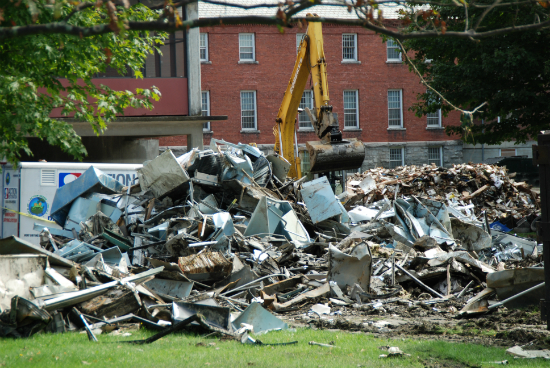
Governor Peter Shumlin and Mark Landry, Federal Coordinating Office with FEMA, today announced approval for Vermont to begin demolition of 11 state office complex buildings that were severely damaged in 2011 by Tropical Storm Irene. More approvals for demolition of up to 12 more buildings are expected in the coming weeks. This demolition work is the critical first step in a structured redevelopment of the Waterbury Complex.
‘These demolitions will facilitate one of the first construction projects at the Complex ‘the building of a new, consolidated Central Plant,’Landry said. He noted that at this point, FEMA funding has not been finalized. The State and FEMA are working together to determine the structure and amount of federal funding available. Final decisions were delayed, by mutual agreement, as both parties evaluate flexibility granted by the Sandy Recovery Improvement Act (SRIA) of 2013 that extended certain benefits to the State.
‘I am pleased that after two years of concentrated effort on the Waterbury office project, we can finally move forward with construction that will reunite nearly 1,000 employees of the Agency of Human Services in Waterbury, provide flood-resistant, modern and efficient office space, and enable the state and Waterbury community to partner in finding the best uses of these buildings moving forward,’Governor Shumlin said. He said this approval ensures Waterbury businesses that workers are returning to the downtown.
All buildings at the renovated Waterbury State Office Complex will be at least 6 inches higher than 500 year floodplain.
In addition, disaster recovery assistance in the amount of $2.5 million has been committed by the state to help reintegrate a number of the buildings back into downtown Waterbury. A new municipal office complex, a mixed-income housing development and the restoration and expansion of a much-loved child care center have all received Community Development Block Grant (CDBG) funding from the Agency of Commerce and Community Development.
‘Each of these projects addresses critical unmet needs,’said ACCD Secretary Lawrence Miller. ‘Together, they signal a commitment on the part of the state and the community to restore these historic buildings, make them safer and put them back to work for Waterbury and its residents.’
‘The State, its design teams and FEMA have gone to great lengths to preserve the historic character of the Waterbury campus,’Landry said. ‘The architectural significance of these buildings and the varied history of the complex will be documented in a new nomination to the National Register of Historic Places.’
The state of the art State Office Complex facility will be the home of the Agency of Human Services and six of its departments. It will include a new office building, renovated historic core offices, a new central plant for heating and cooling, new site infrastructure with restructured parking, and landscaping. The estimated project cost is approximately $125 million.
The project will increase efficiency by creating a more open, interactive environment to enhance team work, information sharing and information storage. The historic nature of the Complex will be preserved by a complete exterior restoration of the 13 original historic core buildings. The project will be designed to LEED standards and green building strategies where practical and cost effective. Vermont manufactured building materials will be incorporated into the design to the greatest extent possible.
The new Central Plant will include two wood fired bio-mass boilers (with oil or gas back-up boilers) for hot water heating, electric chilled water production for cooling, two electrical generators for emergency and standby power, and maintenance offices and workshops needed for the care of the facility. The updated infrastructure will allow for a significant decrease in overall energy consumption.
All of the improvements to the State Office Complex will be made in a manner to reduce flood risk. Nineteen flood prone buildings will be removed. All occupied space in the new and renovated facilities and the new central plant will be elevated or further flood proofed.
In addition to the new office building and central plant, a summary of the work includes:
Phased removal of existing buildings, structures, and connectors.
New site design for flood plain restoration, storm water management, underground utility infrastructure, pedestrian access, roads, parking lots, site lighting and landscaping.
Historic core interior and exterior restoration, dry flood proofing, and structural fill in lower levels.
Development of a program to accommodate 892 workers. This includes 450 occupants in the historic core, 426 occupants in the new building, and 16 occupants in the new Central Plant Maintenance Facility. This reflects a 10 percent personnel reduction for telecommuting, for a total population of 992.
Stabilization of the Weeks and Hanks buildings with dry flood proofing, redesign of mechanical, electrical, and plumbing systems, and limited architectural upgrades; and
Back up mechanical and electrical services for the existing Department of Public Safety building.