

Joined by state officials, substance abuse experts, medical staff and others, Governor Peter Shumlin today outlined Vermont’s progress in the battle against opiate addiction since January. The group highlighted expanded addiction treatment across the state, a new regional and national focus on the crisis promoted by Vermont’s leadership, an increased number of counties launching pre-trial risk assessment programs to move more Vermonters into treatment rather than prison, and more.
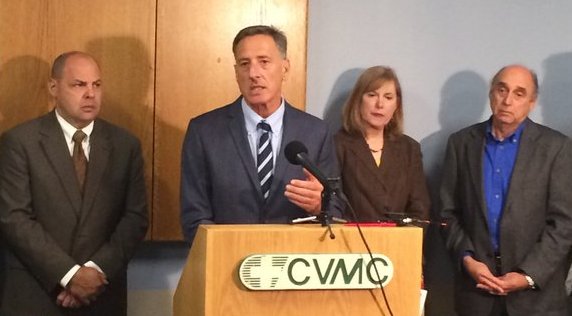 “I am proud of our state for taking on one of the most challenging problems facing Vermont and the nation, and moving quickly with compassion to do everything possible to battle opiate abuse, keep Vermonters addiction-free and healthy, and protect communities from the crime that too often accompanies drug abuse,” Shumlin said. “We spoke aloud about a taboo problem that for too long has been hidden by shame. Now the nation is having that same conversation and working to reduce the drug crisis that is hurting our friends and family members, our communities and our economies.”
Shumlin devoted his State of the State address in January exclusively to proposals to battle opiate and heroin addiction, stressing that drug addiction is a health care problem, not exclusively a law enforcement issue. Since that speech, the state has:
Significantly expanded drug treatment programs so more Vermonters have help beating addiction. Since January, the number of people in treatment has climbed from 1,704 across the state to 2,519. Among the improvements: West Ridge treatment center in Rutland has opened and is treating more than 300 patients; Brenda Gagnon, director of the BAART Central Vermont clinic serving Washington, Lamoille and Orange Counties, said the Berlin-based clinic saw patients increase from 65 daily a year ago to more than 250 currently; and in Chittenden County, the Howard Center had 932 active clients last week, up from 722 the first week in January – a 30 percent increase in men and women working actively on their recovery. The Howard Center still have an active wait list of about 290 but the combination of active and inactive people on the waitlist is 55% lower today than last January.
Brought together Governors and/or their staffs from Connecticut, Maine, Massachusetts, New Hampshire, New York, Rhode Island and Vermont to aggressively find ways of working together to break down the borders impeding treatment, law enforcement and substance abuse initiatives across the region. In addition, the White House Office of National Drug Control Policy has visited the state, and Gov. Shumlin was invited to Washington D.C. by the White House to speak about Vermont’s progress.
“By joining forces within our state, across the Northeast and at the national level, in just nine months we have seen progress in confronting the problem of opioid abuse,” said Secretary of Human Services Harry Chen, MD. “As we build and share expertise, prevention and treatment resources across borders, we believe we can accomplish much more working together than we can alone.”
Co-chairing the National Governors Association’s Drug Abuse Academy with Gov. Sandoval of Nevada. A six-state Policy Academy on Prescription Drug Abuse, the goal is to help Vermont “develop and implement a comprehensive, coordinated system for eliminating the illicit use of prescription drugs and preserving access to prescription drugs for appropriate use.” Those lessons, along with other states’ best practices, will be shared throughout the NGA.
At last week’s conference, Vermont was hailed by Gov. Sandoval, the NGA, and many addiction experts from around the country as leading the way in a new approach to this profound and truly national problem.
Expanded the use of pre-trial risk-assessment programs to more counties. Vermont is in the process of implementing Act 195, the comprehensive pretrial services bill. We have hired the first director of pretrial services, Annie Ramniceanu, the former clinical director at Spectrum Youth Services in Burlington. Soon, criminal justice professionals across Vermont will train on the risk assessment instrument to be used statewide. In addition to the pioneering pre-charge program started by Chittenden State’s Attorney TJ Donovan, Addison, Rutland, Lamoille, and Windham counties have started or are about to start their own pre-charge programs designed to bypass the court process for those people who can be safely treated in a community setting.
Hosted with the United Way of Vermont a statewide Community Forum on Opiate Addiction, bringing together experts and interested community members from across the state to share community-based solutions to tackle opiate addiction. As a result of that successful conference, the Health Department is hosting follow up local forums in 12 regions across the state – 10 have already been held, with approximately 500 people participating. The local forums are creating action agendas to ensure the information shared at the statewide Forum results in concrete efforts to reduce addiction.
Received by the Health Department an 18 month, $300,389 competitive Harold Rogers Prescription Drug Monitoring Program enhancement grant from the US Department of Justice Bureau of Justice Assistance. The grant will enable the Department to support the Vermont Prescription Drug Monitoring Program’s focus on preventing and reducing misuse and abuse of prescription drugs by, among other things, enhancing data collection and creating a comprehensive educational website.
VDH has distributed the contents for 1,175 Overdose Rescue Kits to participating pilot sites. The types of sites include syringe exchange/harm reduction programs (3), MAT treatment hubs (2), and one recovery network site for a total of 6 active pilot locations. Safe Recovery at Howard Center continues to be by far the busiest with 850 kits going to them, 500 have been distributed and 67 (as of last Friday) overdose reversals have been seen. An additional 185 kits worth of materials have been supplied to Vermont State Police to equip frontline troopers.
Created a pilot project in two Vermont prisons – Chittenden and Rutland – to allow inmates to remain on their maintenance drugs of suboxone and methadone to reduce the likelihood of re-addiction to more serious opiates, including heroin, upon their release from jail.
Supported a pilot project by Dr. William Roberts and Northwestern Medical Center in St. Albans to provide treatment for some former inmates now on probation or parole using a new drug Vivitrol – which blocks the effects of opiates for 30 days – before moving on to suboxone or other maintenance drugs.