

He’s not very big, and not very fast. ButDartmouth College footballwill have a new “player” on the sidelines this fall, and he may prove to be a big contributor to the team and to Dartmouth Athletics.As part of a new partnership betweenDartmouth-Hitchcock’s Center for Telehealth andDartmouth’s Department of Athletics and Recreation, a telemedicine robot will be on the sidelines for all five Dartmouth home football games this fall. The robot is just one of the telemedicine technologies that will be supplied by the D-H Center for Telehealth for a remote concussion assessment pilot program that kicks off at the first Big Green home football game onSeptember 20. This pilot is part of a more far-reaching Dartmouth Athletics initiative in which the D-H Center for Telehealth will provide real-time, emergency clinical support via virtual technologies to a variety of Dartmouth sports, said Drew Galbraith, senior associate athletics director for Dartmouth Peak Performance.
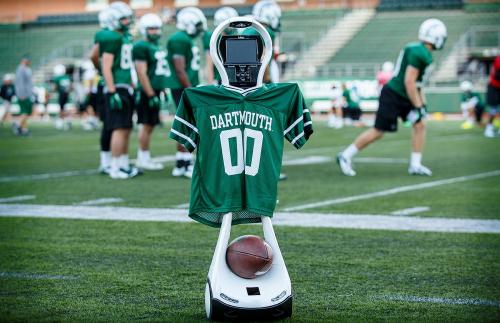 Sarah Pletcher, MD, MA, director of the D-H Center for Telehealth, said Dartmouth-Hitchcock Medical Center’s section of neurosurgery will be providing remote assessments of Dartmouth players with suspected concussions. “In addition to a telemedicine robot, we will also integrate tablet and smartphone solutions that will offer reliability and flexibility as we expand the program to other Dartmouth sports in the very near future,” said Pletcher, noting that physicians from the D-H emergency department will be participating in future clinical service offerings.
“Our goal at Dartmouth is to give our student-athletes the best medical care possible,” said Galbraith, who added that Dartmouth currently has two orthopedists, a general medicine doctor and an ambulance present at all home football games. “By partnering with the Dartmouth-Hitchcock Center for Telehealth we can tap into the latest technology and provide additional medical coverage by having a neurosurgeon on call should a player suffer a significant head injury or need a concussion screening.”
“Dartmouth College is an early adopter of this telemedicine robot technology, which was validated by the Mayo Clinic and Northern Arizona University’s football program in 2013,” said Robert J. Singer, MD, FACS, one of the DHMC neurosurgeons who will be participating in the pilot program. “Our participation in the Big Ten-Ivy League collaboration studying the effects of head injuries in sports integrates nicely into this effort.”
Galbraith said the telehealth program will extend the athletic training staff’s reach and help them provide even better medical care for Dartmouth’s 34 Division I varsity athletic teams. “Telemedicine technology will help us have greater coverage for our teams. For example, when they’re training far from campus, such as Nordic skiing, or holding a practice out of season, especially sports where there’s a risk for head injuries,” said Galbraith, who foresees potentially providing coaches with tablets equipped with telemedicine software. “Having the ability to connect to a doctor immediately presents some real opportunities for us to provide better care for our athletes in the moment.”
Dartmouth head athletic trainer Jeff Frechette said he and his staff have been discussing various uses for the telehealth technology, and “are looking forward to learning more about the capabilities. It’s exciting to think about the possibilities and how we might best incorporate this into our programs to benefit our student-athletes.”
SOURCE: DARTMOUTH-HITCHCOCK: