

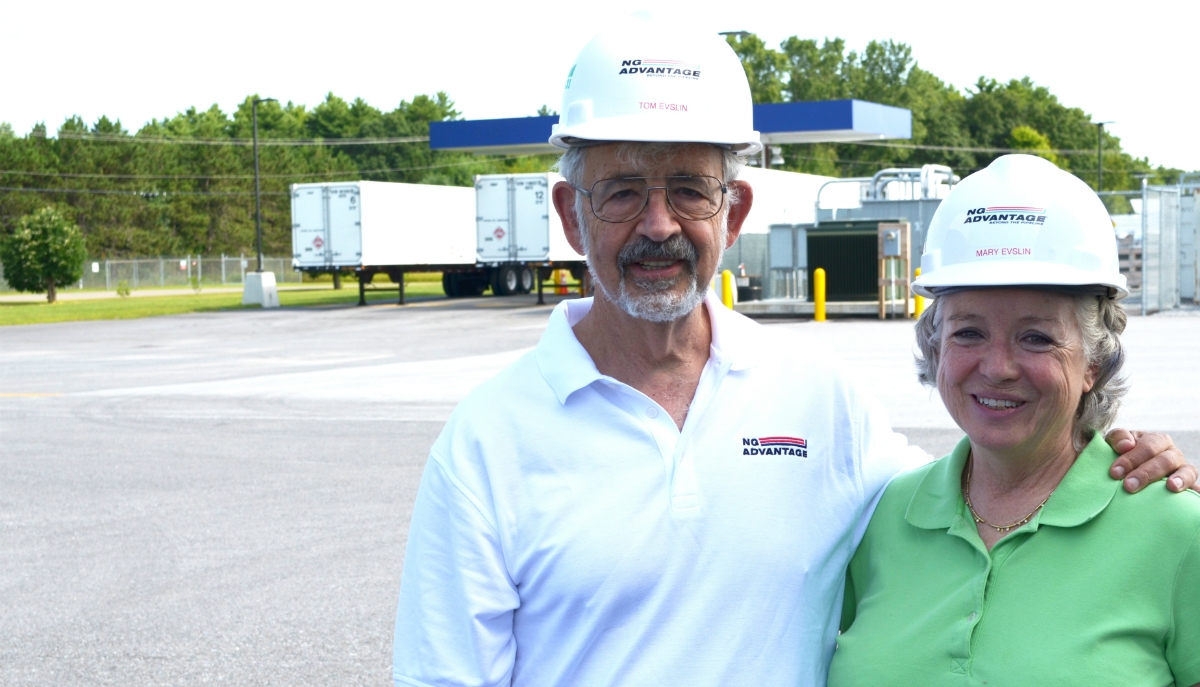
by Timothy McQuiston, Vermont Business Magazine NG Advantage CEO Tom Evslin said during a ribbon-cutting on a rainy October day in 2012 that his new company would be Vermont Gas’ largest customer by the end of 2013. NG has delivered on that promise. NG compresses natural gas at a facility at the Catamount Industrial Park in Milton and trucks it to industrial customers up to 200 miles away. A new facility in New Hampshire and another planned west of Albany will create a web of hubs to serve industrial customers in the Northeast.
NG was the first company in the nation to take advantage, literally, of the higher cost of fuel oil and propane and the abundance of natural gas in North America, said Mary Evslin, co-founder and VP of Marketing. The industrial customers that NG seeks out are typically plants, like paper mills and hospitals, which have both high energy uses and are off the natural gas pipeline.
“We’re creating a new segment of the downstream natural gas delivery network that’s never been done before and we’ve learned a lot,” Mary Evslin said.”
NG Advantage estimates that customers that use approximately $750,000 (which Evslin sees as a minimum to make the economics work; so no residential) of fuel oil, propane, or coal annually will save 20-40 percent off that bill by changing to compressed natural gas as their primary source of process and comfort heat.
A large customer may have three trailers on-site, Mary Evslin said, while a smaller user, like a hospital, may have only one, as NG uses a “just-in-time” supply method.
“Sometimes that’s tricky,” Mary Evslin said. Sophisticated and propriety technology, as well as working closely with the customer, keeps the supply and timing as tight as possible to keep efficiencies up and costs down.
CNG differs considerably from liquefied natural gas. LNG requires much colder temperatures and more expensive technology to use. LNG is typically used for power plants and extremely large industrial plants.
An LNG storage facility could cost $2 million with much more regulation, she said.
“It comes cold, it stays cold, and they then have to heat it up to use it,” Mary Evslin said. The CNG, which is chilled in the process of compressing it, is still in gaseous form, though it still needs to be warmed up some to use.
NG Advantage purchases natural gas from existing pipelines, compresses it, and loads it into special tanks mounted on traditional tractor trailer chassis that are delivered to customer sites. Customers have no need to invest in onsite storage as the gas is drawn directly from the NG Advantagetrailers. They are continuously monitored by NG Advantage in Milton and replaced before they are depleted.
The customer is responsible for the burner conversion within their facility, site work and bringing electricity, communications and a gas line from their facility wall to the off-loading station. NG builds that station outside the plant that decompresses, heats, and sends the CNG into a regulator and the new burner. Customers keep their legacy fuel as a backup. They are additionally given access to an NG Advantage on-line dashboard that allows them to monitor their usage and the off-loading process.
While NG is a leader in the field, trucking natural gas has caught on quickly and is expanding in all forms.
RELATED: Vermont Gas and NG Advantage to create first 'gas island'
Vermont Gas’ parent company, Montreal-based Gaz Metro, recently signed a deal with GDF SUEZ Gas NA, which operates a large LNG terminal in Everett, MA, to truck Canadian LNG to power plants in New England. While none of that natural gas will wind up in Vermont, the deal is expected to reduce the spike in prices caused by a shortage in natural gas in New England last winter.
Mary Evslin said that there is plenty of natural gas in North America and that to some extent it is being kept in the ground as a hedge against prices falling too much. The price spike last winter, which affected home heating prices as well as electric costs as natural gas power plants ran more during the long, cold winter, were not because of raw supply but because of transmission.
She said that while the price has gone up, the supply is still vast in North America, so prices should not fluctuate much.
“I think it should stay stable, at $4 or so (per million BTUs),” Tom Evslin said over the constant drone of the compressors as he and Mary stood on the tarmac outside their modest, pre-fab offices in Milton. They have a more traditional office in Colchester. They declined to reveal their annual revenues. But it is a capital intensive business, Tom Evslin said, and he was soon off to meet with potential private equity investors.
As of late August, NYMEX had set the price for September 2014 at $3.88 per million BTUs. Tom Evslin suggested that if the price stayed below $4, there would not be much incentive to drill more wells, even though there is abundant supply in the Marcellus shale fields in the eastern US for the foreseeable future (mostly Pennsylvania, West Virginia and Ohio). That is why, after the cold winter sent prices up, the prices came down quickly.
“We (the US) literally can be energy independent,” Mary Evslin said.
The compressed natural gas comes off the main pipeline at a kind of substation near NG’s terminal in Milton, Mary Evslin said. It is then compressed as needed to fill waiting trucks. The gas comes out of the Vermont Gas transmission line at about 500 psi and is compressed into the trucks to about 4,000 psi. At the customer end, another regulator further reduces the pressure to between 2 to 5 psi at the burner (your home pressure is only about ¼ psi).
Several trucks might be needed to supply a single facility. Evslin said all the plants they work worth have a backup system, typically an oil burner to ensure redundancy.
“Whether they sign up with us or not, they should have duel fuel, that’s an insurance policy for them,” Mary Evslin said.
“We tell them they should pick two. I think we should be one of them,” she said. The customer will have two burners under their boiler, one for natural gas and one for, say, fuel oil. There’s volatility in the marketplace, she said, and customers sign “interruptible fuel contracts” which also saves them some money.
The truck itself acts as the storage tank on the customer’s side and the gas is fed directly into the burner.
While the gas travels at 90 degrees, when the gas comes out of the NG truck and hits air it decompresses to 64 degrees Fahrenheit below zero. It’s then warmed up to go into the plant, typically to 50 degrees above zero and 50 psi, or about what they would get from a distribution gas pipeline.
“Our goal is to have their experience be pretty much like being on a pipeline,” Evslin said.
NG has 21 employees, while Massachusetts trucking firm JP Noonan has hired another 25 on its behalf.
For its new facility in New Hampshire, NG has teamed up with Clean Energy Fuels Corp, one of T Boone Pickens’ companies. Clean Energy operates natural gas filling stations for fleet trucks across the country and now in Pembroke, NH, near Concord. NG will fill its tankers with natural gas to extend its reach of servicing industrial customers east and south. Its first customer from that facility is Cheshire Medical Center/Dartmouth-Hitchcock Keene.
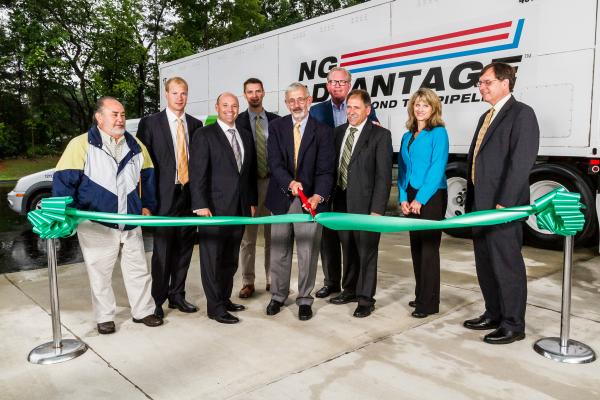 NG Advantage at the Pembroke, NH, ribbon cutting in July 2014. Courtesy photo.
Evslin said Clean Energy has talked to NG about sometime in the future putting one of its “gas stations” at the Milton site, which she said could easily be done when the time comes.
“There’s no storage here,” Evslin said. They don’t anticipate having another such terminal in Vermont. It’s pretty much a hub and a spoke. She said NG is looking at perhaps Ohio or Michigan to expand.
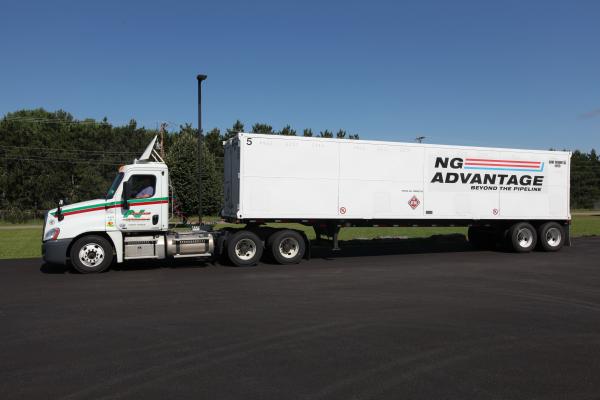 Evslin said NG’s "virtual pipeline" of high-tech carbon-fiber tanks mounted on traditional trailer chassis brings dramatic savings and substantial improvements in "carbon footprints" to customers. Natural gas lowers CO2 emissions by 26 percent with almost no particulates.
NG does not have ski resorts as customers, at least not yet, because while they use a lot of energy, frequently propane, there is not an internal pipe network between the chalets and lodges and restaurants, which might all have their own propane tank.
Some of NG’s customers include: Soundview Vermont Holdings (formerly Putney Paper) which is a recycled paper products mill; Wilk Paving, Rutland Regional Medical Center and Foley Services in the Rutland area; Northeastern Vermont Regional Hospital in St Johnsbury; APC Paper Company, Inc , Claremont, NH; .Cheshire Medical Center, Keene, NH; HP Hood plant in upstate New York; Pike Industries asphalt plants in New Haven and Waterford, VT; FiberMark in Brattleboro, VT; and Erving Paper in Erving, MA.
VERY TOP PHOTO: NG Advantage founders Tom and Mary Evslin at the filling station in Milton in August. VBM photo.