

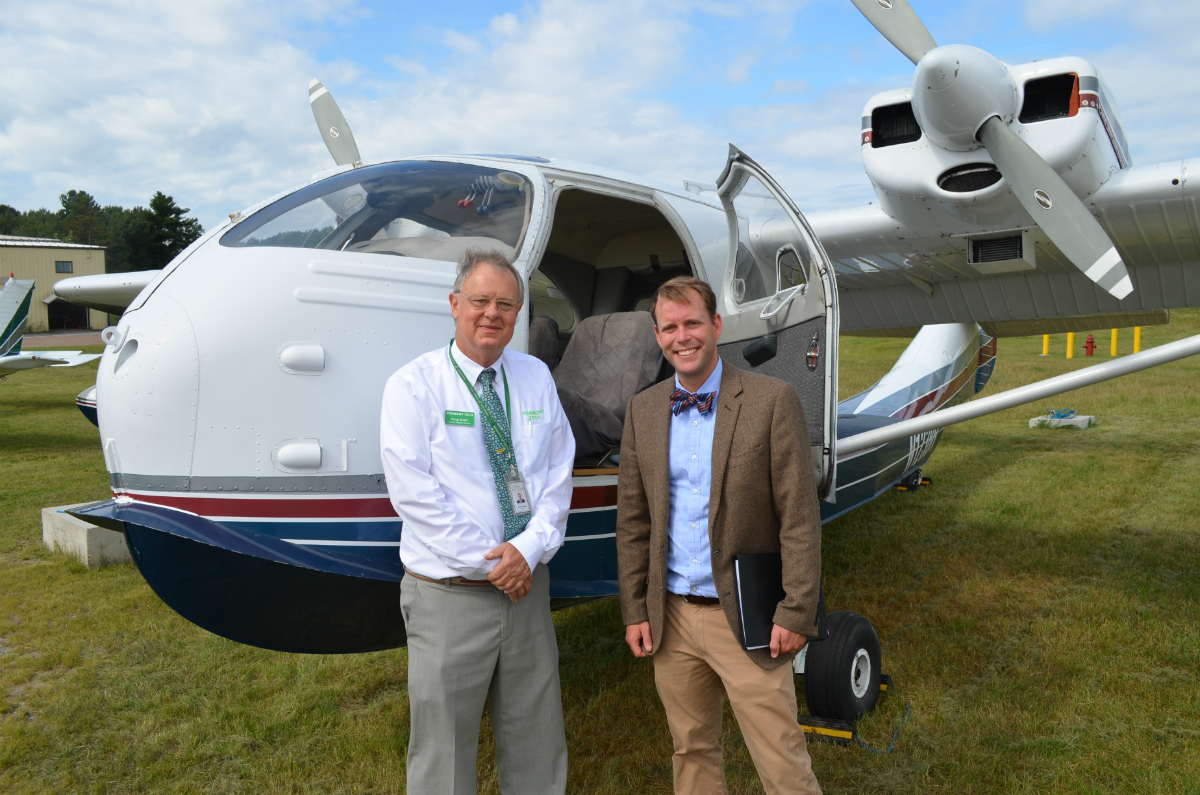
Vermont Business Magazine It took 17 and a half hours, traveling at only 100 miles an hour, with required stops every few hundred miles to refuel, but Vermont Tech got its plane. VTC's Professional Pilot Technology Program, in partnership with the Vermont Flight Academy, has received a Twin Seabee amphibious aircraft that was recently donated by a southern California couple. The donation of this aircraft has made Vermont Tech the first college in the US to offer training in multi-engine seaplanes, in addition to single-engine seaplanes. The Twin Seabee is the sixth airplane donated to the program, making up about 30 percent of the fleet. The new plane, which is an amphibiousaircraft that operates on both land and water,was unveiled at the Burlington International Airport on Wednesday.
“The Twin Seabee is a great addition to our expanding program,” said Doug Smith, program director of Aviation Technology at Vermont Tech. “Students that go through our Professional Pilot Technology Program will be the first college students in the country to have the opportunity to receive multi-engine seaplane training.”
Smith was part of a two-person crew that flew the plan from Florida to Vermont. He said Lake Champlain and other large bodies of water in Vermont will be used for the training.
He said while they are always interested in donated aircraft, this plane expands the program's offerings. Smith said the great advantage to the students is that they now will be able to get certified in multi-engine aircraft, seaplane aircraft and as a multi-engine instructor.
The plane, meanwhile, is a bit of a commercial oddity. It doesn't fly very fast or very far and has limited capacity beyond the four seats. It originally had a single "pusher" engine, but was modified in 1980 to two wing engines and the tail was extended. But for his instruction purposes, Smith said it was ideal.
VTC President Dan Smith said, "What I love about this program is how it reinforces so much of what Vermont Tech does well. We are a college where students learn by doing, whether it is flying a plane, running a dairy farm, designing efficient buildings and safe water systems, or treating patients in nursing and dental hygiene."
Vermont Tech’s Aviation curriculum exposes students to a diverse learning experience that include seaplanes, conventional landing gear aircraft (tail draggers), aerobatic flying, high performance aircraft and a full set of flight instructor credentials before graduation, Doug Smith said. The program prepares students for a wide range of careers in the aviation industry, from a flight instructor to a commercial airline pilot. Vermont Tech students that graduate through the program receive multiple Federal Aviation Administration (FAA) pilot certificates. By completing their Flight Instructor credentials during their junior year, students in the program will enjoy job placement opportunities as instructors before they graduate.
 About Vermont Tech– Vermont Tech ( www.vtc.edu) is a leading public college with a mission of applied education. One of the five Vermont State Colleges, Vermont Tech serves students from throughout Vermont, New England, and beyond at its two residential campuses in Williston and Randolph Center, regional campuses in Brattleboro and Bennington, and at six nursing campuses located throughout the state. Vermont Tech takes an optimistic, rooted and personal approach to education to support students in gaining the confidence and practical skills necessary to not only see their potential, but to experience it. Our academic programs encompass a wide range of engineering technology, agricultural, health, and business fields that are vital to producing the knowledgeable workers needed most by employers in the state and in the region.For additional information about Vermont Tech’s Aviation Program, please visitwww.vtc.edu/professional-pilot.
TOP PHOTO: Doug Smith, left, and Dan Smith in front of the Seabee, parked at Burlington International Airport.