

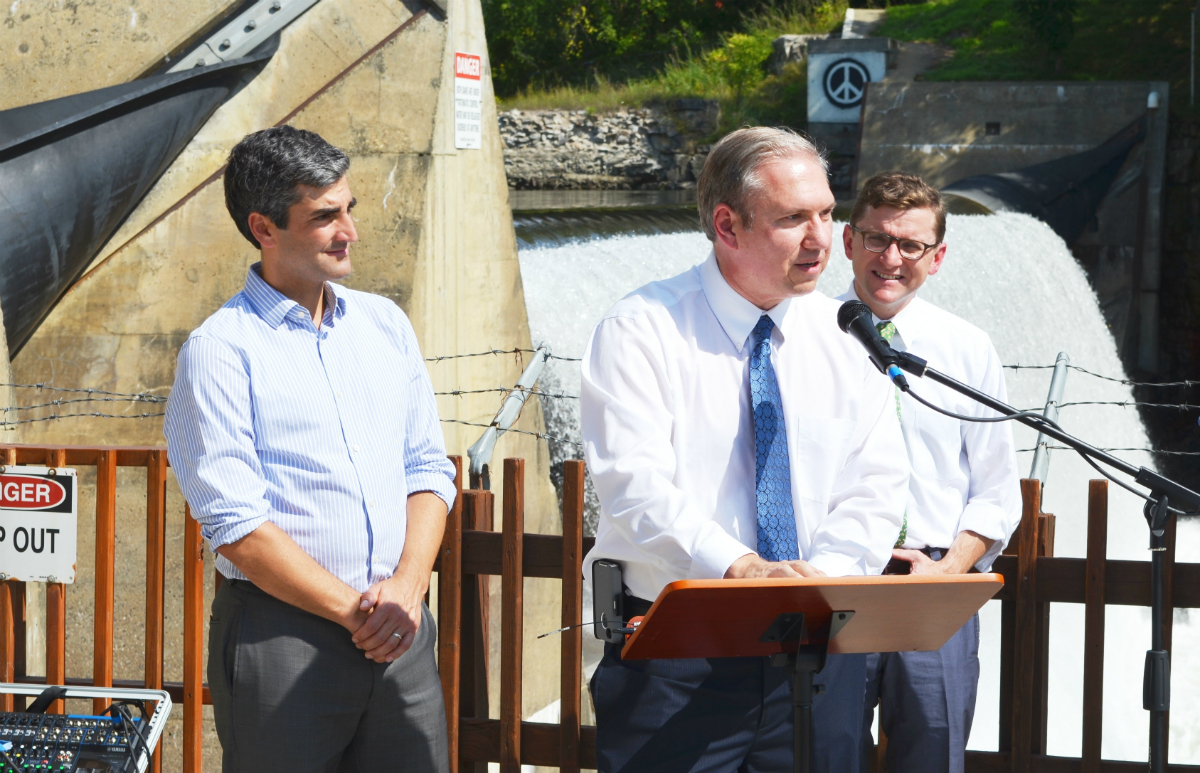
by Timothy McQuiston Vermont Business Magazine A commercial waterfall for more than two centuries and a hydro facility in its current state since 1993, the City of Burlington just paid $16 million for the three turbine, 7.4 megawatt Winooski One Hydroelectric Facility. The Winooski plant can generate 8 percent of the city's power needs, which equates to 5,200 homes. Mayor Miro Weinberger and Burlington Electric Department (BED) officials today announced the completion of the purchase of the Winooski plant, the 7.4 megawatt plant located on the Winooski River on the border with Burlington.
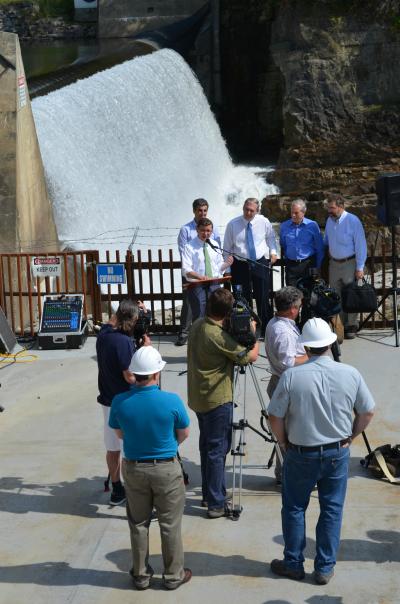
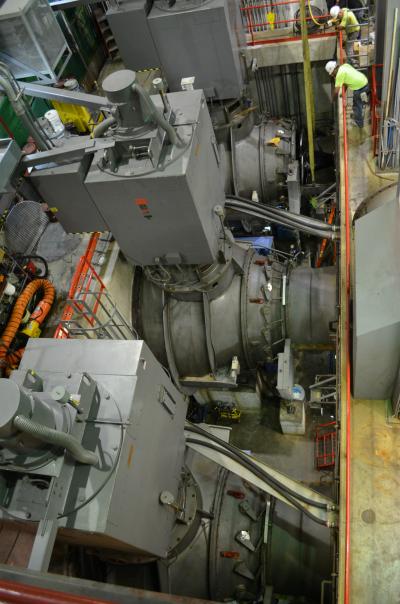 Burlington now owns or has contracts with renewable energy facilities sufficient to serve 100 percent of the city’s electricity needs. Moody’s Investors Service improved BED’s outlook from stable to positive based, in part, on the facility’s stable costs and contribution to BED’s power supply diversification. At a news conference Wednesday at the facility, John Warshow, one of Winooski One’s former owners, handed over the facility keys to Weinberger.
“For many years, the City has sought to own this renewable energy facility on the edge of Burlington, and last March nearly 80 percent of the voters endorsed that goal,” said Mayor Weinberger. “It is exciting to announce today that we have achieved this long-standing goal that helps our City make progress both on our climate action plans and our financial stability efforts. Owning and operating a hydroelectric plant that feeds directly into BED’s distribution system is an important step toward ensuring stable, low energy costs for our customers.”
The city has worked toward Winooski One ownership and authority over its renewable portfolio for many years. After filing competing applications with the federal government to build a hydroelectric generator at nearly identical locations on the Winooski River, BED and Winooski One’s previous owners entered into a contract in 1991, stipulating that Winooski One be built by private owners and BED receive an option to purchase the facility after March 31, 2013. BED then worked with the Winooski One owners to complete a fair market value purchase. The deal closed September 1.
The July 2014 Moody’s report includes the following summary explaining the outlook improvement: “The outlook change to positive from stable reflects our belief that the department will continue to reduce its exposure to the power supply market through long term contracts and diversify the power supply portfolio through the acquisition of the Winooski hydro facility. The outlook change also reflects our expectation of stable or improving debt service coverage ratios and other financial metrics.”
 “This purchase is exciting not only because it is a clean, renewable source of power, but also because it increases our energy security by protecting us from variations of the market,” said Neale Lunderville, BED Interim General Manager. “Knowing that our electric rates will be affordable for years to come because of power like this is welcome news for the business owners and residents of Burlington.”
A $12 million bond was issued on August 27, 2014. The bond had received unanimous support from the Burlington Electric Commission, a unanimous vote from the Burlington City Council, and more than 79 percent approval from the voters of Burlington this past Town Meeting Day.
 Ken Nolan, BED’s Manager of Power Resources, added, “During the time the bond is being paid off, Winooski One power will be very cost competitive with BED’s other market alternatives. After the 20-year bond is fully paid, Burlington ratepayers will continue to receive power for decades to come, and the only cost will be that of operating the plant.”
BED currently sells Renewable Energy Credits (RECs) associated with its renewable resources as a rate stabilization strategy. The entity that purchases the RECs claims the renewability from these resources. While the City transitions to renewable energy, selling RECs is one way to help keep rates stable while supporting clean, green, local power for the future.
One-third of the city's electricity is sourced from biomass and generated mostly through the 54 MW McNeil plant in Burlington, another third is sourced from wind, including from Georgia Mountain, and the other third from hydro, including from Hydro Quebec and smaller plants in Vermont. The city uses upwards of 80 MW. The McNeil plant celebrated its 30th birthday this summer with the paying off of its bonds on June 30.
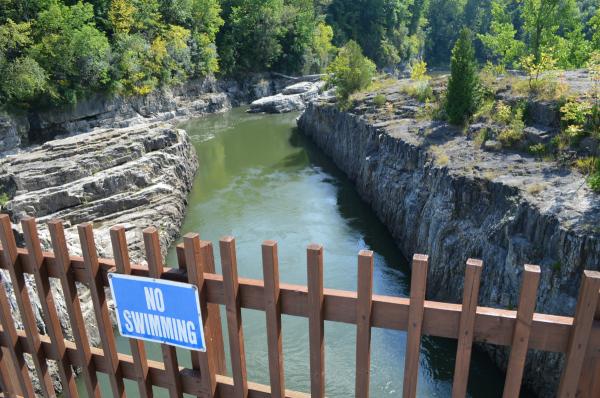
The hydro facility itself is fully automated and only an operator working 9-5 keeps an eye on things within the structure. The power plant has its own backup power, via batteries and a diesel engine. It is built to withstand being fully immersed, as would be the case if a flood on the scale of the 1927 flood were to ever strike the area again. That level of flooding would come nearly to the top of the Winooski bridge, as seen below. The "head," or elevation change between the upstream pond and downstream river which is an important factor in overall force and electric output, is 32.5 feet, according to Matt Rubin, one of the former owners.
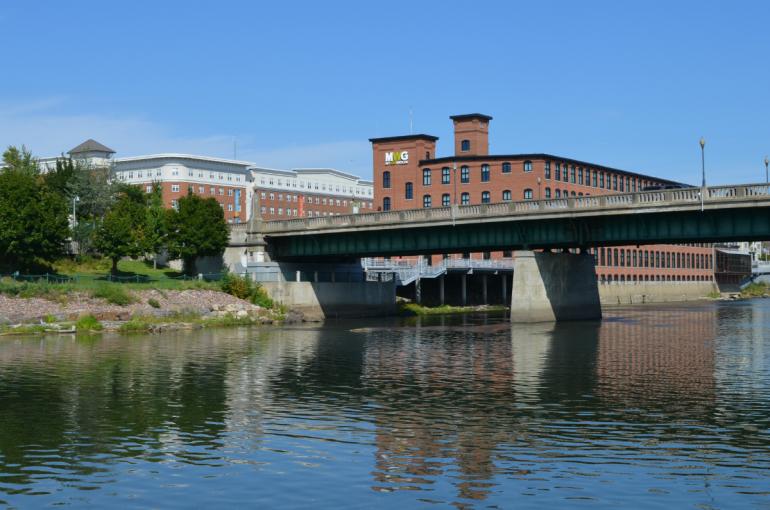 VERY TOP PHOTO: Miro Weinberger, Neale Lnderville and Ken Nolan. From top: the three turbines, one of which is being worked on by PC Construction; the downstream tailrace; press conference with Lunderville speaking; and the Winooski skyline. Photos by VBM