

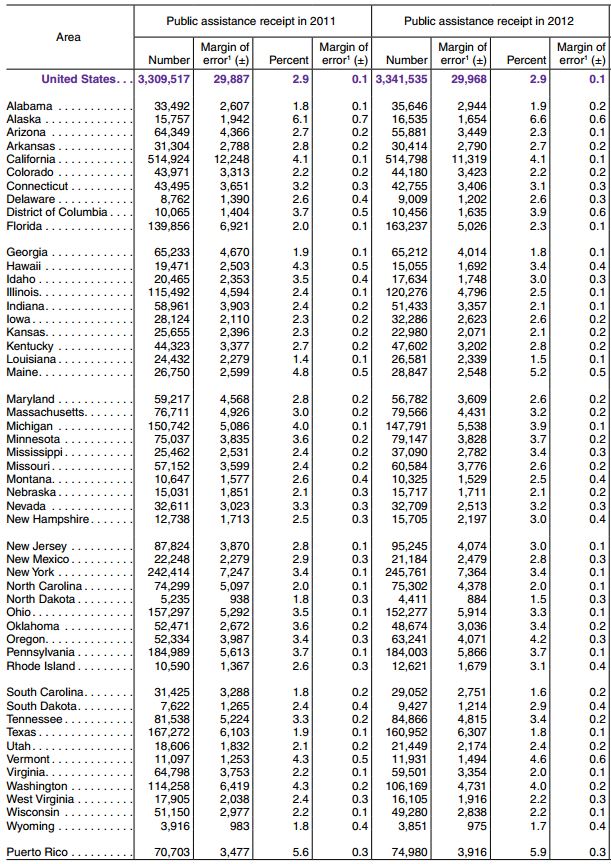
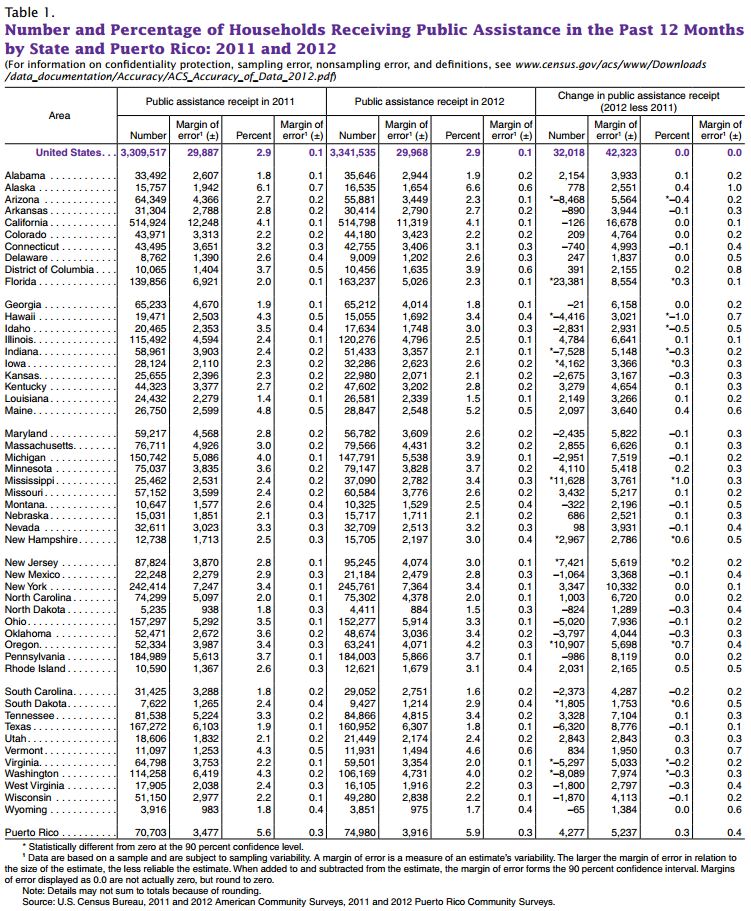
In Vermont, 4.6 percentof households,or nearly 1,500, receive public assistance. The US average is 2.9 percent. The Census Bureau has released a brief, based on data collected during the 2012 American Community Survey, on household receipt of public assistance. Statistics are provided for the nation, states and the 25 metropolitan statistical areas with the largest populations. Public assistance includes Temporary Assistance to Needy Families (TANF) and General Assistance (GA). Although similar briefs have been published for each of the last several years, this is the first that provides comparisons back to 2000 and for metro areas.
 Highlights fromPublic Assistance Receipt: 2000 to 2012include:
- There was no significant increase in 2012 in the number or percentage of U.S. households receiving public assistance benefits from the previous year. Both the 2011 and 2012 American Community Survey showed that 3.3 million households, or 2.9 percent, received public assistance at some point in the previous 12 months.
- Seven states (Florida,Iowa,Mississippi,New Hampshire,New Jersey,OregonandSouth Dakota) had increases in the number and percentage of households receiving public assistance between 2011 and 2012. Five states (Arizona,Hawaii,Indiana,VirginiaandWashington) had declines in the number and percentage of households receiving public assistance over the period.
- Eighteen states and theDistrict of Columbiahad higher public participation rates than the national average in 2012, withAlaska,California,Maine,Oregon,VermontandWashingtonhaving among the highest rates.
- According to the 2000 American Community Survey, about 2.7 million households, or 2.6 percent, received public assistance at some point in the past 12 months. In 2012, both the number and percentage were higher.
- From 2000 to 2012, 26 states experienced an increase in both the number and percentage of households receiving public assistance. Four states experienced a decrease in the number and percentage over the period.
- Among the 25 most populous metropolitan areas, there were five that had increases between 2011 and 2012 in both the number and percentage of households receiving public assistance. Two of these areas (Miami-Fort Lauderdale-Pompano BeachandTampa-St. Petersburg-Clearwater) were inFlorida.
FULL DATA TABLE
 SOURCE WASHINGTON,Sept. 2, 2014/PRNewswire-USNewswire/ --US Census Bureau