

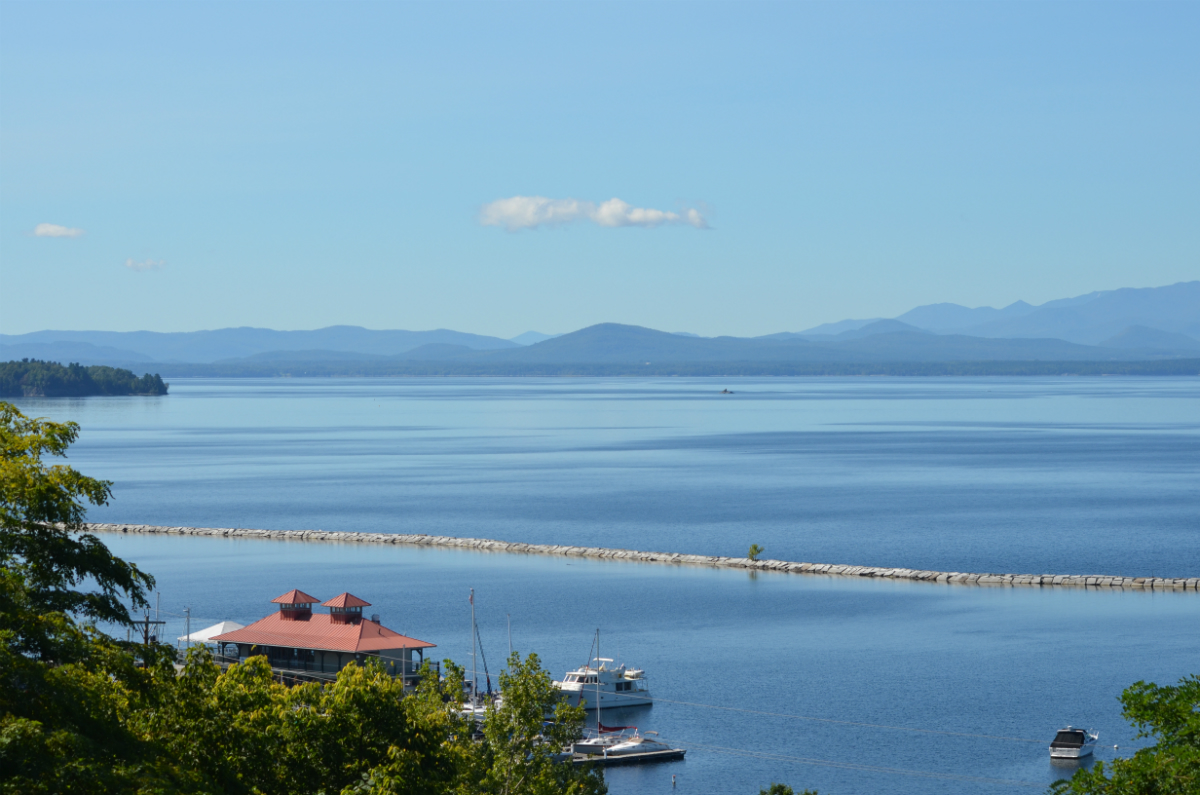
Agriculture Secretary Tom Vilsack announced today that up to $45 million will be provided to protect and improve soil and water quality in the Lake Champlain Basin in Vermont over the next five years. In recent years, Lake Champlain has been plagued by blue-green algae blooms that periodically become toxic. The algae blooms are the result of degraded water quality, primarily due to phosphorous pollution. Phosphorus can affect water quality by enabling excessive aquatic plant and algae growth, which can contribute to fish die offs and other environmental impacts.
“We are dedicated to protecting and improving this beautiful and unique natural resource,” Vilsack said. “This historic USDA investment will help improve water quality while assisting producers in establishing and expanding sound conservation practices.”
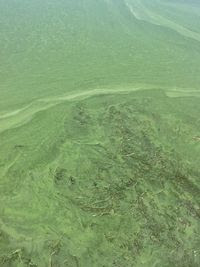 Algae bloom photo by Lake Champlain Committee monitor Philip Brett
Funding will be provided for conservation activities on and around farming operations in the Missisquoi Bay, St Albans Bay and South Lake Watersheds. Over the past ten years, USDA, through the Natural Resources Conservation Service (NRCS), provided about $46 million to help Vermont farmers address water quality issues in the Lake Champlain Basin, making this new five-year pledge almost double the historic investment in the area.
Also, in order to accelerate on-the-ground work this year, NRCS provided an additional $1 million of Environmental Quality Incentives Program (EQIP) funds to help producers plant cover crops on vulnerable soils and address conservation issues for livestock operations.
Joining Vilsack for the announcementat ECHO at the Leahy Center for Lake Champlainwas Senator Patrick Leahy (D-Vermont), Congressman Peter Welch (D-Vermont) and Vermont Secretary of Agriculture Secretary Chuck Ross. Leahy is the most senior member of the Senate Agriculture Committee and a leader in the Senate panel’s efforts to bolster land and water conservation efforts in the new Farm Bill, which was signed into law on Feb. 7.
The funds will directly support Vermont farmers’ efforts to eliminate phosphorus-laden runoff in the Lake Champlain Basin by helping with the infrastructure needed to properly store manure and for improved practices to better apply manure so that it feeds the soil and is not lost from the land and drained into Lake Champlain. Agricultural runoff is recognized as being only part of problems related to Lake Champlain’s health, contributing about 38 percent of lake’s phosphorus, basin wide. Developed lands contribute more than 45 percent and rural roads and urban streets are also major sources.
Leahy said: “I am deeply grateful to Secretary Vilsack for taking to heart what Governor Shumlin, Congressman Welch, Senator Sanders and I have been telling him about the importance of restoring the lake’s health, and then for joining us in Vermont to announce this significant commitment. We are at a moment of great need, but also a great moment of opportunity to improve Vermont’s agricultural water quality. Our farmers are ready. They are well informed and eager to participate -- so-much so that we quickly went through our original allotment of USDA funds this year, and farmers still continue to apply. EPA is moving forward with strong new phosphorus standards. Milk prices are up, giving farmers some room to take on new projects, and Vermonters strongly support a cleaner lake. Now is the time to act, and these funds will contribute greatly to helping us meet that goal.”
 Congressman Welch, Senator Leahy and Secretary Vilsack. Courtesy photo Leahy's office.
Welch said: "Thank you to Secretary Vilsack for this important support for water quality efforts in Vermont. The future of our lake will depend on effective conservation measures, which these funds will support."
In a statement, Governor Shumlin said: “Clean water quality is critical to our economy, to our health and to our communities. I am grateful that Agriculture Secretary Vilsack came to Vermont to announce a significantly increased USDA commitment to support our efforts to improve water quality. Federal resources, aimed at polluted runoff, are critical to enable Vermont to work with our farming community to implement the practices needed to help our lake recover. These resources will give us the ability to meet the challenge outlined in the TMDL compliance proposal I recently submitted to the Environmental Protection Agency. There is no doubt that we must expand the progress we are making on water quality in Vermont. I appreciate the hard work of Senator Leahy on this effort, and I look forward to continuing to work with Secretary Vilsack and EPA Administrator Gina McCarthy to address these challenges.”
In a statement, Senator Bernie Sanders (I-Vermont) said: “We know that blue-green algae blooms are more prevalent in warm, shallow waters such as Missisquoi Bay. We know that, in the last few years, warmer water temperatures associated with climate change and extensive nutrient loading from frequent storms and flooding are causing blooms to appear in a broader area of the lake. We also know that great efforts have already been made by our farmers, especially those who have joined the Farmers Watershed Alliance, working closely with the Natural Resources Conservation Service to mitigate much of the non-point source pollution which was ending up in Lake Champlain. Farmers have focused on the less costly solutions, but some big problems remain and technical assistance is needed as well. This new federal funding will go a long way in providing the major match needed to assist in the completion of the more complex water quality projects.”
“With a team of dedicated conservation experts working one-on-one with proactive landowners, we will continue to focus on the future of this vital basin,” Vilsack said.
EQIP offers technical and financial assistance to help producers identify and implement conservation practices and systems that address natural resource issues. In Vermont, the program helps off-set the costs of conservation practices critical for water quality, such as conservation tillage, fencing to exclude livestock from water bodies, riparian buffers, stream crossings, and more.
“Vermont’s farmers and landowners are committed to protecting and improving our precious water resources,” said NRCS State Conservationist Vicky Drew. “An unprecedented surge in EQIP applications in the past year speaks to producers’ strong interest as stewards of the basin.”
Additional efforts spearheaded by NRCS in Vermont include edge of field monitoring to demonstrate the effectiveness of key conservation practices, and a cooperative conservation effort with key partners to provide coordinated assistance to Lake Champlain producers.
A number of factors contribute to algae blooms. Warm water, lack of agitation, rainfall and runoff from farms, lawns, and other sources can all contribute to the problem. Members of the scientific community believe that global warming is contributing to earlier blooms, not just in waterways in the United States but elsewhere. Conservation practices such as no-till reduce the amounts of sediment and nutrients in run-off, which is also influenced by the amount of precipitation and the time precipitation occurs. The U.S. Environmental Protection Agency and the USDA are working together to assist producers in efforts to reduce runoff by planting cover crops, controlling drainage and constructing systems like anaerobic digesters to reduce the amount of untreated effluent entering ditches, streams, rivers and lakes.
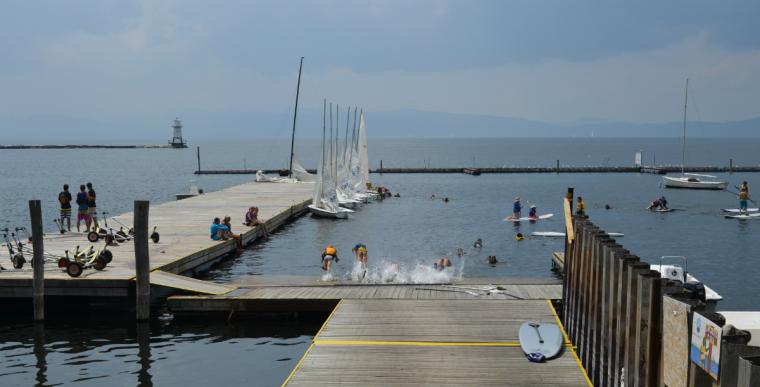 BURLINGTON, VERMONT, Aug. 28, 2014-–USDA. Top and bottom photos of the Burlington Boathouse and the Community Sailing Center boat launch by Vermont Business Magazine.