

by Anne Galloway vtdigger.org A legislative panel has come to an agreement with the Shumlin administration on $31.28 million in cuts to the state budget. Two senators voted against the proposal. Lawmakers, after initially voting against the cuts, ultimately approved a rescission that will remove a 1.6 percent increase in Medicaid reimbursements for health care providers. That move alone saves the state about $10 million. The $4.5 million Vermont Enterprise Fund, which is seen as a job-retention tool, was cut a million to $3.5 million.
Governor Peter Shumlin told reporters that revenues were up this year over last, it’s just that they’re up “less than we were hoping.”
“That’s why we had to make these tough decisions,” Shumlin said. “Let’s see where the economy goes, it’s a fragile recovery, we continue to create jobs but we’re being fiscally responsible by making these decisions and I’m grateful to the legislature for making it.”
The retraction of the 1.6 percent Medicaid increase was unfortunate, but he said his administration is “the one that finally started increasing reimbursement rates to hospitals and to our hard-working doctors and providers.”
“They’re working in a broken reimbursement system,” Shumlin said. “We’re trying to fix that. We’re proud to have raised that considerably last year. We’d like to continue to raise it in future, but obviously we can’t do it with money we don’t have. It’s the stark reality of being a governor. You can’t spend money you don’t have. I’m not willing to say to Vermont taxpayers, ‘hey, give us more.’ Vermont taxpayers are paying enough.”
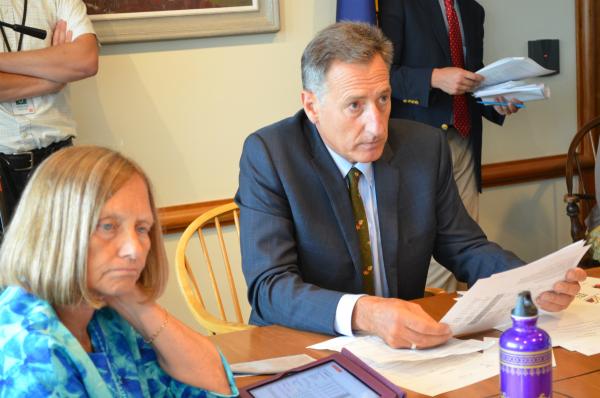 Representative Martha Heath, Chair of the Joint Fiscal Committee, and Governor Shumlin listen to economists explain the lowered tax revenue expectations for the current fiscal year at the Emergency Board meeting last month. Vermont Business Magazine photo.
The 10-member Joint Fiscal Committee initially rejected Gov. Peter Shumlin’s proposal and asked the administration to find more money for disability services and elder care. They also insisted on restoration of funding for a program that helps mentally ill young adults.
Lawmakers insisted that the funding come from the Vermont Enterprise Fund and a carry-forward in Medicaid funding. The enterprise fund was originally set at $4.5 million and was designed to provide an incentive to maintain the presence of a large employer, which was widely speculated to be IBM, in the state. Lawmakers pointed out that the money had not been disbursed, and no proposal has been filed with the state for the money.
Jim Reardon, the commissioner of the Department of Finance and Management, told lawmakers that the governor wasn’t happy about transferring money out of the fund to balance the budget, but he agreed to shift $706,000 of it to disability and elder care services. Shumlin had already tapped $250,000 of it in his rescission proposal, bringing the Vermont Enterprise Fund down to $3.5 million.
Shumlin said he didn’t want to see the enterprise fund go down, “just like I didn’t want to see anything go, but the bottom line is, it leaves us $3.5 million in fund, and we’ll use that as wisely as we can to help grow jobs that are here as well as to bring new jobs into Vermont.”
The reduction in state spending is a response to a July 24 revised economic outlook for the coming year that estimates state revenues will be down by 3 percent. While tax receipts have increased year-over-year since the Great Recession, they have grown more slowly than anticipated and have not kept up with state spending. Revenues will be $28 million less than the state’s economists predicted in January. In July, actual tax receipts were down $1.8 million.
Sen. Jane Kitchel, chair of the Senate Appropriations Committee, said the recovery is much slower than lawmakers have experienced in the past.
“It is obviously disappointing,” Kitchel said. “We built a budget with revenues at a certain level and they didn’t come in and to have to go in and align budget with spending and revenues is always difficult.”
Two members of the Joint Fiscal Committee voted against the rescission proposal: Sens. Tim Ashe, D/P-Chittenden, and Diane Snelling, R-Chittenden. Ashe said he voted no “primarily because I wasn’t ready to say yes.”
“I remain concerned about retracting that 1.6% reimbursement because I think it’s still going to be a priority when we come back in January,” Ashe said. “My feeling is, I’d rather it be a default setting going in to January. There are a few other areas that with more time we could have shaved from the budget that wouldn’t disadvantaged people, but in the time frame we had we didn’t quite get those advanced where I could make a proposal.”
Snelling objected for philosophical reasons. She wants the Legislature to use a more data-driven approach to setting budget priorities.
RELATED STORIES:
Budget cuts hit drug treatment, family services
Shumlin Administration unveils $31 million in spending adjustments
Tax revenue slump leads to lowered projections
Pelham: Chaos at the helm
Here is a rundown of the cuts:
- The state’s community designated agencies, which provide services to mentally ill and disabled Vermonters, will still see a reduction in funding of at least $5 million.
- The governor is seeking to reduce the state’s drug and alcohol program by about $673,000. Earlier this year, Shumlin made opiate addiction the centerpiece of his State of the State address and captured national media attention for his focus on getting drug addicts into treatment. The proposed cuts eliminate a financial incentive payment for substance abuse treatment providers and carry through the level funding of Medicaid reimbursements.
- The Shumlin administration also proposes to rescind a 1 percent increase to appropriations for the University of Vermont, the Vermont Student Assistance Corp. and the Vermont State Colleges.
- Working landscape grants would be reduced by about $280,000 under the plan.
- The state no longer needs to spend $500,000 on the All-Felon DNA program thanks to a recent ruling from the Vermont Supreme Court that determined that taking a DNA sample from a suspect before he or she is convicted is unconstitutional.
- The Shumlin administration will not fill vacancies in positions in state government, including a seat on the Superior Court. Seven open state trooper positions will not be filled for a savings of $500,000.
State employees are untouched by the rescissions, and, according to Reardon, were not interested in reopening their contract with the state to discuss furloughs or salary concessions. The state’s workforce took a 3 percent pay cut during the recession, and 660 positions were eliminated when the state saw revenues decline by 7 percent and 5 percent in 2008 and 2009, respectively.
Meanwhile, Vermont Republican House leader Representative Don Turner (R-Milton) issued the following statement Thursday on the budget reductions:
"This administration and the Democrat super majority have been spending at a rate greater than the growth in Vermont's revenue, relying on onetime dollars, spending state reserves and growing government at an unsustainable rate since they took office four years ago. We have opposed the budgets for the last four years for this reason and have foreseen this crisis. The data will show that had budgets been limited to grow at a 3% per year rate for the last four years as we proposed, this problem would not exist. Further, reducing spending in this manner would not have been necessary since the entire legislature would have had input versus a small committee under duress.
"The budget process is about making choices and we are very concerned by the choices being made by the administration and the Democrat super majority. They have hired over 600 new state employees in the last 4 years, negotiated a $24 million(all funds) pay raise for state employees, spent almost all of the state reserves, continued to rely on onetime funds for base programs and continue to spend millions on the failed Vermont Health Connect as well as the Governor's single payer priority. Vermonters can't afford these choices.
"While addressing the immediate crisis is a good first step, now it's time to really assess the operation of our government to ensure that we continue to use resources wisely while delivering the services that Vermonters deserve.
Vermont can not afford to continue down this path. Vermonters deserve better!"