

Vermont Business Magazine Some of the largest departments – the Agency of Human Services, Department of Children and Families, Vermont Health Access and Public Safety– took the biggest hits as the Shumlin Administration attempts to cut over $31 million in General Fund spending to realign the state budget with lagging tax revenues.
Appearing before the Legislature’s Joint Fiscal Committee today at the Vermont State House, Administration Secretary Jeb Spaulding and Finance and Management Commissioner Jim Reardon outlined $31.3 million in proposed adjustments in state spending for the current fiscal year to match projected available revenues, consistent with the updated revenue forecast adopted by the Vermont Emergency Board on July 24. The adjustments are spread broadly across state government, but they said that they preserve core state services, do not require furloughs or layoffs, and ensure Vermont will end the fiscal year with a balanced budget.
With only slight changes, the Joint Fiscal Committee subsequently approved the changes with only two nay votes.
Spaulding promised swift action by the Administration and ordered department heads to cut their budgets 4 percent by August 1 to present a revised budget to legislators by August 11.
“We have moved quickly to propose fiscally responsible adjustments to keep the state budget balanced, without raising taxes on hardworking Vermonters, and I sincerely appreciate the prompt response by legislative leaders and the Joint Fiscal Committee,” Governor Peter Shumlin said. He said the adjustments will not access the State’s Budget Stabilization Reserve, reduce debt service and retirement funds, and will maintain the full General Fund transfer to the Education Fund to protect property taxpayers.
Secretary Spaulding pointed out that while the General Fund revenue forecast was reduced from the previous projection, receipts continue to increase.
“Available General Fund revenues have increased from the bottom of the last recession by close to $300 million to the highest level in State history and are projected to increase by another $40 million this year,” he explained.
The biggest cuts (SEE CHARTS BELOW) include $847,000 from Buildings and General Services, $1.5 million from the State Police (includes not hiring seven troopers as planned), $1 million from Financial Regulation, $10 million from the Agency of Human Services Global Commitment (removes 1.6 percent Medicaid provider increase), $1.8 million from the Department of Health Access, $3.8 million from the Department for Children and Families (Reduce Child Development caseload by $1.3 million; Reduce Reach Up caseload by $2.1 million), and $680,000 from Corrections.
RELATED:
Shumlin proposes cutting current state spending nearly 2 percent
Tax revenue slump leads to lowered projections
The Administration’s proposed adjustments are spread broadly throughout state government in order to minimize the disruption to any individual program or service, with an emphasis on base spending reductions in order to adjust to the steady but slower growth projections in the budget years ahead. Adjustments to increases passed in this budget were scrutinized and targeted, so as not to require significantly deeper cuts to any particular function of state government. The size of required reductions will vary depending on the unique circumstances of specific appropriations.
For example, rather than requiring a potentially disruptive 4 percent decrease in funds for the State Colleges and UVM, the Administration proposed rolling back this fiscal year’s appropriation increase, leaving these programs level funded from the prior year.
Spaulding said, “We are very glad to have supported increases for higher education in recent years, after prior years of austerity. While it is disappointing that the reduced revenue growth requires us to scale back the higher education increase this year, we are very glad the impact will be modest.”
Similarly, after several years of increases, the proposed rescission plan includes rolling back this year’s increase in the Medicaid provider rates, leaving the rates level from last year.
“In the long term,” Governor Shumlin said, “we have to address the sustainability of our health care costs by reforming how we pay providers and putting a system in place to insulate revenues meant to pay for health care costs from the year to year vagaries of the rest of our state budget.”
The governor noted that his Administration worked hard to propose reductions that would not affect proven cost-effective solutions to poverty and homelessness, such as the Vermont Rental Subsidy and Family Supportive Housing programs, or efforts to reduce opiate addiction. Finally, he recognized the critical importance of continued focus on job creation, proposing a modest 5.5 percent decrease to the Vermont Enterprise Fund created by the Legislature this year, and holding a $500,000 VEDA entrepreneurial lending appropriation harmless from the proposed adjustments.
“The cuts proposed today won’t be without pain,” Shumlin said. “But they are the responsible way to deal with revenue growth that fell short of projections, keep Vermont’s books balanced, maintain critical services, and preserve the state’s solid bond rating.”
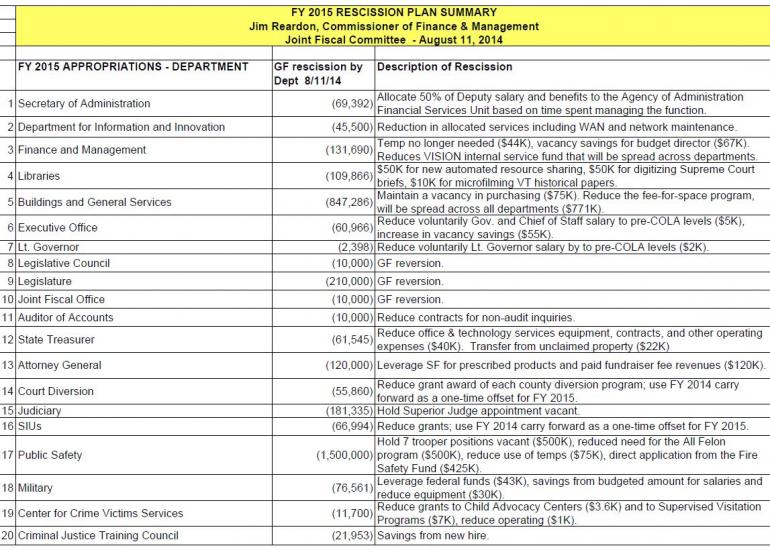
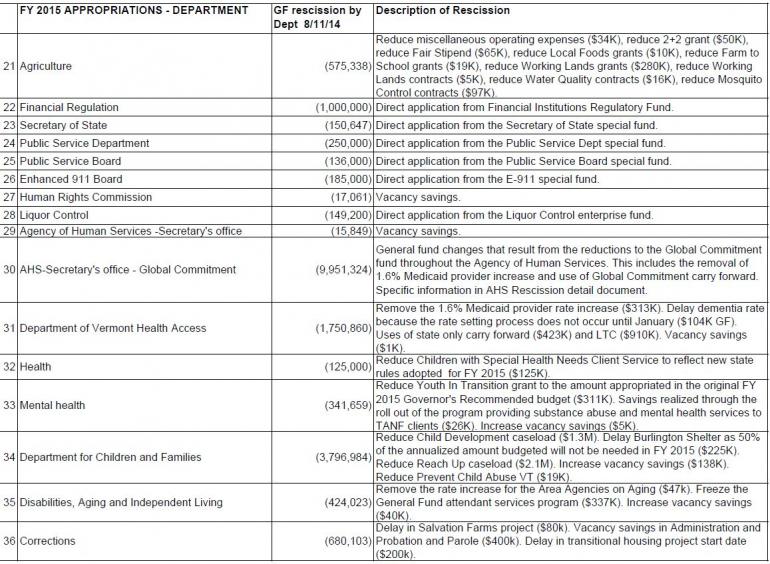
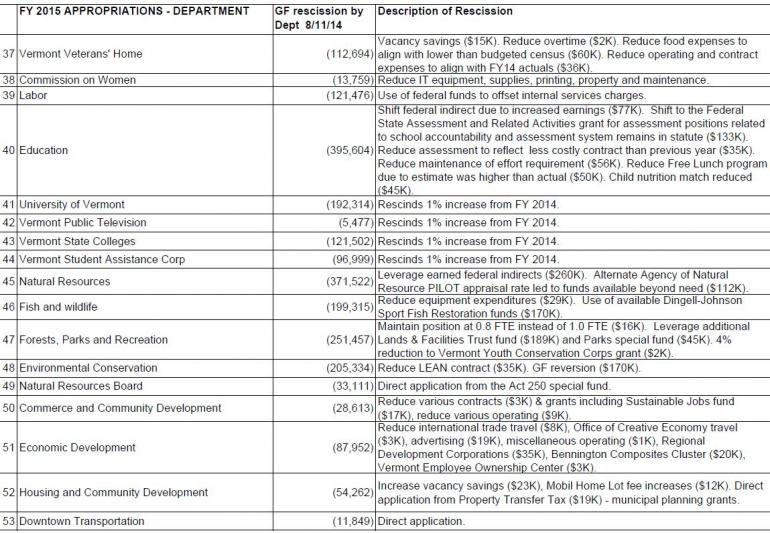
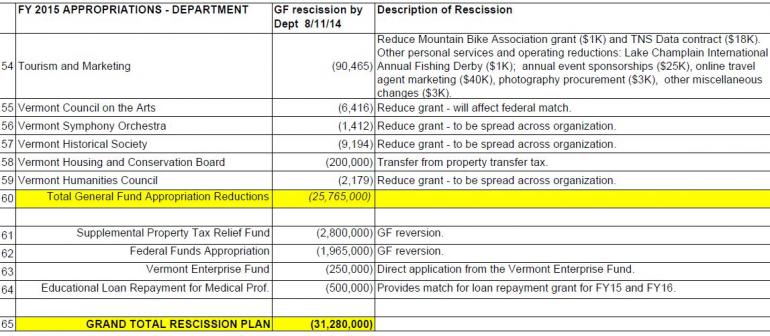
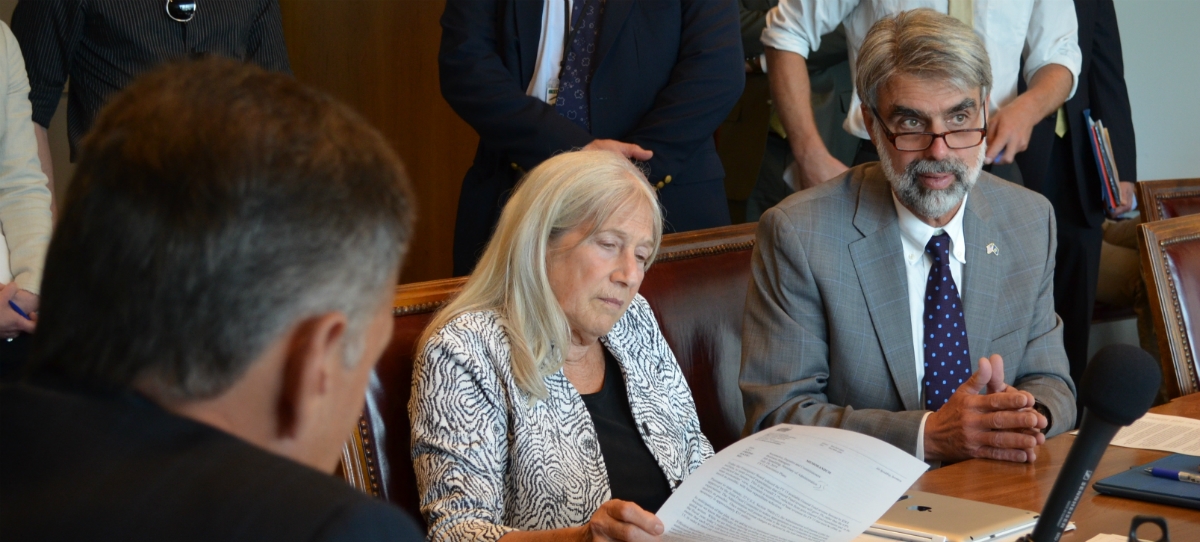
Source: Shumlin Administration. 8.11.2014. VERY TOP PHOTO: Administration Secretary Jeb Spaulding (far right) lays out his plan of action at the July 24, 2014, Emergency Board meeting, as Governor Shumlin and Representative Janet Ancel (D-Calais) listen. Photo by Vermont Business Magazine.