

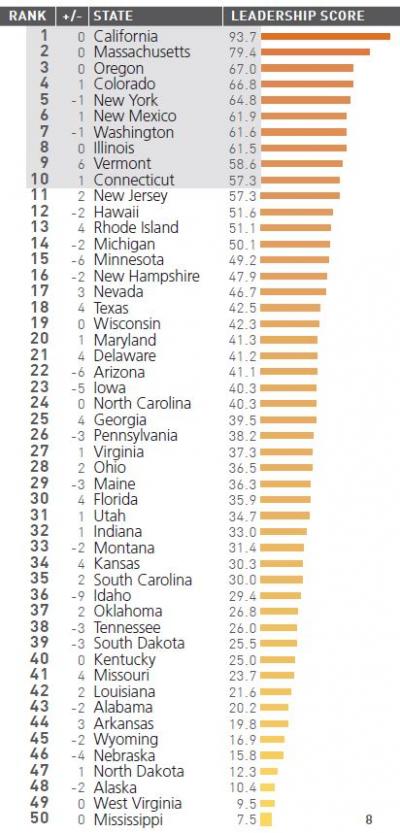
Vermont Business Magazine Vermont leaped six places from 15th in 2013, placing ninth with a score of 58.6, in a renewable energy index compiled by a national advocacy organization. With the smallest population of any state except Wyoming, Vermont gets a lot of bang for the buck in normalized scores, particularly in indicators like venture capital deals, energy efficiency program dollars, and hybrid and electric vehicles. Vermont ranks number 3 in Capital and is the highest-ranking eastern state in Technology, finishing eighth, according to the 2014 US CLEAN TECH LEADERSHIP INDEX, released by Clean Edge Inc.
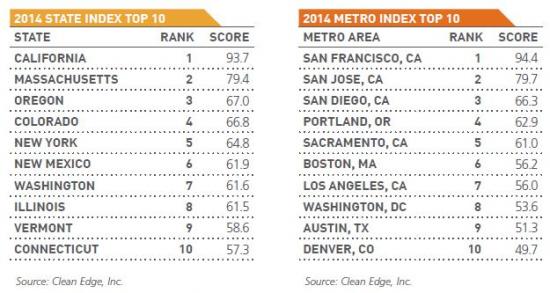
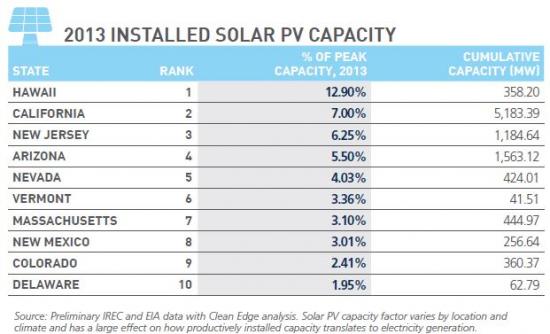
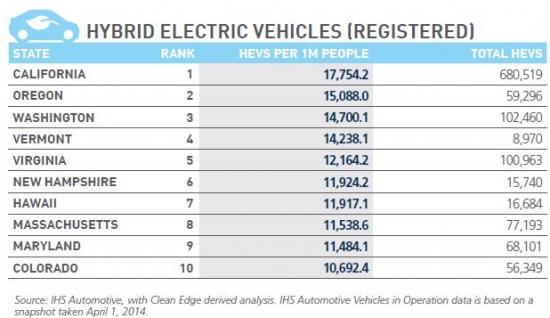
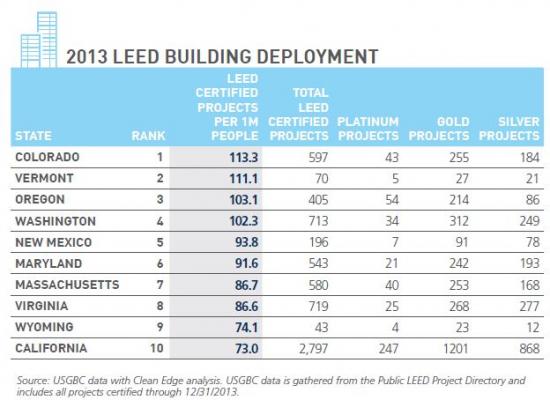 Over the past year, states and cities continued to be where most of the clean-tech action is in the United States. Supportive policies and aggressive technology deployments from Connecticut to California have made clean-energy generation, in particular residential and commercial solar PV, increasingly a popular energy choice for mainstream America, the report said. Eleven states generated more than 10 percent of their electricity from clean-energy sources (not including hydro) in 2013, with two, Iowa and South Dakota, exceeding 25 percent (mostly wind). At least eight states now have more than 50 percent smart-meter market penetration, with California topping 70 percent. Sales of all-electric vehicles, led by the Nissan LEAF and Chevy Volt, more than tripled in 2013 to nearly 50,000. And 14 states – among them Georgia, North Carolina, and Pennsylvania – are each now home to more than 500 LEED-certified green building projects.
On the Policy front, where Vermont ranked surprisingly low at 24th, the report said that leading states and metro areas continue to make clean-energy expansion a priority. Net-zero or near-zero energy mandates for buildings, green banks and other effective financing mechanisms, and the nation’s first energy-storage mandate in California are just a few policies implemented in the last 12 months that will drive the clean-tech growth tracked by this Index. But clean tech, the report said, has unquestionably turned political, with partisan attacks by certain lobbyists, legislators, and utilities in several states resulting in minor setbacks (for now) of clean tech-friendly policies like net metering and renewable portfolio standards. The report cited a law passed this year in Ohio that freezes Ohio's RPS mandate (25 percent renewables by 2025) for two years for further study as evidence of a setback for renewable energy advocates.
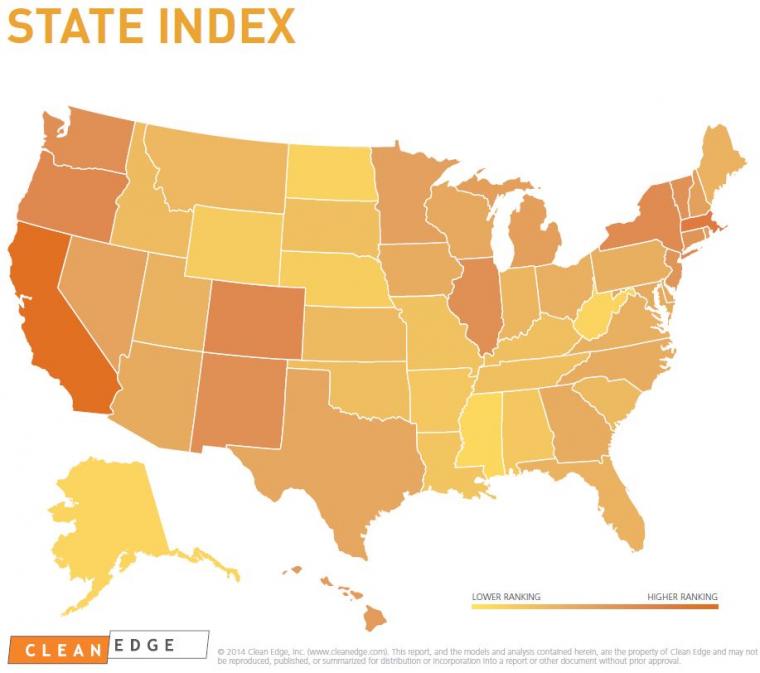
The US CLEAN TECH LEADERSHIP INDEX report contains findings from the 2014 editions of Clean Edge’s State and Metro Indexes, which track activity in the US based on a diverse set of underlying industry indicators at state and metro levels. Indicator performances are grouped into separate categories (for index weighting purposes) and ultimately used to calculate regional leadership scores. The STATE INDEX offers scores for all 50 states, derived from more than 70 state-based indicators. The METRO INDEX uses 20 metro-based indicators to calculate scores for the 50 largest U.S. metropolitan statistical areas. Organizational structures of both indexes are shown at the right, and more information can be found later in the report (State
Index methodology on page 24; Metro Index methodology on page 43).
The objective of the Leadership Index is to serve as a tool for regional comparative research, a source for aggregated industry data, and a jumping-off point for deep, data-driven analysis of the US clean-energy market. This is the fifth edition of the
State Index, the third annual Metro Index, and the second year that topline index rankings and scores have been released as a public report.
 Source: The Energy Foundation. 8.6.2014 cleanedge.com/indexes/u.s.-clean-tech-leadership-index
Founded in 1991, the Energy Foundation is a partnership of philanthropic investors
committed to building a new energy future. A thriving clean energy industry will
provide good jobs in viable industries, strengthen national security, and keep our air
and water clean and healthy – for today’s children and future generations. Working
in the U.S. and China, we seek to build markets for clean energy technologies
in the transportation, buildings, and power sectors, and to grow national and
state support for clean energy and strong climate policies. The Energy Foundation
is pragmatic and nonpartisan, dedicated to finding practical solutions that work
in the real world. Our primary role is as a grantmaker, providing resources to the
institutions that most effectively leverage change. Our offices are in San Francisco,
CA; Chicago, IL; Raleigh, N.C.; and Beijing, China. www.ef.org
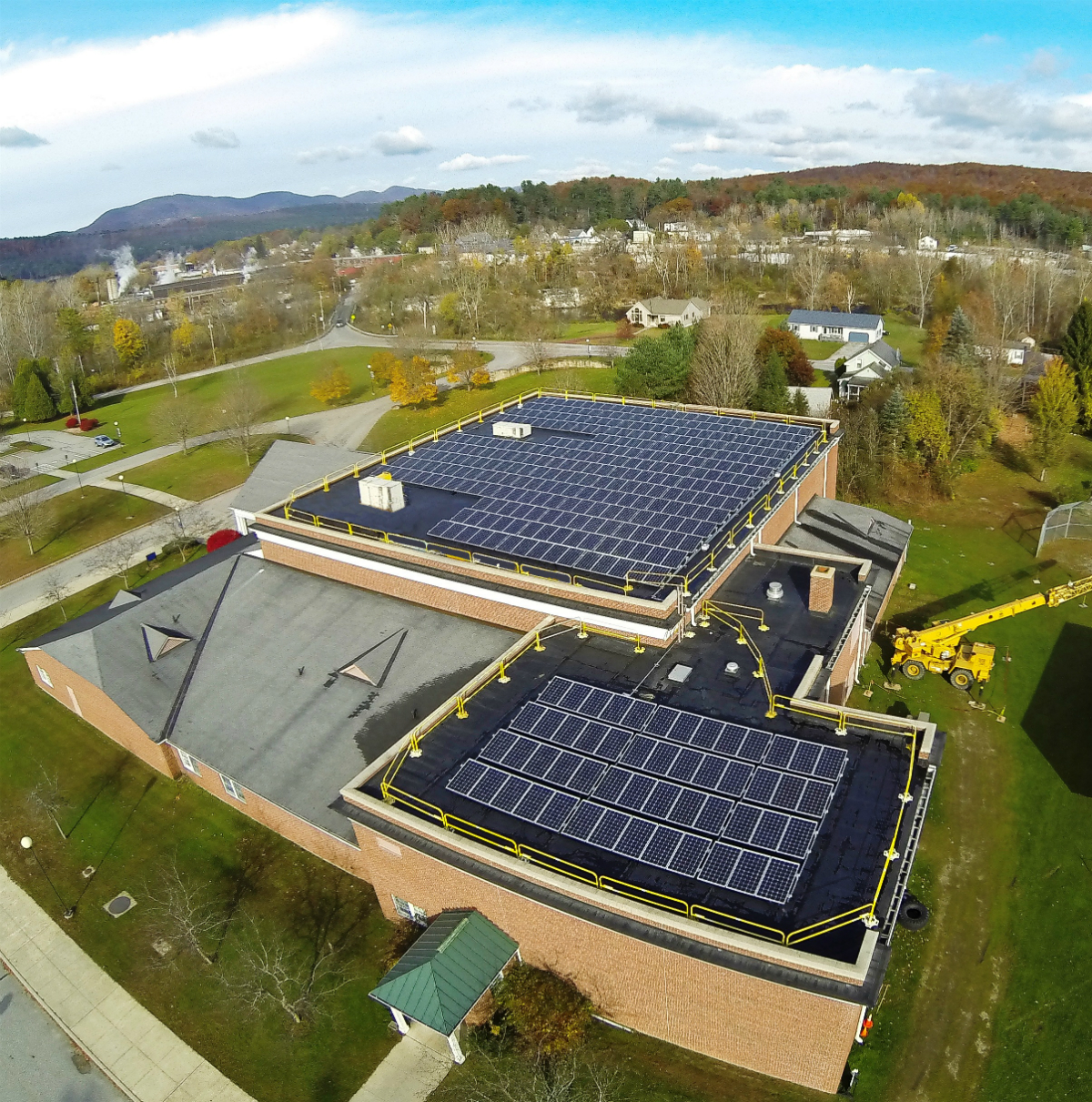
 VERY TOP PHOTO: Rooftop solar panels at the College of St Joseph in Rutland. Courtesy photo.