

by Timothy McQuiston Vermont Business Magazine Governor Peter Shumlin and Administration Secretary Jeb Spaulding said Thursday that Vermont continues to recover from the deepest recession since the Great Depression and that the current state budget will need to be cut $31 million in order make up for lagging tax revenues. In Fiscal Year 2013, Vermont’s General Fund receipts were up $91 million over the previous year. This past fiscal year saw continued growth, with receipts $46.6 million higher than 2013. Since 2011, receipts have increased by a total of $179.6 million, helping reverse the trend of declining revenue brought about by the recession. While that steady growth has helped Vermont recover, Shumlin said, the rebound has been slower than economists had projected, reflecting a trend seen in other states, and forcing Vermont to issue an adjusted forecast reducing anticipated growth from 4.8 percent to 3 percent for FY ‘15. That rate of growth still marks a $45 million revenue increase over the previous year, but it falls short of approved FY ‘15 spending. The governor also issued an immediate hold on hiring, requiring Agency of Administration approval of any hiring for currently vacant positions.
To ensure the state’s budget is balanced, the Administration will propose trimming about $31 million from Vermont’s $1.4 billion general fund budget – a reduction of approximately 2 percent. The governor stressed that state government will meet this challenge of slower growth through decreased spending because he does not support raising additional revenue through tax increases to fill the gap. In addition, he said his Administration would adjust spending expectations for the foreseeable future to match the new revenue reality, ensuring any recalibration of base revenues is offset as much as possible by expenditure reductions.
“We’ll meet the need by reducing spending, just as a family would do if they learned that a raise wasn’t going to be as high as expected,” Shumlin said. “While any reduction from the approved budget will present challenges, we are focused on delivering the best possible services to Vermonters within the means that we have. We hope to work quickly with the Legislature to make these changes in a fiscally responsible way that minimizes the disruption caused by the adjustments.”
The Administration will provide a FY 15 rescission proposal for approval to the Joint Fiscal Committee to ensure that state spending fits the new 3 percent growth forecast. Spaulding said he has given department heads only until August 1 to come up with a new spending plan, meaning that Joint Fiscal could approve it as early as August 11. He said the sooner the better since the state will already be into the second month of the fiscal year by then. FY15 began July 1.
The governor pointedly said that there would be no broad-based tax increases; no property tax increase; no cuts to public education; and no raiding of the teacher pension or "rainy day" funds. The so-called rainy day funds are reserves earmarked in the budget to cover shortfalls in the state revenue stream.
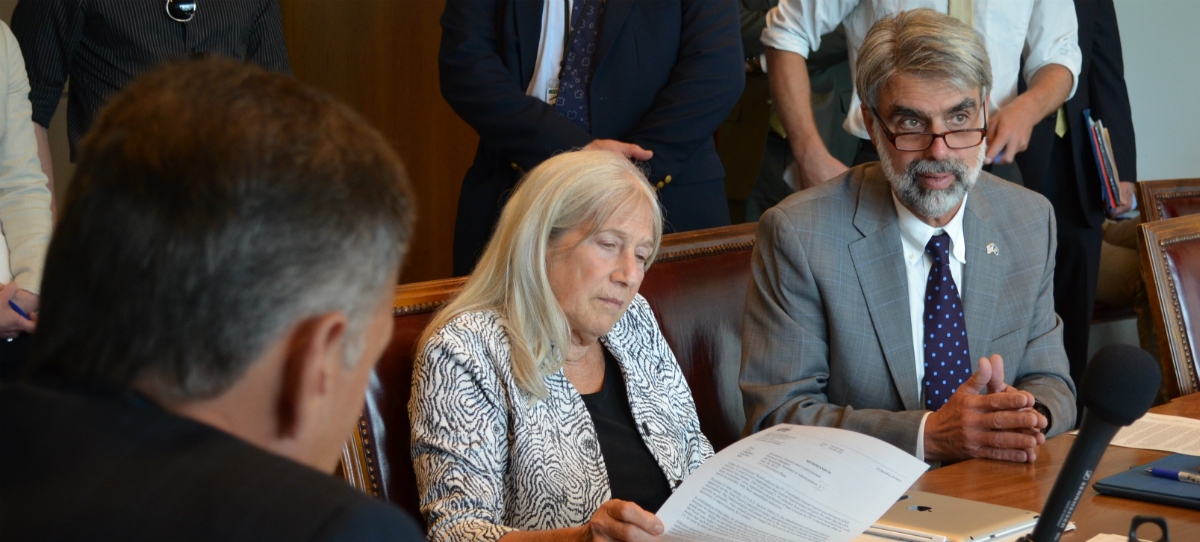
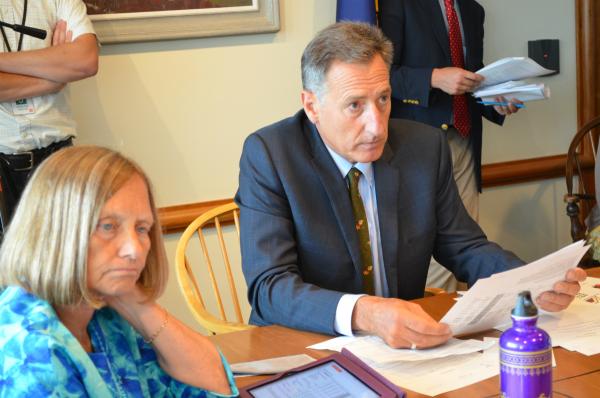 Governor Shumlin and fellow Emergency Board member Representative Martha Heath (D-Westford) listen to state economists on July 24 explain why the state is facing $28 million less in projected tax revenues for the current fiscal year. VERY TOP PHOTO: Administration Secretary Jeb Spaulding explains to the E-Board the Administration's plan of action to deal with the shortfall. Also pictured is Representative Janet Ancel (D-Calais) and to the far left, Governor Shumlin. VBM photos.
“As we tighten spending to meet the new forecast, we will do it in a way that is fiscally responsible and ensures that critical services to Vermonters are maintained,” Shumlin said. He said the state will not tap the budget stabilization fund to cover the shortfall, nor cut debt service or retirement contributions.
The Administration also will recommend keeping the General Fund transfer to the Education Fund whole, adding, “We will not support any cuts that would be made on the backs of already burdened property taxpayers.”
Spaulding added that there would not be state layoffs, but that currently unfilled positions would need his direct approval to be filled.
He laid out the plan of action that was given to department heads.
In a memo to the secretaries, deputy secretaries and commissioners, Spaulding said: "We know that difficulty in reducing spending in any given fiscal year is meaningfully eased by quick action."
"We do not believe that these spending readjustments should require a Reduction in Force or a renegotiation of the new State employee contract," Spaulding wrote.
During the Great Recession, the Douglas Administration became embroiled in bitter negotiation with the state workers' unions in an attempt to reduce state spending. Ultimately, Governor Douglas ordered some layoffs of state workers, as efforts to renegotiate the contract failed.
In an attempt to get ahead of such a conflict, Spaulding wrote: "We have invited the Vermont State Employees Association and Vermont Troopers Association to meet with an Administration team quickly to suggest and discuss mutually acceptable ideas to help reduce spending as needed, with as little disruption as possible to our employees and to the delivery of important services to Vermonters."
Along with saying that the state will "fully meet" its debt service retirement fund obligations, Spaulding reiterated comments made by the governor in saying, "The Governor also does not support adding to the already-significant property tax burden Vermonters face, and therefore we will recommend that the Joint Fiscal Committee follow state stature by fully funding the General Fund transfer to the Education Fund, as set forth in the FY15 budget. Taking these decisions into account, the overall target reduction we have set is 4%."
While putting a tight grip on new hires, Spaulding told the department heads:
- Limit discretionary spending immediately;
- Temporarily suspend all management-requested employee/position reclassification actions.
- Spending reduction targets and a timeline to meet them will be issued on Friday, July 25;
- A firm deadline of August 1 must be met;
- The cuts must be accompanied by their impact on programs
- He recommended spreading out the cuts as widely as possible to reduce the impact on any one program
Governor Shumlin acknowledged at the Emergency Board meeting July 24 that not every department, because of their different natures, will see the exact same percentage decline, some maybe be more and some may be less, but that the ultimate goal of saving $31 million in the current fiscal year must be met and must be met quickly.
CLICK HERE FOR ECONOMIC REVIEW AND TAX REVENUE FORECAST
Tax revenue slump leads to lowered projections
Spaulding said his office will work with Administration agencies and legislators to submit a plan to the Joint Fiscal Committee.
“We are taking immediate steps to meet the challenge,” Spaulding said. He and Shumlin met with Cabinet members on Wednesday to discuss the updated growth projection, and directed departments across state government to begin immediately to manage to a budget of up to 4% lower than passed for FY 15. Spaulding sent a memo to all agencies and departments outlining instructions for creating the plan for savings.
“I’ve asked them to tamp down discretionary spending and look at their programs, delivery and staffing to ensure they meet the new number,” Spaulding said.
“I am pleased that Vermont’s economy continues to grow and revenues are climbing,” Shumlin said. “I am also proud that, facing the national reality that growth is slower than projected, Vermont is immediately taking appropriate steps to control spending for this fiscal year, and ensure our budget needs match revenues in the years to come.”
Source: Governor's office. 7.24.2014