

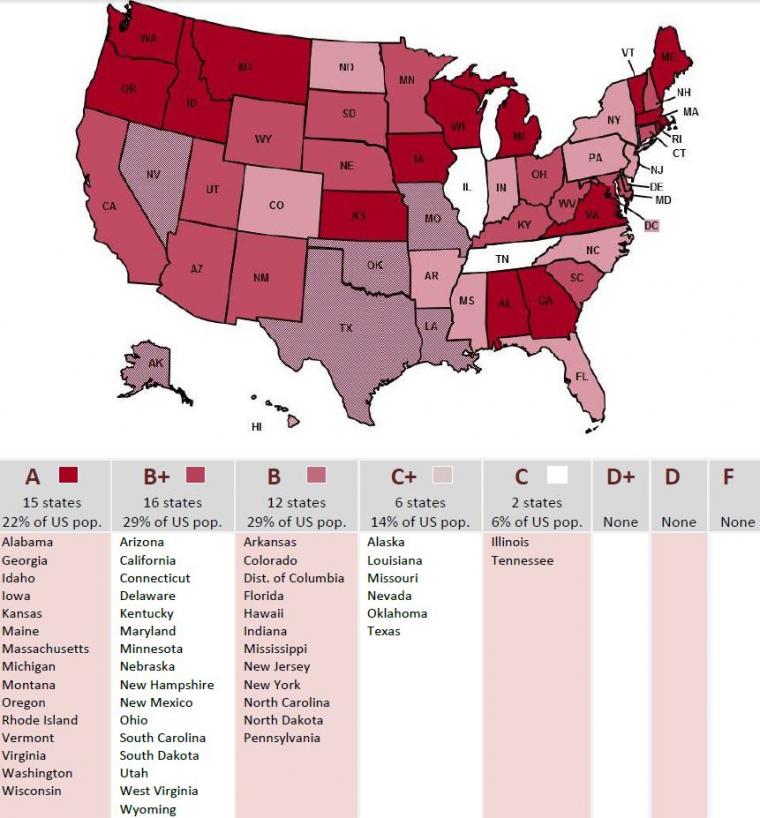
Vermont scored well in enacting balanced policies that enhance the delivery of effective pain management for patients battling a chronic disease such as cancer, according to a new report issued by leading researchers and patient advocacy groups. Nationwide, the findings showed that states have made considerable progress over the last decade in enacting policies that enhance access to pain care, including the use of pain medications, and minimizing potential treatment barriers. Based on 2013 data, the report gave Vermont a letter grade of A in measuring the quality and balance of its policies to make pain treatment available to patients. The state also received an A in 2012. Prior to that, it got B+s in 2006, 2007 and 2008, which represent the three previous reports.
The report, Achieving Balance in State Pain Policy: A Progress Report Card (CY 2013) shows the extent that state policies can support pain management and patient care. The University of Wisconsin Pain & Policy Studies Group (PPSG) prepared the report, which was jointly funded by the American Cancer Society, the American Cancer Society Cancer Action Network (ACS CAN) and the LIVESTRONG Foundation.
 “Vermont is doing well in implementing sensible policies that make the treatment of pain available to people with cancer and other life-threatening diseases. Through effective regulations we can continue to address the serious problem of untreated and poorly treated pain and, at the same time, establish a system to mitigate drug abuse,” said David Woodmansee, associate director of state and local campaigns for ACS CAN, the advocacy affiliate of the American Cancer Society. “Patients, health organizations, healthcare professionals, regulatory officials, licensing boards and policymakers all have a role to play to promote a balanced approach to pain control policy and practice.”
PPSG researchers evaluated the content of state laws and regulatory policies to determine whether they could enhance or impede pain management. The report assigns each state a grade from ‘A’ to ‘F’ that reflects the quality of its policies that can influence patient pain care. States’ current grades are then compared to their grades from the 2012 and prior years to identify changes over time. According to the findings, Vermont showed no change in effective pain policies over that time period.
Nationwide, the 2014 report found continued improvement in state policies influencing pain management over almost a decade. A total of 24 states changed or adopted new policies to improve access to pain management between 2012 and 2013. The improvement was largely a result of state health care regulatory boards adopting policies to encourage appropriate pain management and state legislatures or regulatory agencies repealing restrictive or ambiguous policy language.
“While we’re pleased with the uptick we’ve seen, we can’t rest until all 50 states have an ‘A’ grade and cancer survivors no longer have to needlessly suffer due to a lack of medication to regulate their pain,” said Doug Ulman, LIVESTRONG Foundation President and CEO. “Alongside our partners in the cancer community, we will continue to relentlessly advocate on behalf of patients and survivors to ensure that policymakers enact patient-centered solutions to cancer care.”
Pain is the most common reason Americans access the health care system, and it is the leading contributor to health care costs. Most painful conditions can be relieved with proper treatment, yet patients often face significant barriers that can prevent proper assessment, diagnosis, and treatment of pain. Untreated pain can devastate a person’s quality of life, affecting all aspects of daily functioning, including sleep, work and relationships.
While an integrative approach to patient pain care utilizing medication and non-drug therapies is encouraged, opioid medications can be a beneficial treatment for managing serious, persistent pain in carefully selected patients. But health professionals can be reluctant to prescribe such medications for numerous reasons, including concern about unwarranted sanctions for violating laws governing health care practice. Such policies can unduly restrict healthcare decision making, contradict current medical knowledge, establish, ambiguous practice standards, and fail to communicate appropriate messages about pain management.
The complete report, Achieving Balance in State Pain Policy: A Progress Report Card (CY 2013) is available on ACS CAN’s website: www.acscan.org
About the American Cancer Society
The American Cancer Society is dedicated to eliminating cancer as a major health problem by saving lives, diminishing suffering and preventing cancer through research, education, advocacy and service. Founded in 1913 and with national headquarters in Atlanta, Georgia, the Society has 13 regional Divisions and local offices in 3,400 communities, involving millions of volunteers across America. For more information anytime, call toll free 1-800-ACS-2345 or visit www.cancer.org.
About the American Cancer Society Cancer Action Network
ACS CAN, the nonprofit, nonpartisan advocacy affiliate of the American Cancer Society, supports evidence-based policy and legislative solutions designed to eliminate cancer as a major health problem. ACS CAN works to encourage elected officials and candidates to make cancer a top national priority. ACS CAN gives ordinary people extraordinary power to fight cancer with the training and tools they need to make their voices heard. For more information, visit www.acscan.org.
About the LIVESTRONG Foundation
The LIVESTRONG Foundation fights to improve the lives of people affected by cancer now. Created in 1997, the Foundation is known for providing free cancer support services and advocating for policies that improve access to care and quality of life. Known for its powerful brand – LIVESTRONG – the Foundation has become a symbol of hope and inspiration around the world. Since its inception, the Foundation has served 2.5 million people affected by the disease and raised more than $500 million to support cancer survivors. One of America's top non-profit organizations, the Foundation has been recognized by industry leaders including Charity Navigator, the National Health Council and the Better Business Bureau for its excellent governance, high standards and transparency. For more information, visit www.livestrong.org
About the Pain & Policy Studies Group
The Pain & Policy Studies Group (PPSG) is a global research program at the University of Wisconsin Carbone Cancer Center within their School of Medicine and Public Health. The PPSG mission is to improve global pain relief by achieving balanced access to pain medications in an effort to enhance the quality of life of people living with cancer and other painful diseases. The PPSG’s work, guided by a public health approach, aims to address governmental and regulatory environments governing professional healthcare practice relating to pain management and palliative care. Such efforts are achieved through effective public policy, communications, and outreach efforts. Since its creation in 1996, the PPSG has been the home of a World Health Organization (WHO) Collaborating Center. For more information, visit www.painpolicy.wisc.edu
Source: [Williston, VT] – July 22, 2014 – American Cancer Society