

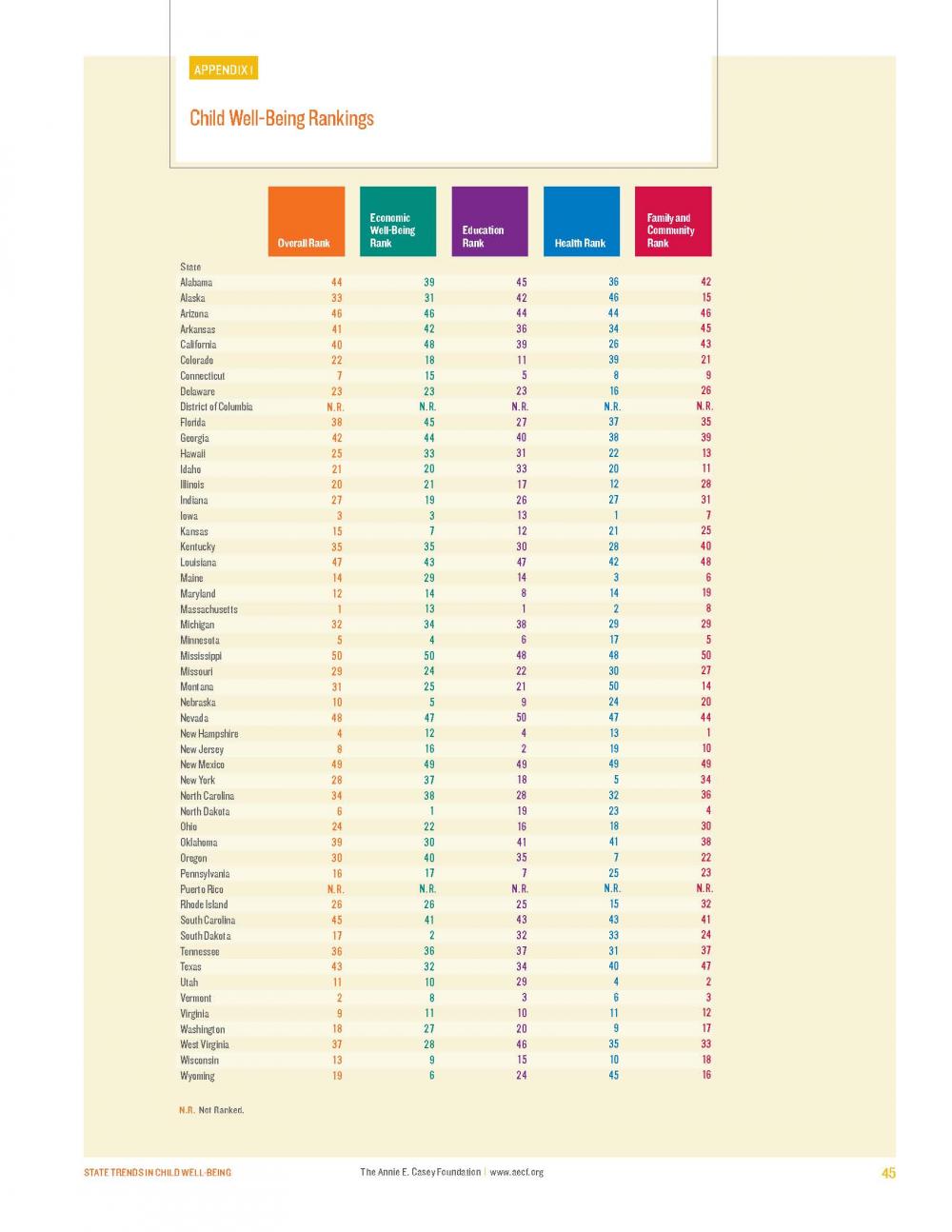
Vermont Business Magazine Demographic, social and economic changes combined with major policy developments have affected the lives of lower-income children in both positive and negative ways since 1990, according to the Annie E Casey Foundation’s 25th edition of its annualKIDS COUNT Data Book. For 2014, the three highest-ranked states for child well-being were Massachusetts, Vermont and Iowa; the three lowest-ranked were Nevada, New Mexico and Mississippi. The report also provides national trends, comparing the latestdata with mid-decade statistics.The good news, according to the report, is that there has been steady improvement in the numbers of children attending preschool and a decline in the number of schoolchildren not proficient in reading and math.TheKIDS COUNT Data Bookis an annual publication that assesses child well-being nationally and across the 50 states, as well as the District of Columbia and Puerto Rico. Using an index of 16 indicators, the 2014 report ranks states on overall child well-being and in four domains: (1) economic well-being, (2) education, (3) health, and (4) family and community.
In the individual categories, Vermont ranked 8th in economic well-being, 3rd in education, 6th in health and 3rd in family and community. Vermont also was 2nd in 2013, with New Hampshire 1st and Massachusetts 3rd. New Hampshire is 4th in 2014. (SEE TABLE BELOW)
The 2014Data Bookis the 25th edition of the Casey Foundation's signature publication. As such, the report also examines trends in child well-being since 1990, the year of the firstreport. It highlights positive policies and practices that have improved child health and development and features stories from several states on advocacy efforts that have improved outcomes for kids and families.
Along with the gains in preschool attendance and math and reading proficiency, there also is a positive trend in parental education that benefits kids: A smaller percentage of children live in families in which no parent has a high school diploma — from 22% in 1990 to 15% in 2012. In addition, the teen birth rate is at a historic low and the death rates for children and teens has fallen as a result of medical advances and increased usage of seat belts, car seats and bike helmets.
 Worrisome trends include a rise in the official child poverty rate as defined by the federal government. Although the rate dropped from 18 to 16% from 1990 to 2000, the rate had reached 22% by 2010 and has remained at roughly that level. In 2012, nearly 16.4 million kids were living in poverty. The percentage of children living in single-parent families has risen significantly — in 1990, 25% of children lived in a single-parent household and by 2012 the figure had risen to 35%. Since 1990, the rate of children growing up in poor communities has also increased, with 13% of children living in a neighborhood where the poverty rate is 30% or more.
“With advances in neuroscience, as well as solid research on what works, we now know more than ever before about how to give children a good start and help them meet major developmental milestones throughout childhood,” saidPatrick McCarthy, the Foundation’s president and CEO. “On several fronts, we’ve seen the difference that smart policies, effective programs and high quality practice can make in improving child well-being and long term outcomes. We should all be encouraged by the improvements in many well-being indicators in the health, education and safety areas.”
“But we must do much more,” McCarthy said. “All of us, in every sector — business, government, nonprofits, faith-based groups, families — need to continue to work together to ensure that all children have the chance to succeed. We should strengthen our commitment and redouble our efforts until every child in America develops to full potential. We simply cannot afford to endanger the futures of the millions of low-income children who don’t have the chance to experience high-quality early childhood programs and the thriving neighborhoods that higher-income families take for granted.”
To examine the more recent trends between 2005 and 2012,the newData Bookuses 16 indicatorsacross four areas – economic well-being, education, health and family and community.
- Children continue to progress in the areas of education and health. All four education indicators covering milestones such as preschool attendance and high school graduation showed steady improvements. Child health also improved across all four indicators, and more children have access to health insurance coverage than before the recession. There were also drops in child and teen mortality and teen substance abuse. The percentage of low-birthweight babies declined slightly.
- Economic progress still lags, even after the end of the recession. Three of the four economic well-being indicators were worse than the mid-decade years, which is not surprising given the severity of the economic crisis over the past six years. However, the majority of the indicators in this area improved slightly at the national level since the2013 Data Book, indicating modest but hopeful signs of recovery.
- Mixed picture on family and community indicators. The teen birth rate is at a historic low. There was a small drop in the percentage of children living in families where the household head lacks a high school diploma. However, there was an increase in the percentage of children living in single-parent families and more children living in high-poverty areas.
At the state level, Massachusetts, Vermont, Iowa, New Hampshire and Minnesota rank highest for overall child well-being, while Arizona, Louisiana, Nevada, New Mexico and Mississippi rank lowest. Three southwestern states — Arizona, Nevada and New Mexico — are once again in the bottom five for the overall rankings. Other state highlights:
- While three New England states rank within the top five for overall well-being among the 50 states, the top five states in the area of economic well-being are in the heartland and Plain States regions — North Dakota, South Dakota, Iowa, Minnesota and Nebraska.
- The biggest improvements in overall rankings compared to last year’sData Bookare seen in Iowa, Utah, Illinois, Indiana and Tennessee. The biggest drops in overall rankings are seen in Wyoming, New Hampshire (moving from #1 to #4), New Jersey, Montana and Oklahoma.
- Forty-nine states and the District of Columbia saw improvements since 2005 in math proficiency, but a considerable gap lies between Massachusetts with only 45% of its eighth-graders not proficient in the subject, and Alabama with 80%.
“The Foundation’spartnership with state and national advocatesfor children has thrived since our firstData Bookand has brought steady attention to how kids are faring, saidLaura Speer, Casey’s associate director for policy reform and advocacy. “TheData Bookhighlights the achievements of advocates across the country that have been critical in advancing increased investment in effective programs and services to help ensure that kids get the best possible start in life.”
The2014KIDS COUNT Data Bookfeatures the latest data on child well-being for every state, the District of Columbia and the nation. This information is available on theKIDS COUNT Data Center, which also contains the most recent national, state and local data on hundreds of measures of child well-being. Data Center users can create rankings, maps and graphs for use in publications and on websites, and view real-time information on mobile devices.