

by Hilary Niles vtdigger.org State government spent more than $16.7 million on temporary employees in fiscal year 2013. The Vermont State Employees Association says too much state money is used to support long-term temporary positions.
VSEA, the state employees’ union, has made the issue of temporary employees a priority this year, and has launched an “invisible workforce” advertising campaign to draw the public’s attention to the issue.
The Shumlin administration and the VSEA have negotiated a lower number of hours per year that an employee can work as a “temp” before the position is converted to permanent status. Now the VSEA wants to obtain earned sick leave benefits for temporary employees.
Temps typically do not receive fringe benefits such as health insurance or pension contributions. Ineligible for VSEA membership, temps work for wages that are not negotiated by the union through collective bargaining.
S.218 would limit the number of hours in a year someone could work as a “temporary” employee.
Human Resources Commissioner Kate Duffy told a legislative panel recently that she has “areas of concern” regarding the state’s over-reliance on temporary workers.
“The Shumlin administration has been increasing the number of positions to address that. But it’s a slow process,” Duffy said.
The number of temporary workers employed by the state came down 5 percent in FY13 compared with the year before, according to the Department of Human Resources annual workforce report on the executive branch. The aggregate hours worked by temps and their cumulative pay was also lowered, by 6.3 percent and 3.2 percent, respectively.
The number of temporary employees jumped 10.5 percent in FY11 and 8.8 percent in FY12.
A VTDigger analysis of state employee compensation data shows that temp workers have hovered around 3.5 percent of the state’s total human resources payout in fiscal years 2009 through 2013.
VSEA wants to lower the threshold for hours worked in a permanent position. Right now, work that averages less than 20 hours per week is considered temporary, as long as it doesn’t exceed 1,520 hours in a year.
Duffy has the authority to create and fill temporary positions, and even raise the cap on hours for specific cases.
“I believe there is an appropriate use of temporary positions,” Duffy testified to the House Committee on Government Operations.
She said she holds positions with temporary workers when a permanent employee is off-duty for an extended period — for example due to workers’ compensation or family medical leave.
Duffy and the VSEA have compromised on an annual cap of 1,280 hours before a position would be converted to permanent. The commissioner would retain the discretion to grant waivers when that hour limit is exceeded.
The VSEA originally proposed lowering the cap by a third, to 1,040 hours per year.
The parties also have agreed to study the Department of Corrections’ dependance on temporary employees.
House Government Operations Committee Chair Rep. Donna Sweaney, D-Windsor, said Tuesday her committee would pick up the option of earned, paid sick leave for temps on Thursday, when they take up the bill for discussion and a possible vote.
The committee also may vote Thursday on a proposal to remove the early retirement penalty for emergency response dispatchers. Sweaney said she is more inclined to vote on S.225 as it passed the Senate.
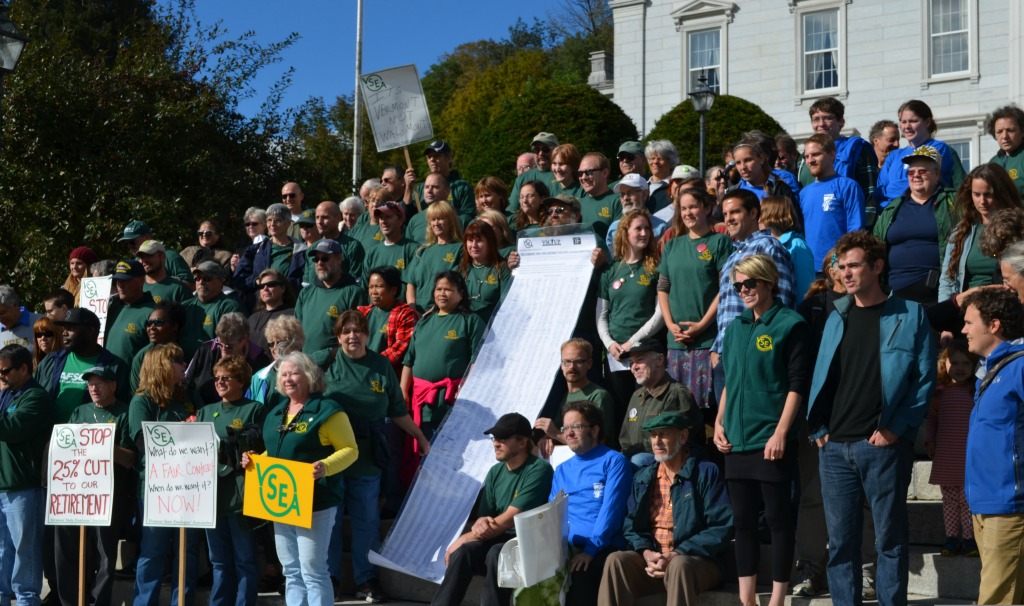
Photo: A Vermont State Employees Association rally in September 2013. Photo by Alicia Freese/VTDigger