


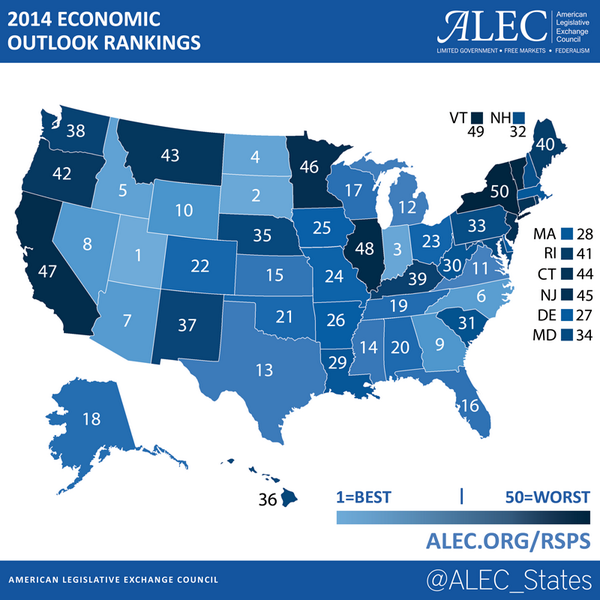
Utah again earns the top spot for states with the best economic outlook in 2014, followed by South Dakota, Indiana, North Dakota and Idaho, according to the newest edition of the Rich States, Poor States report released by the American Legislative Exchange Council. The report also reveals that big reforms significantly helped Indiana, Michigan and North Carolina improve their national rankings this year. Illinois, Vermont and New York ranked last. Vermont ranked 50th in 2013.
“The big story in our report this year is that fundamental tax and fiscal policy reforms significantly improved the economic competitiveness rankings of North Carolina, Indiana, and Michigan. These states are now better poised to realize real economic growth,” said Jonathan Williams, director of the American Legislative Exchange Council Center for State Fiscal Reform and co-author of Rich States, Poor States: ALEC-Laffer State Economic State Competitiveness Index.
Rich States, Poor States examines the latest trends in state economic growth. The data ranks the 2014 economic outlook of states using 15 equally weighted policy variables, including various tax rates, regulatory burdens and labor policies. The seventh edition examines the trends over the last few decades that have helped or hurt states’ rankings, and states with low tax rates and right-to-work laws are more likely to have a better economic outlook.
The 15 economic policy variables used by the authors to rank the economic outlook of states have shown over time to be among the most influential variables for state growth. The top ten and bottom ten states for 2014 are:
Top 10 (states link to individual state data. SEE FULL RANKING BELOW.)
1. Utah
2. South Dakota
3. Indiana
4. North Dakota
5. Idaho
7. Arizona
8. Nevada
9. Georgia
10. Wyoming
Bottom 10
41. Rhode Island
42. Oregon
43. Montana
44. Connecticut
45. New Jersey
46. Minnesota
47. California
48. Illinois
49. Vermont
50. New York
“The report shows that states are taking responsibility for their own economic success and not waiting for direction from the federal government,” said report co-author and Heritage Foundation Chief Economist Stephen Moore. “The short story is, the states are leading the way in pro-growth, economic reforms.”
“Rich States, Poor States clearly outlines the benefits that lower taxes, sound labor policies and spending restraints can have on the economic environments in the states,” said report co-author and economist Dr Arthur B Laffer. “It is a valuable resource for those who seek to promote economic growth in their own state.”
 To download a copy of Rich States, Poor States and to see individual state data, visit www.alec.org/rsps
2014 Economic Outlook Rank
|
Economic Performance Rank
|
Arlington, VA (April 15, 2014)—ALEC