

by Mike Polhamus vtdigger.org A hearing before the Public Service Board Tuesday began with a faux Christmas carol and ended with bickering between lawyers over an agreement between the state and Vermont Gas that caps ratepayers’ liability for a 41-mile pipeline in Northwestern Vermont. Critics say ratepayers shouldn’t be on the hook for the project; lawyers for the state and Vermont Gas say the pipeline will boost the economy of Addison County, in part by lowering energy costs for Agri-Mark, a farmers cooperative that manufactures Cabot Cheese in Middlebury.
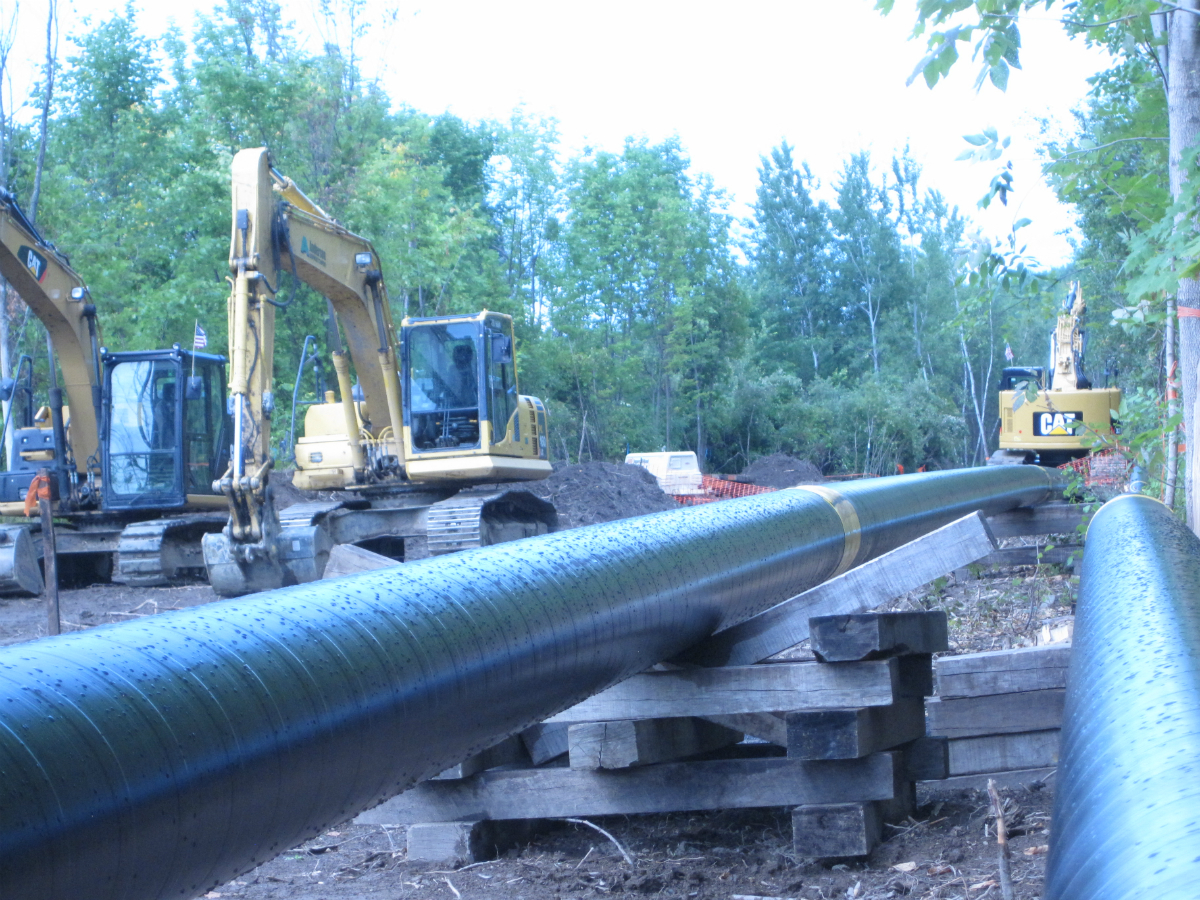
 Members of the activist group Just Power sing protest parodies of Christmas songs outside the Public Service Board hearing room in Montpelier during a hearing on Vermont Gas Systems’ Addison-Rutland Natural Gas Pipeline on Tuesday, December 1, 2015. Photo by Erin Mansfield/VTDigger. Very top photo of gas pipeline installation in Williston by Vermont Business Magazine.
The Public Service Board held the hearing as part of deliberations on the public benefit of the natural gas pipeline. The board must decide whether the memorandum of understanding between the Vermont Department of Public Service and Vermont Gas should be entered into evidence.
Cost estimates have ballooned since the pipeline expansion was first proposed in 2013 from $86 million to $154 million. In December 2014, the Public Service Board decided to re-evaluate whether the project, now partially completed, is still in the best interest of ratepayers.
Before the hearing, affected landowners and other pipeline opponents gathered in the hallway and sang to the tune of ‘Oh Tannenbaum”:
“Oh pipe be gone, oh pipe be gone,
why don’t you just go away?
Oh pipe be gone, oh pipe be gone,
You’ll cost much more than we can pay.”
The document at the heart of the hearing ensures that Vermont Gas ratepayers will pay for no more than $134 million of the project’s cost, the company’s CEO Don Rendall said. The rest of the money for the capital investment would come from Vermont Gas, which is a subsidiary of Gaz Metro in Montreal.
“This was a significant achievement of the Department of Public Service, to which Vermont Gas has agreed, and it will serve to assure our customers, our regulators and our stakeholders that we at Vermont Gas — and not our customers — will take responsibility and risk for costs over $134 million,” he said.
The agreement binds Vermont Gas Systems to terms that will serve Vermonters, Rendall said, and board members should expect it to be upheld by the state and the company.

Don Rendall, president and CEO of Vermont Gas Systems. Photo by Erin Mansfield/VTDigger
“This was an important day for our project, and for the Public Service Board to review the very important agreement we reached with the Department of Public Service in October to cap the cost of the project” for ratepayers, Rendall said.
Opponents say Vermont Gas shouldn’t be allowed to introduce evidence into the process months after the hearings concluded in June.
Rendall said the agreement was entirely proper.
“This proceeding, as with many other similar proceedings, has been very focused on what’s changed over time,” Rendall said. “This was a significant achievement … I made a commitment, we at Vermont Gas made a commitment when we reset the process a year ago, to be open, direct and timely in bringing important information related to this project to the Public Service Board, and that’s what we’ve done.
“It’s entirely appropriate for the Public Service Board to consider agreements like this, and it’s often the case, when parties reach significant agreements, that they’re brought to the Public Service Board and considered by the Public Service Board,” he said. “It’s appropriate, it’s important, and it’s part of our commitment to being open and direct.”
Sandra Levine, a senior attorney for the Conservation Law Foundation, said regulators shouldn’t place much faith in the agreement because both parties can change it in future.
“It’s an agreement between two entities that already think the project at $154 million is a good deal,” she said. “There’s nothing preventing them from modifying the agreement later.”
Conservation Law Foundation, AARP Vermont and Nate and Jane Palmer are parties in the case and have opposed the pipeline.
At the hearing, Levine asked Rendall if he’d consent to an order from the Public Service Board preventing the Public Service Department and Vermont Gas Systems from later altering the MOU.

Jane and Nathan Palmer, landowners in Monkton who are intervenors in the Addison-Rutland Natural Gas Pipeline case before the Public Service Board, listen at a hearing on the project on Tuesday, Dec. 1, 2015. Photo by Erin Mansfield/VTDigger
Her question prompted an immediate objection from Peter Zamore, Vermont Gas’ attorney, which was followed by a huddled discussion between Public Service Board members. The Board allowed the question, and Rendall said that if the Board required such a condition, his company wouldn’t violate its terms.
“Vermont Gas Systems would of course abide by any conditions or requirements the board imposes related to the project,” he said.
Potential exceptions or loopholes in the MOU ought to concern Vermont regulators more than they appear to, Levine said after the hearing.
“Unfortunately Vermont and the Public Service Board have had a really bad experience with utility agreements,” she said. “Regulators really thought Vermont Yankee was going to make good on their word, and they didn’t.
“[Vermont Yankee attorneys] parsed the language of the agreements in a way that shortchanged Vermonters,” she said. “With that experience, any agreement needs to be evaluated very carefully before regulators rely on it. And under careful evaluation and scrutiny, the agreement presented yesterday just doesn’t hold up.”

Peter Zamore, a lawyer from Sheehey Furlong & Behm who represents Vermont Gas Systems, testifies at a Public Service Board hearing in Montpelier on the Addison-Rutland Natural Gas Pipeline on Tuesday, Dec. 1, 2015. Photo by Erin Mansfield/VTDigger
Vermont Gas will stick to the terms of the agreement, Rendall said Wednesday, as many other Vermont utilities have in the past.
“We made this commitment, we will abide by it, and we have a long history in Vermont of parties reaching agreements and sticking to them, and being held to them,” he said. “We expect to be held to this, and I’m confident there won’t be any questions about our holding up our end of the bargain.”
Levine says whether the agreement is upheld or not, the cost to ratepayers is unacceptable.
“Even at the rate cap of $134 million, the project is still too expensive and it fails to provide sufficient environmental and economic benefits that would justify saddling Vermont customers for decades to come with paying for it,” Levine said.
“For how long are current customers going to be paying for the project? Thirty-plus years,” she said. “That’s long past the time Vermont needs to be moving away from fossil fuels. So making a really big investment right now in an outdated fuel choice is a bad bet for Vermont.”