

by Mike Polhamus vtdigger.org Harold Deering and his father raise just under 200 dairy cows on one of about 2,500 small farms that must comply with new rules the state is drafting to protect Vermont’s water bodies from excess phosphorus. Joining nearly 100 other farmers gathered in Middlebury last Thursday to review the new rules, Deering said he and his father had been preparing for them for years. Like several others at the meeting, Deering said he hopes Vermonters understand that farmers want clean water as much as anyone else.
“The public needs to know that we’re out – the farmers – are out not to add it to the lake, they’re already trying to keep it contained and monitored in levels that benefit them the most, because it is beneficial to everybody to keep it in the soil, in the crops, to help grow your dairy cows, to make milk, to make vegetables,” he said. “We’re not just out there dumping it into the lake.”
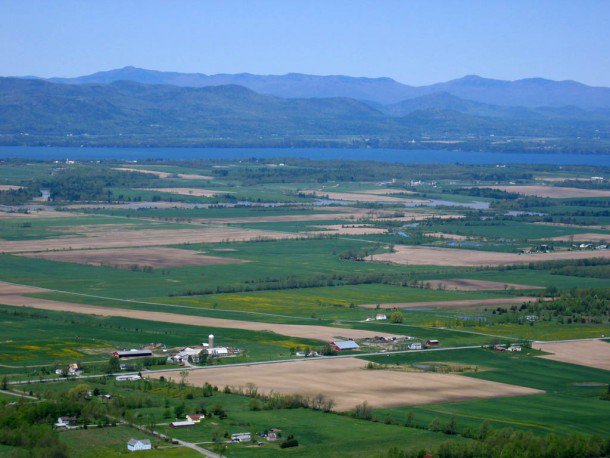 The Lake Champlain basin as seen from Mount Philo. Photo courtesy Lake Champlain Basin Program
Treated today as a pollutant in Vermont’s water bodies, phosphorus is a nutrient essential to plant life that farmers add to their crops. Agriculture generates about 40 percent of Vermont’s phosphorus pollution and a long list of upcoming regulations are meant to address that problem.
Nutrients contained in runoff from agriculture and commercial development is a leading cause of pollution in Lake Champlain, causing annual blooms of toxic blue-green algae that raise health concerns.
Deering said small farms in Vermont typically add the nutrient in the form of manure, which they generate on their own farms from dairy cows.
Since it’s a needed fertilizer, it’s in the farmer’s own interest to adopt practices that keep the manure on their own land, he said.
“It is your financial investment,” Deering said. “We don’t want runoff, we want it to stay, for the plants.
“It’s money,” he said. “If my cow was already creating this fertilizer, if I can utilize it and not have to bring in more to feed the crops, it’s beneficial to me – more so than letting it run with the water into the lake.”
New rules under discussion Thursday, drafted by the state’s Agency of Agriculture, Food and Markets, are meant to accomplish just that, he said.
They would affect small farms in particular, which until now were advised to follow these practices, but beginning July 1 will be required to adopt them.
Under the proposed rules, owners of small farms will be required to submit to inspections once every 10 years, and must attend training courses on methods to prevent excessive runoff from their properties. They’ll also become responsible for annual compliance reporting.
Among the most significant changes is a requirement that small farm owners write and follow a plan designed to keep nutrients from running off the land and into Vermont’s lakes.
This educational component is crucial, said Beth Pratt, of Addison, who owns a beef farm on Lake Champlain, and who formerly raised dairy cows on the same plot of land. Pratt was also at the meeting Thursday, hosted by the agriculture agency.
“Most farmers truly believe they’re doing a good job,” Pratt said. “Just like, you know, somebody believes they’re a good cook.”
Some farmers just don’t know better, she said. In part through the requirement of nutrient management plans, the new regulations are likely to help those farmers use their resources more efficiently, and make more money.
Much of what’s being discussed is just good farming, she said – “things we were doing since, well, since my husband’s great-grandfather was alive.”
New technologies are also available to accomplish many of the same goals, said Eric Severy of Cornwall, who applies manure to fields for Matthews Trucking LLC. He attended Thursday’s meeting anticipating good news.
His company specializes in injecting manure beneath the soil, Severy said. This aids plant growth and dramatically reduces phosphorus runoff. The proposed regulations will be a boon for his business.
“This is going to dramatically affect us,” he said.
Severy’s business, like other custom manure applicators, will need to be certified by the state, under the proposed new rules. Like small farm owners, they, too, will be required to attend training courses on proper application methods.
Most farmers have already adopted the practices that will become required this summer, Severy said. Much of the problem with phosphorus pollution isn’t from farmers who flout the rules, but from practices that were common before the problem was known.
“Ninety percent of the farms out there are following what’s being proposed, and I think it’s more of a long-term problem that you’re not going to see results in right off,” Severy said. “We’ve got slow-moving rivers like Otter Creek that are full of phosphorus-laden soil that aren’t going to get cleaned up for years.
“I’m afraid they’re going to propose all these new plans, they’re going to work, but the tests won’t show they’re working, because the problem’s from years and years and years,” he said.
Kristin Workman, an outreach professional for the University of Vermont’s extension office in Middlebury who also attended Thursday’s meeting, works to teach best practices to farmers, for the benefit of Vermont’s water quality and for the farmers themselves.
Some farmers will be hit hard by the new regulations, she said. One in particular will need to spend hundreds of thousands of dollars to come into compliance.
But most of what’s being proposed isn’t new to anyone, and isn’t unwelcome.
“Overall I think farmers, they don’t want to be the reason the lake is polluted, and they want to be good farmers doing the right thing, so within reason, they don’t want the way they’re farming to be part of the problem,” she said. “Nobody wants to be the reason the lake turns green in the summer.”