

Vermont Business Magazine University of Vermont start-up company EASY LLC has received a $1 million Phase II Small Business Technology Transfer grant from the National Institutes of Health to develop a commercial prototype for a digital printer that will translate conventional graphics to raised-line versions readable by the blind. Under a Phase I version of the grant, intended to demonstrate product feasibility, the company developed the first working prototype for the printer. EASY originated in an engineering class at UVM.
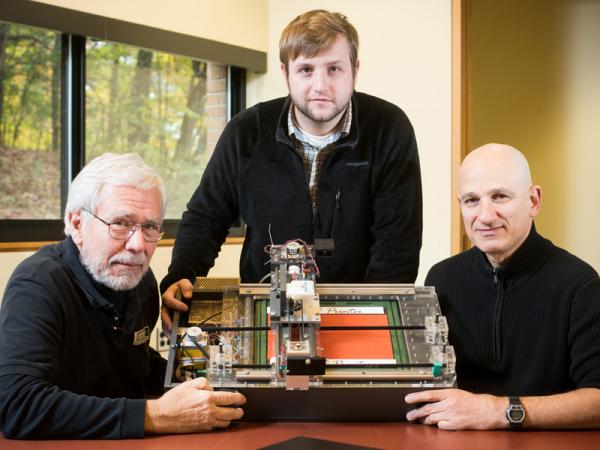 With a $1 million grant from the National Institutes of Health, E.A.S.Y. founders Michael Rosen, Joshua Coffee '11 and Mike Coleman (from left) will develop a commercial digital printer that translates conventional graphics to raised-line versions readable by the blind. They’re pictured with a prototype of the new printer. (Photo: Andy Duback)
The company's product line currently includes the inTACT sketchpad for blind users, which converts marks drawn on plastic sheets to raised lines that can be felt, and the inTACT "eraser" that can remove the lines so drawings can be altered.
E.A.S.Y.'s goal for its product line is to normalize drawing and graphic expression for young blind children, said company co-founder and president Josh Coffee, a 2011 UVM graduate in mechanical engineering. That's an intrinsic benefit, he said, but also one that clears a path to areas of study and professional opportunity that require graphic literacy, like math and science and STEM fields, generally, which the blind have traditionally been closed off from.
"We're hoping to change the paradigm," he said. "If you're comfortable and competent drawing in elementary school and before, you're less likely to be inhibited from taking geometry in eighth grade or calculus in eleventh grade, or taking STEM courses in college, or pursuing a career as an engineer or an architect."
The sketchpad and eraser, which launched in 2014, are already in use in many schools around the country. But the new printer will greatly enhance their utility and speed adoption.
Printer as translator
While it will also print raised-line drawings created on E.A.S.Y's upcoming inTACT digitized sketchpad, the printer's real significance is as a kind of translational interface between conventional graphics-based worksheets for sighted students -- used in math or science courses, for instance -- and braille-annotated, raised-line versions that teachers could print and distribute to blind students.
"A teacher could simply send a digital file for a conventional worksheet for sighted kids to the printer, and a raised-line graphic version of it, with accompanying braille, will print out," said E.A.S.Y. co-founder and vice president Mike Rosen, a research associate professor in UVM's College of Engineering and Mathematical Sciences.
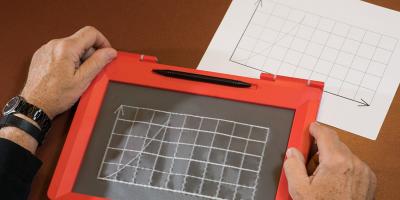 A new printer created by UVM start-up E.A.S.Y. can convert a standard math worksheet to a raised line version usable by blind students. Using the company’s sketchpad and eraser, students can change, correct and update math and science work, as sighted students do. (Photo: Andy Duback)
Unlike all other braille-plus-graphics printers on the market at present, the printer will produce its tactile graphics drawings on the same type of plastic drawing sheets used in the sketchpad. These sheets are not just "read-only"; using the sketchpad and eraser, they allow blind students to add to, alter, edit and complete the drawings produced by the printer -- for example to complete homework assignments. This interactivity is unique to the inTACT product line.
That kind of interaction is also possible in a professional setting, Rosen said, with a blind engineer, for instance, interacting with graphics created by colleagues or originating designs others would react to.
"These tools represent a significant step forward for the blind, a game-changer," said Mike Coleman, E.A.S.Y.'s other co-founder and vice president, an associate research professor the College of Engineering and Mathematical Sciences.
High profile partners underscore printer's potential
The STTR Phase II grant is a vote of confidence that E.A.S.Y.'s vision of expanding the horizons of the blind is achievable, said Coffee, a 2011 graduate from the School of Engineering. Further evidence of its promise, he said, is the list of high-profile organizations serving the blind who are partners on the grant and have agreed to pilot test the commercial printer when it is available next summer.
Partner organizations include the National Federation for the Blind; Pearson Publishing, a leading textbook publisher; the Perkins School for the Blind, a pioneer in the field; the Texas School for the Blind and Visually Impaired, which specializes in STEM education; the Louisiana Center for the Blind; the American Institutes for Research; and gh, the leading braille publisher.