

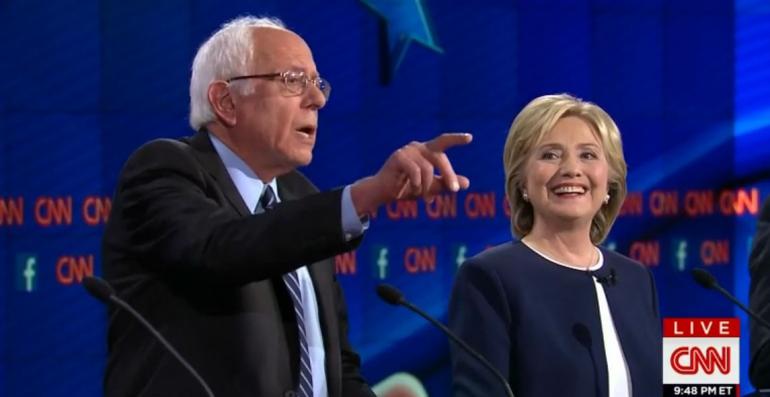
 CNN.com screen shot. For CNN videos click on image.
Jasper Craven, VTDigger’s political reporter, filed this news analysis from Las Vegas. Mark Johnson contributed to this report. Senator Bernie Sanders introduced himself to millions in Las Vegas Tuesday night in a high-stakes matchup that saw the Vermont Senator hit his policy points hard, though he leveled little criticism of his main contender, former Secretary of State Hillary Clinton, who aggressively exploited Sanders’ weaknesses to shore up the perception that she is the inevitable Democratic candidate.
“What Democratic Socialism is about is saying that it is immoral and wrong that the top one-tenth of one percent in this country own almost — almost — own almost as much wealth as the bottom 90 percent,” Sanders said in his first few minutes onstage, priming potential supporters perhaps tuning in to Bernie FM for the first time.
Sanders got nearly a half an hour to lay out his policy proposals to millions of Americans, with Clinton racking up only a few more minutes in the two-hour CNN debate, which also included former Maryland Gov. Martin O’Malley, former Rhode Island Gov. Lincoln Chafee and former U.S. Sen. Jim Webb of Virginia.
Sanders’ loudest, most passionate debate moments were essentially tweaked rallying points from his stump speeches, including his signature table-pounding rhetoric on wealth inequality and his disdainful language for weak campaign finance laws.
Clinton was forceful and detailed in her foreign policy pronouncements, and Sanders made no bold proposals on foreign policy during the matchup.
While Sanders rarely, if ever, trips on his signature lines on the trail, he was a bit shaky in the first few minutes of the showdown, a likely sign of nerves on a big new stage.
Campaign advisors said Sanders spent a moderate amount of time preparing for the debate over the past 10 days, noting foreign policy was one issue in which the campaign paid special attention.
Clinton and Sanders shared similar views on a number of issues, including income inequality, racial justice and the environment.
But a deep gulf formed in the debate between Sanders and Clinton on gun rights, an issue that has been highlighted following another mass shooting, this time at a community college in Oregon earlier this month.
Sanders has voted against legislation that mandated background checks and waiting periods. In statements, he has said that gun manufacturers should not be held legally responsible for mass shootings.
“Sen. Sanders did vote five times against the Brady bill,” Clinton said. “Since it was passed, more than 2 million prohibited purchases have been prevented.”
Sanders did not back far away from his past votes, and defended what he characterized as a moderate gun record in a state full of hunters. He prioritized mental health outreach as the main fix for stemming gun violence.
“All the shouting in the world is not going to do what I would hope all of us want, and that is keep guns out of the hands of people who should not have those guns and end this horrible violence that we are seeing,” he said.
Clinton and Sanders diverged on other issues, including marijuana legalization (Sanders: yes, Clinton: no) and the biggest foreign policy challenge today (Sanders: global warming, Clinton: nuclear weapons). Sanders said he would shutter most National Security Agency spying programs, another proposal Clinton rejected.
In a rare hard hit on Clinton, Sanders said her plan to regulate Wall Street was toothless, and called for the breakup of the big banks.
“Secretary Clinton, you do not–Congress does not regulate Wall Street,” Sanders said. “Wall Street regulates Congress.”
Unlike the Republican debates, personal attacks were nonexistent in Vegas on Tuesday. In a generous moment, Sanders even dismissed the email scandal that has plagued Clinton’s campaign for months, saying “The American people are sick and tired of hearing about your damn emails.”
“Thank you.” Clinton replied with a grin on her face as the two shook hands. “Me too. Me too.”
If the debate revealed Sanders’ weakness on guns, Clinton’s shifting political stances were questioned the most aggressively by Cooper and the candidates.
Clinton has tacked closer to some of Sanders’ progressive platforms in recent weeks, prompting Cooper to ask: “Will you say anything to get elected?”
Clinton deftly defended her ideological shifts, saying she has “absorbed information” over the years that has forced changes on issues including gay marriage and the Trans Pacific Partnership.
Yet her policy prescriptions now are markedly different than in the past, with many now that are unmistakably similar, if more moderate, than statements made by Sanders. Clinton even defined herself as progressive in the debate, with the pointed caveat, “I’m a progressive who likes to get things done.”
While Clinton was neither soft nor sparing when it came to questioning Sanders’ record on guns, Sanders made no hard hits on Clinton’s flipped policies. The campaign sent out sporadic emails to reporters throughout the debate pointing to Clinton’s inconsistencies, but these were not pushed hard by Sanders onstage.
Near the end of the debate, the candidates were asked about the Black Lives Matter movement, and both Sanders and Clinton talked about the need to reform the criminal justice system. Sanders was the only candidate to mention a victim of police violence in the debate, recalling the death of Sandra Bland while in police custody in Texas.
Both campaigns have been vying for support and seeking input from activists in the movement for months, including Deray McKesson.
McKesson told VTDigger after the debate that he appreciated Clinton’s words on issues like police accountability and mass incarceration, but that he wished she would have acknowledged racial inequity.
“Sanders clearly noted that we need to end institutional racism and that the criminal justice system was broken,” McKesson said.
“I expected more discussion of race from all of the candidates,” he added.
Garrison Nelson, a political science professor at the University of Vermont, told VTDigger after the debate that Sanders performed well, but that he doesn’t think he will greatly expand his roster of supporters following Tuesday’s showdown.
“I think Bernie deepened his support, I don’t think he broadened it,” Nelson said. “He turned to familiar themes, and he reiterated them.”
Eric Davis, a retired political science professor at Middlebury College and longtime observer of Vermont politics said Sanders is good at returning to his fundamental themes – the influence of big money on politics and the media and the need for an expanded government role in health care, higher education and restoring the middle class.
The jury is out, however, on whether he can expand his base beyond young voters and middle-class white progressives, which Davis says may lead to wins in Iowa, New Hampshire, and a few other states such as Vermont, Minnesota, Colorado, Oregon, and Washington, but won’t give him much of an edge in the South.
“In particular, can Sanders make inroads among African-American and Latino voters, and among working-class voters?” Davis says.
Clinton has yet to address issue raised by O’Malley and others (including Republicans) of Americans wanting new leadership, Davis said, and she needs to work on her weaknesses between now and next summer. If she ends up as the winner of the Democratic nomination, “after what will likely be a long-drawn-out contest for delegates between now and early June,” it will be because of strong support among members of Congress, governors, and other “super-delegates.”
Sanders has yet to be endorsed by a single colleague in the Senate and only by two members of the House.
Bill Grover, a political science professor at St. Michael’s College, said “Bernie certainly held his own; he was ready for prime-time.”
But he was “back on his heals on gun control and on Syria and the Middle East.”
“On foreign policy he was not readily distinguishable from the others, which is something he needs to work on, in my view,” Grover said.
While Sanders surrogates said Bernie won in the Spin Room after the debate, they also pointed to the dearth of experience Sanders has in front of a national audience.
“This will be Hillary Clinton’s 26th debate for president and Bernie’s first,” campaign advisor Tad Devine joked to VTDigger before the matchup. “Her strongsuit is she has done this for a long time and been very successful, she has won almost every one of them.”
Asked how important the night is, Devine portrayed it as just one second in a long span of time.
“It’s a very important moment in the election,” he said. “But it’s just a moment.”