

Lake Champlain Committee (LCC) The information below represents the results from the latest reporting by a reduced crew of monitors. While most areas should see decreases in cyanobacteria populations there are places in New York, Vermont and Quebec where they may persist for several more weeks. Anyone recreating on the water or shoreline should be check the water and avoid contact with algae scums or blooms.
Lake Champlain Monitoring Sites
Missisquoi Bay– 3 reports. The Shipyard area of Highgate continued to report high alert conditions. Chapman Bay and Donaldson Point reported good conditions. Everyone active on the water and shoreline of Missisquoi Bay should watch for changing conditions and keep people and pets away from blooms.
St. Albans Bay– 1 report. There was a single report of good conditions. There have been no reports of blooms. This area is considered generally safe.
Inland Sea– 1 report. There was a single report of good conditions. There have been no reports of blooms. This area is considered generally safe.
Malletts Bay– No reports this week. No reports of blooms, this area is considered generally safe.
13 reports overall for the Main Lake
Main Lake North– One station noted good conditions. There have been no reports of blooms and this area is generally considered safe.
Main Lake Central– All locations reported good conditions. There have been no reports of blooms and this area is generally considered safe.
Main Lake South– All stations reported generally safe conditions with no bloom sitings.
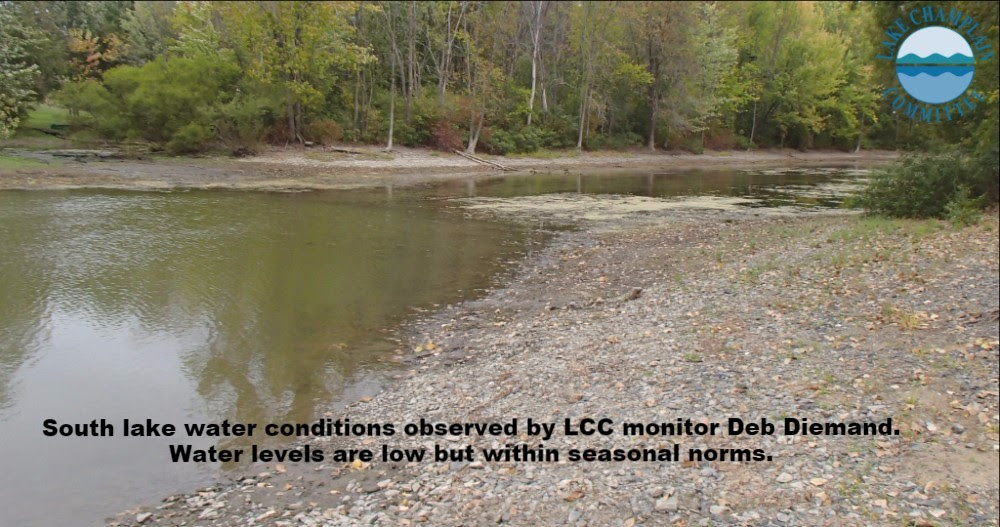
South Lake– 1 report. There have been no reports of blooms and this area is considered generally safe.
Other VT Lakes
Lake Carmi– 3 reports. Mixed conditions continued through this week. High alert conditions were reported again at North Beach and Westcott shore had low alert conditions Dewing Road reported good conditions. Everyone recreating in this area should watch for changing conditions and keep people and pets away from blooms.
Lake Iroquois– 1 report from 1 site of generally safe conditions.
Lake Memphremagog– 2 reports. Conditions were mixed this week with one low alert along the Newport Derby bike path receivedFridaymorning. Everyone on the lake should watch for changing conditions and keep people and pets away from blooms.
TAKE ACTION
Raise Awareness About Blue-green Algae
As people interested in water quality, please help spread the word about the risks of blue-green algae and actions to take. Blooms are caused by a combination of warm water temperatures and high concentrations of nutrients in the water, particularly phosphorus. Reducing the supply of phosphorus is key to reducing blooms. So please continue to takeactions around your home and workplaceand advocate for stringent controls to reduce nutrients flowing into the lake.
INFORMATION RESOURCES
- Blue-green Algae in Lake Champlain
- Blue-green Algae Fact Sheet
- Blue-green Algae Fact Sheet for Veterinarians
- LCC flier on how to differentiate blooms from other lake phenomena
BACKGROUND ON LCC's MONITORING PROGRAM
The Lake Champlain Committee (LCC) developed a blue-green algae monitoring program for Lake Champlain in 2003/2004 and has overseen the citizen-based program ever since. The focus of the program is to raise awareness of the issue, build a database of information on bloom frequency, and identify and publicize any potential health hazards. The information gathered will help us better understand the triggers for blooms and aid in the work to reduce their frequency.
LCC coordinates our monitoring program closely with Vermont and New York health and environmental agencies. We annually train hundreds of citizens in methods to assess and report on water conditions. We also conduct trainings for state and municipal park staff, town health officers, and public water supply operators. LCC monitors provide important data on lake health from more than 80 Lake Champlain locations and five on Lake Carmi and one on Lake Iroquois.
FUNDERS & PARTNERS
The Lake Champlain Committee's blue-green algae monitoring program is funded byLCC members, the Lake Champlain Basin Program and the Vermont Department of Health. Key program partners include the Vermont Department of Environmental Conservation, Vermont Department of Forests, Parks, and Recreation, Vermont Department of Health, New York Department of Environmental Conservation, New York Department of Health, and the Lake Champlain Basin Program.