

Vermont Business Magazine Governor Peter Shumlin joined the Woodstock Community Trust, Twin Pines Housing Trust, Housing Vermont and funders and supporters of Safford Commons to celebrate the opening of the rental housing development at the site of the former Grange Hall and church on Route 4 across from the Woodstock High School. Safford Commons provides a total of 28 attractive, affordable and energy-efficient rental apartments. Four apartments were created through extensive renovations of a former Grange Hall and church building while 24 new construction apartments are scattered among 10 buildings.
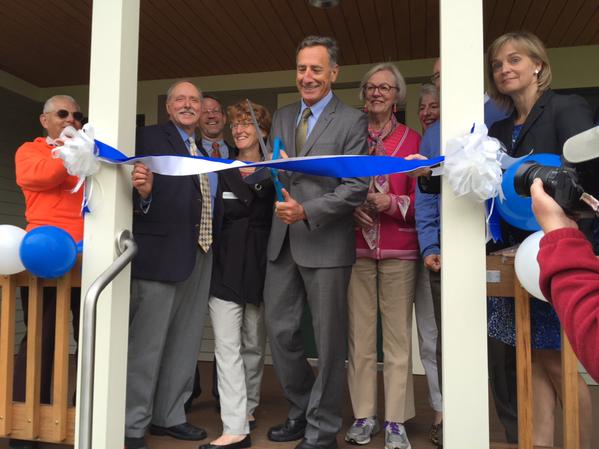 “While it took a long time to develop this project, it took no time at all to fill it,” said Governor Peter Shumlin. “Without a stable and affordable home, it is nearly impossible to be a good parent, a motivated student, a productive employee, an effective volunteer or an engaged citizen. It is even more impossible to overcome challenges such as mental illness or addiction. Housing is the foundation of communities and success for all Vermonters. I am delighted to be here today to celebrate the opening of 28 new homes at Safford Commons.”
Michael Wisniewski, Duncan-Wisniewski Architecture, designed Safford Commons to reflect a village landscape clustered on the lower portion of the site to retain open space and forest on half of the site. Six different building designs, all with front porches facing the street, contribute to the neighborhood feel.
Twenty-three apartments are available for households earning up to 60% of the HUD area median income for Windsor County (for example, up to $39,540 for a three-person household), three units are available for moderate income households and two apartments will be rented with no income restrictions. Rents range from $600 for a 1-bedroom affordable unit to $1,000 for a market 2-bedroom unit, including heat and hot water.
Demand for the housing has been high.
“Apartments became available in August and we have already leased 27 of the 28 apartments,” said Andrew Winter, executive director of Twin Pines Housing Trust. “Additionally, we already have a significant waitlist of more than 40 families, which is reflective of the demand that we see for affordable housing in the Upper Valley.”
Patsy Highberg, Woodstock Community Trust, noted that most of the new residents are already familiar with Woodstock. “These well-built, energy efficient homes are now filled with families who want to live in Woodstock. Many are people who have lived in our community or have moved away and were able to come back thanks to the availability of affordable housing at Safford Commons,” Highberg said.
According to Winter, of the first 24 tenants, eleven households were living in Woodstock before moving to Safford Commons, nine came from neighboring communities, two from elsewhere in the Upper Valley, one is a parent of a Woodstock resident, and one moved to Woodstock for a job at a local hospital.
The majority of the $9.5 million total development cost is funded through tax credit equity from Housing Vermont’s Green Mountain Housing Equity Fund. Other funding sources include the Lake Sunapee Bank, Vermont Housing and Conservation Board, Vermont Community Development Program, and the proceeds from the sale of Vermont tax credits. DEW Construction Corporation was the general contractor
“We’re here today to celebrate the successful conclusion of a ten year effort—nine years in the development process and a year of construction,” said Housing Vermont President Nancy Owens. “As we have seen, Safford Commons clearly meets a need in this community. We look forward to continuing to serve the community for many years to come,” she said.
The development reflects the name of one of Woodstock’s earliest settlers. Joseph Safford began the first settlement on the "flats," as the plateau above the river was called. He was one of the framers of Vermont's Constitution and was sent to the General Assembly by the town for several sessions.
Housing Vermont is a private, nonprofit development company founded in 1988 to produce permanently affordable rental housing for Vermonters through partnerships with communities and the private sector.
Since its inception, Housing Vermont has raised more than $300 million in private equity to finance 159 affordable rental housing developments throughout the State. This equity has leveraged an additional $391 million in private financing and public investment. The 4,950 apartments created or renovated in these efforts serve low and moderate income Vermonters including seniors and those with special needs. Many developments also include commercial space.
Twin Pines Housing Trust (TPHT) was formed in 1990 to develop, own and manage affordable housing on both sides of the upper Connecticut River Valley. TPHT has developed over 289 rental units, including family and transitional housing across northern Windsor County and southeastern Orange County in Vermont and southern Grafton County in New Hampshire. Additionally TPHT has provided homeownership opportunities for more than 40 families in a mixture of condominiums and single family homes that are permanently affordable. A 501(c)(3) nonprofit, TPHT is governed by a twelve- member board of directors and operated by a staff of 15 full- and part-time employees. Its office is located in White River Junction.
Source: Housing Vermont 9.22.2015