

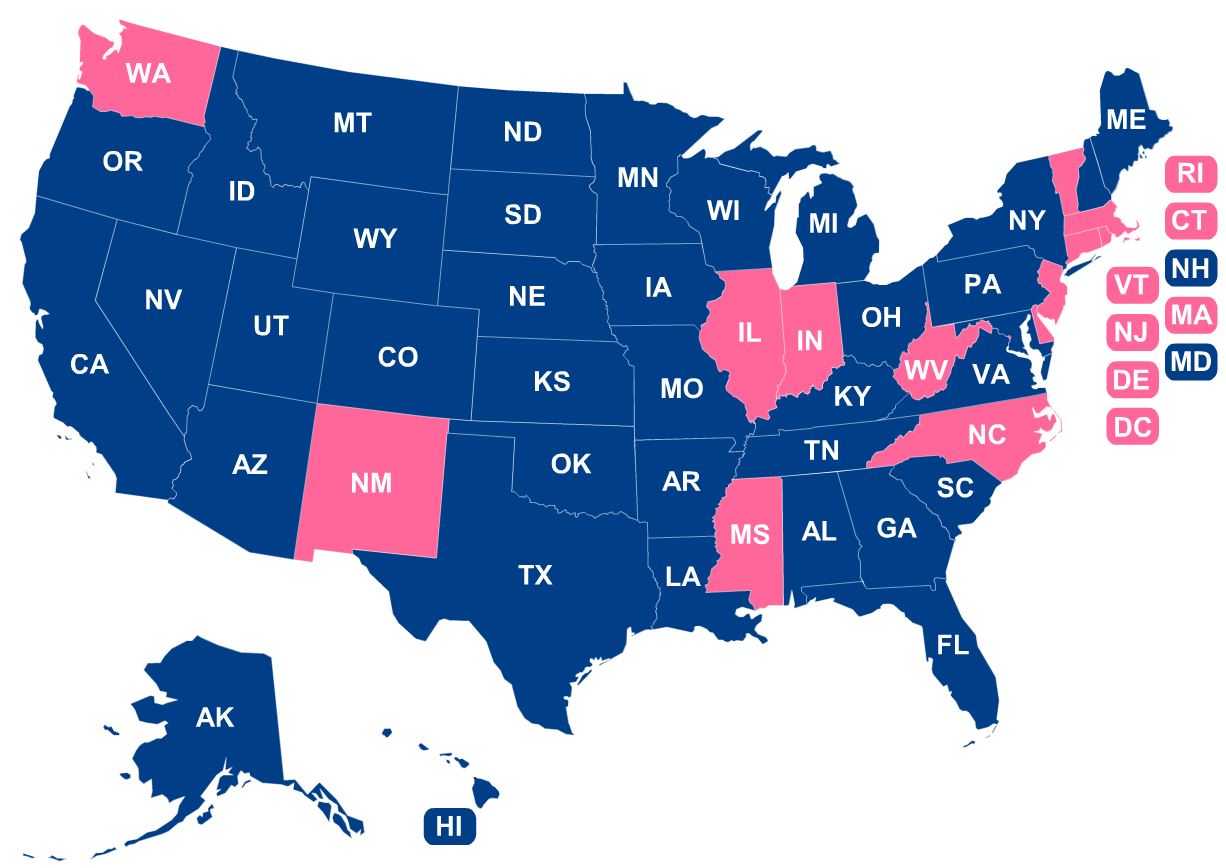
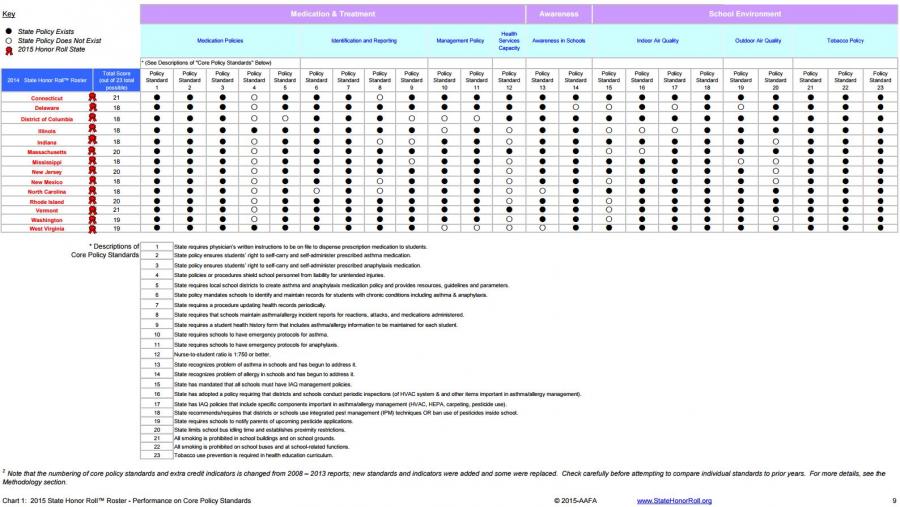
Vermont Business MagazineVermont has received the highest grade in the nation in a report on school asthma and allergy health care.With schools acrossthe United States soon to be, back in session, it's never too late – or too early – to ensure that students and faculty with asthma, food allergies and other allergic conditions remain safe.Today, the Asthma and Allergy Foundation of America (AAFA) unveiled its 2015 report, the State Honor Rollof Asthma and Allergy Policies for Schools. Fourteen states made-the-grade this year, with Connecticut tying Vermont for the top spot (21 points, Georgia was last with 7).
SEE VERMONT REPORT BELOW
Nearly 26 million people in the USsuffer from asthma, and approximately 28% of them are children and the number of missed school days each year due to asthma is 14 million. Also, there are an estimated 6 million children with food allergies and 10 million with other allergic diseases. That is why it is important for schools to implement policies that encourage a supportive learning environment for students and adults living with asthma and allergies in America's schools to help keep them safe and in control.
The good news is that the number of states to make AAFA's 2015 "Honor Roll" has more than doubled since the first report in 2008. One key driver has been the near universal adoption of state epinephrine stocking laws and policies, indicating states' awareness of how important it is to keep emergency medications for severe allergies on-hand at school. That is a realization that should bring some comfort to parents and school officials nationwide.
The full report with tables, charts, maps and state-by-state summaries atwww.StateHonorRoll.org, celebrates exemplary state efforts, and ongoing state progress. The 2015 State Honor Roll list includes (in alphabetical order):
- Connecticut
- Delaware
- District of Columbia
- Illinois
- Indiana
- Massachusetts
- Mississippi
- New Jersey
- New Mexico
- North Carolina
- Rhode Island
- Vermont
- Washington
- West Virginia
AAFA's annual report compares all 50 states and theDistrict of Columbia(DC) on 23 core public policy issues that affect kids and adults with asthma and allergies while they spend the day in K-12 schoolrooms nationwide. States that have enacted at least 18 of these 23 core policies are named to the Honor Roll. Of special note in this year's report, is the success that lawmakers in 46 states have enacted laws making epinephrine auto injectors available to schools for severe allergic emergencies. That is a major victory for just one of the many battles to keep children and school faculty safe. AAFA's 2015 State Honor Roll report also includes two "spotlight" articles on the epinephrine stocking issue in schools, as well as the next challenge regarding laws for medication stocking in other settings, or "entities," such as restaurants.
"The State Honor Roll report makes it easy for parents, legislators and school personnel to proactively seek the changes they wish to see in their school systems," saysMeryl Bloomrosen, AAFA's Senior Vice President of Policy, Advocacy and Research. The report provides parents and caregivers with information that will enable them to assess the asthma and allergy policies in their state and advocate for improvement, provides legislators with an overview of how public policies and practices in their state compare to others and provide models for improvement, and help school system personnel set standards and benchmarks by providing the best practices and the experience of other states. "The next challenge is strengthening environmentalhealth public policies, and improving school nurse coverage," says Bloomrosen "This report is a celebration of the states that are moving ahead, and it identifies future work that still needs to be done make schools safe."
About the Study
For AAFA's State Honor Roll report, three categories of policies were assessed: Medication and Treatment policies, Awareness policies and School Environment policies. Within these categories AAFA research and policy experts, in consultation with leaders in the fields of medicine, education and advocacy, identified 23 core policy standards relating to asthma and allergies in schools. Policy areas included school nurse-to-student ratios; laws allowing students to carry and administer their asthma and anaphylaxis medications; school building indoor air quality policies, and smoking bans and cessation programs.
The full report, methodology, tables, detailed state profiles, maps, as well as back-to-school tips and tools, are available atwww.StateHonorRoll.org. The 2015 report and dissemination are sponsored by Mylan Specialty L.P. Additional support for the study has been provided by Genentech and individual donations to AAFA from patients, families and supporters.
About AAFA
The Asthma and Allergy Foundation of America (AAFA) is a not-for-profit organization dedicated to improving the quality of life for people with asthma, allergies and related conditions through education, advocacy and research. For more information about asthma and allergies, visitwww.aafa.orgor call 1-800-7-ASTHMA.
| VERMONT |
|
AAFA's 2015 State Honor Roll™ of Asthma and Allergy Policies for Schools
Overall, Vermont meets 21 of 23 core policy standards and eight of twelve extra credit indicators. Medication and Treatment Policies: Meets eleven of twelve core policy standards in this category: 1. State requires physician’s written instructions to be on file to dispense prescription medication to students. Meets three of five extra credit indicators in this category: B. State has or is preparing an explicit asthma program with policies, procedures and resources for schools to manage students with asthma. Awareness Policies: Meets both core policy standards in this category: 13. State recognizes problem of asthma in schools and has begun to address it. Meets both extra credit indicators in this category: F. State sponsors or provides funding for staff training in asthma awareness covering school asthma program/policy and procedures. School Environment Policies: Meets eight of nine core policy standards in this category: 16. State has adopted a policy requiring that districts and schools conduct periodic inspections (of HVAC system & other items important in asthma/allergy management). Meets three of five extra credit indicators in this category: H. State makes funding or resources available for technical IAQ assistance to schools. Noteworthy: Vermont has been selected for the State Honor Roll since 2008. Epinephrine in Schools: In 2013, Vermont passed a law allowing schools to stock epinephrine auto-injectors, The law allows a health care professional to prescribe epinephrine auto-injectors to a school, requires the health care professional to issue protocols for assessing a potential life-threatening emergency, and allows administering the medication and caring for the individual after administration of the medication. The bill also allows pharmacists to dispense the medication to a school and includes a provision immunizing school personnel from liability related to administration and student self-administration. The law does not address liability related to asthma inhalers.No. 68 Indoor Air Quality: A 2012 Vermont law states a commitment to improving air quality of schools and environmental health of students. Further, it directs cleaning service contractors with school districts to use only environmentally preferable cleaning products and to provide green training to each school district it provides with such products.S.92 (Act 68 of 2012) The state's "Envision Program", adopted in 1999, mandates that cleaning services contractors use cleaning products that are certified as environmentally preferable by an independent third party and that the distributors and manufacturers of these products provide training to contracting school districts at no costs to the districts."TheEnvision—Promoting Healthy School Environments program". Sources: State Education Agency Website |
 2014 AAFA Honor Roll™ State 2008 - 2015
Source: WASHINGTON,Aug. 11, 2015/PRNewswire-USNewswire/ --Asthma and Allergy Foundation of America