

Vermont Business Magazine Today, Lisa Ventriss, President of Vermont Business Roundtable (VBR) and Jeffrey Carr, President, Economic & Policy Resources (EPR), announced the 2nd Quarter results of their joint initiative, the VBR-EPR Business Conditions Survey. The survey, which is conducted quarterly, provides both a look back at the previous quarter and a predictive index going forward. The data for both the backward and forward-looking questions are weighted to the Vermont economy by sector employment and turned into “diffusion indices”. These diffusion indices provide a tool for analyzing and presenting insight into the Vermont economy over time through the sentiments of the Roundtable members.
The raw survey data can be easily compared to the national Business Roundtable CEO Survey, a quarterly survey of national and multi-national companies, which contains similar questions to the VBR/EPR Survey in terms of employment and capital spending. Comparing these two surveys revealed that Vermont companies expect a greater degree of hiring or stability than national companies, while both national and Vermont business expected a similar degree of capital spending.
The latest survey, which was conducted during the first two weeks of July 2015, achieved a response rate of 69 percent overall and included a 50 percent or greater response rate from all but two sectors within the membership. The survey asked eight retrospective and prospective questions about the economic outlook, demand, capital spending, and employment. Survey results show that:
- For the fifth quarter in a row, most responses to the overall question about the state’s business climate outlook were neutral to mildly optimistic.
- More than half of respondents (59 percent) shared negative outlooks specifically with ease of hiring for available positions; and,
- For the first time, both the accommodations/food services and construction sectors had the most optimistic outlooks on the general business climate (75 percent, respectively).
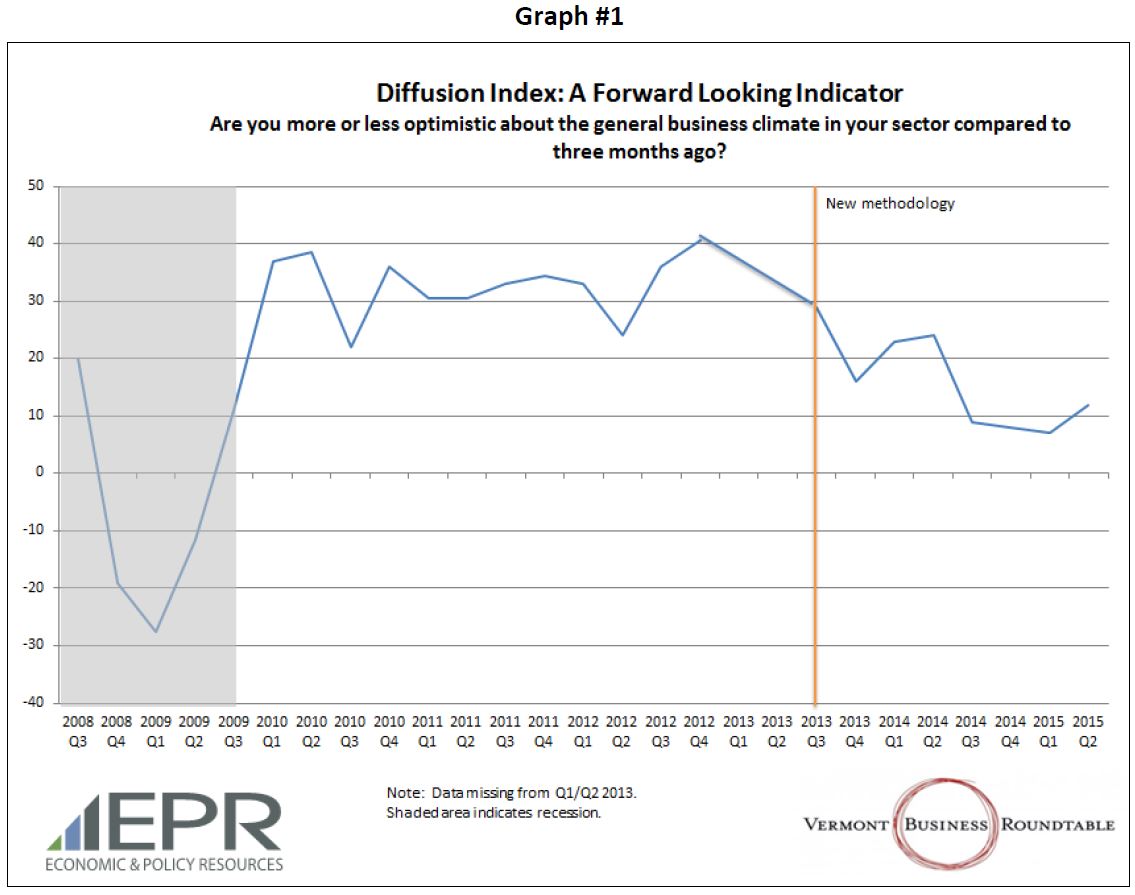
Graph #1 below shows the diffusion index of overall economic outlook, which measures the level of confidence (optimism or pessimism) respondents have about different aspects of the economy based on the first question on the survey, and can range from 100 (where 100% of respondents answered “strong positive”) to -100 (where 100% of respondents answered “strong negative”).
For this reporting period, the diffusion index shows a slight upturn in optimism from Q1 2015 to Q2 2015, indicating that Vermont CEOs continue to feel neutral to mildly optimistic about the business climate for the coming three months.
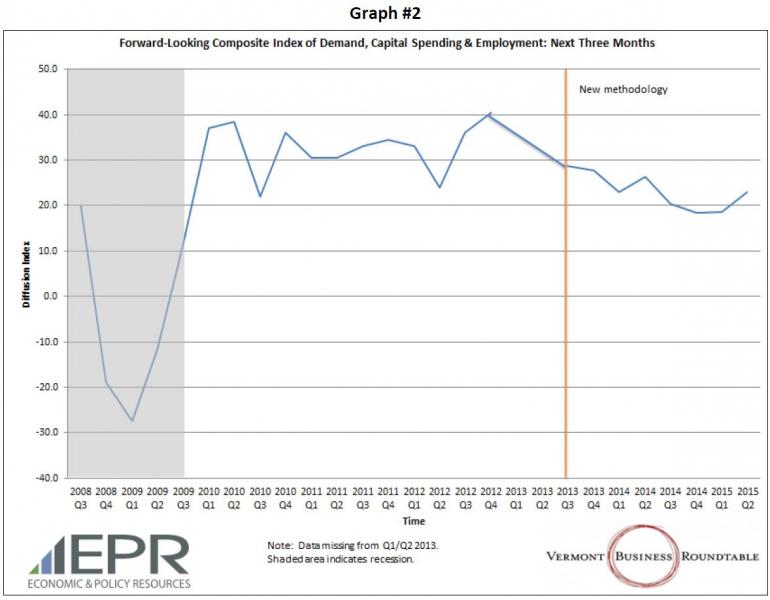
Graph #2 shows the composite index of the diffusion index points for the questions relating to demand, capital spending, and employment in the next three months. The majority of responses were neutral or mildly positive, keeping the line steady between 20 and 25 index points.
 Also included in the survey was the opportunity for Roundtable members to express their opinions on other topics affecting their businesses. The greatest frequency of responses from members concerned high taxes and tax policies, the challenges posed by the permit process, the difficulty of finding workers, and the high cost of healthcare.
The next survey will be conducted in early October, 2015.
The Vermont Business Roundtable (VBR) is a nonprofit, nonpartisan organization of chief executive officers of Vermont's leading private and nonprofit employers, representing geographic diversity and all major sectors of the Vermont economy. The Roundtable is committed to sustaining a sound economy and preserving Vermont’s unique quality of life by studying and making recommendations on statewide public policy issues. www.vtroundtable.org.
Economic & Policy Resources, Inc. (EPR) has been providing private and public sector clients throughout the U.S. and Canada with problem-solving economic research and analysis services for more than 25 years. Our professionals bring a broad spectrum and a deep reservoir of problem-solving knowledge and experience in applied economics to each assignment. We put our capabilities and experience to work for our clients so that they have the insight and understanding necessary to move forward with confidence. EPR has successfully completed assignments throughout the United States and in eastern Canada. www.epreconomics.com.
NOTE: Each question on the survey is weighted by sector employment and the diffusion number is formulated by giving each “strong positive” answer a numerical value of 1.0, “mild positive” answers a numerical value of 0.5, neutral answers a value of 0, “mild negative” answers a value of -0.5, and strong negative values of -1.0. The diffusion index numbers are then formulated based on these numerical values. A value of 100 would mean that every respondent answered “strong positive”, a value of 0 would mean that every respondent answered neutrally, and a value of -100 would mean that every respondent answered “strong negatively.”
Source: VBR. (South Burlington, Vt.) 8.3.2015