


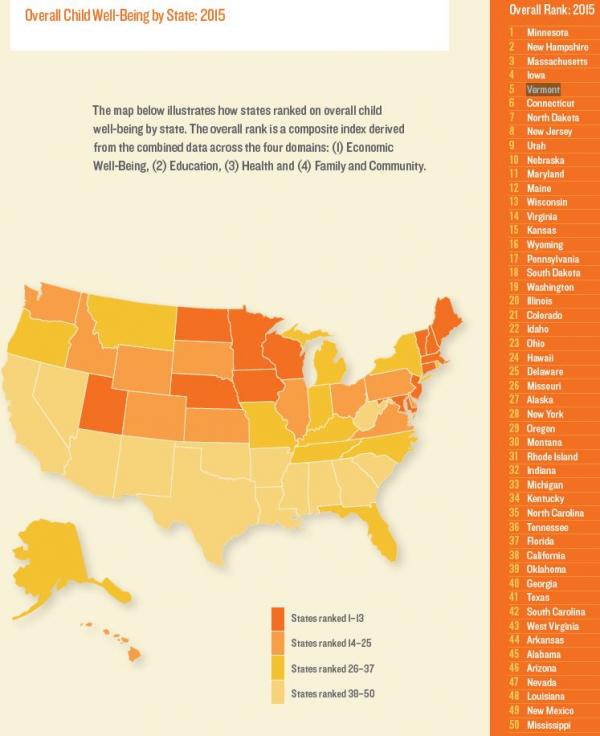
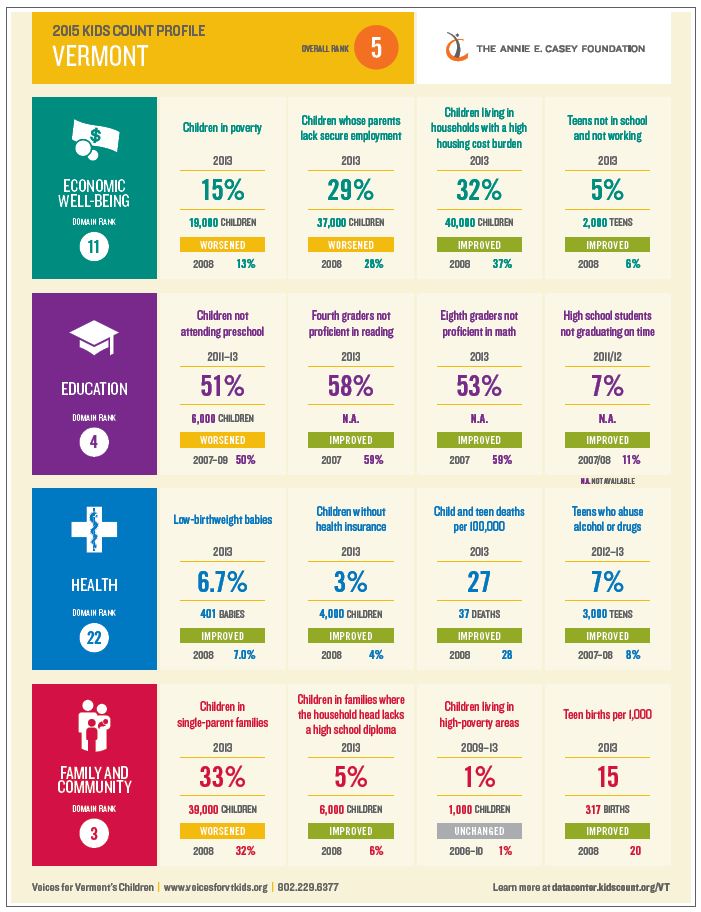
Vermont Business Magazine The latest 2015 KIDS COUNT Data Book state rankings place Vermont 5th in the nation in an index of child well-being. The rankings, released every year by the Annie E Casey Foundation, focus on key trends in child well-being in four domains: economic well-being, education, health, and family and community. Vermont ranked 2nd in 2014, as it did in 2013, and ranked 3rd in 2012. Vermont fell in the Health category from 6th last year to 22nd this year (which likely is related to other states getting better), but rose somewhat in the Economic Well Being Rank from 8th to 4th (where it appears the average across the nation did worse).
Vermont’s drop in overall rank reflects small changes in a number of indicators, said Sarah Teel, research director at the independent child advocacy non-profit Voices for Vermont’s Children.
“We shouldn’t assume that this drop is significant, but nor should we pretend we are not susceptible to the same challenges we see elsewhere if we don’t keep our policy and budget priorities straight,” said Teel. “We may have lost some ground where other states have gained, but as always the important thing is to watch the connection between the data and policy choices that states have made, and their impact over time.”
 Vermont ranks 11th in the economic well-being domain, 4th in education, 22nd in health, and 3rd in the family and community domain.
For the first time in a decade, a non-New England state ranks number one for overall child well-being. Minnesota holds the top spot, followed by New Hampshire, Massachusetts, Iowa, and Vermont. Arizona, Nevada, Louisiana, New Mexico and Mississippi rank lowest.
The biggest improvements in overall rankings compared to last year’s Data Book (www.aecf.org) are seen in Alaska, Minnesota, Wyoming, South Carolina and Missouri. The biggest drops in overall rankings are seen in West Virginia, Indiana, Rhode Island, Virginia, Arkansas and Vermont.
The 2015 KIDS COUNT Data Book paints a picture of an economic recovery which has only reached a few, and that has left an even greater number of children and families in a precarious position than when the Recession started.
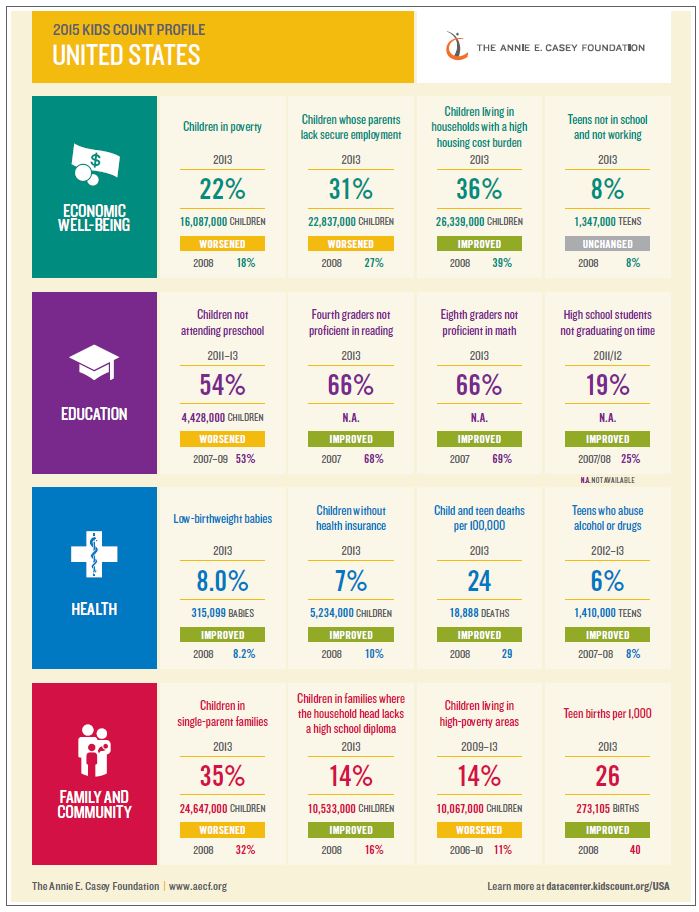
In the US, about 1.7 million more children live in low-income working families today than during the Great Recession. In 2013, one in four children, 18.7 million, lived in a low-income working family in the United States. Nearly a third of children are living in families where no parent has full-time employment. And even when parents are working full time, wages and benefits are often not sufficient to adequately support a family.
Nationally, race is one of the strongest factors influencing a child’s economic stability. Data show the economic recovery of the past five years has bypassed many children of color. Rates of unemployment at the close of 2014 were in single digits for all races except African Americans. African Americans were also the only group for whom unemployment remains higher than before the recession.
“The national averages belie the stark reality that millions of children, particularly African Americans, Latinos, and American Indians live on the precipice of poverty. Today, as the economy recovers, we see a widening gap between the living standards of many children of color and other kids,” said Laura Speer, associate director for policy reform and advocacy. “The good news is when we’ve invested in the right strategies and policies, we have made a difference for kids.”
National and state level policies have proved that investments in health and education can create lasting positive differences for children. The Children’s Health Insurance Program (CHIP), which provides low-cost health coverage to children, was implemented 15 years ago and has drastically reduced the number of children without health insurance. In addition, tax credits and nutrition benefits have helped to lift people out of poverty; however even with these supports, millions of low-income families still struggle to meet their basic needs.
“Although we are several years past the end of the recession, millions of families still have not benefited from the economic recovery,” said Patrick McCarthy, president and CEO of the Casey Foundation. “While we’ve seen an increase in employment in recent years, many of these jobsare low-wage and cannot support even basic family expenses. Far too many families are still struggling to provide for the day-to-day needs of their children, notably for the16 million kids who are living in poverty. We can and must do better: we can make policy choices to lift more families into economic stability.”
The Casey Foundation offers a number of recommendations to make good on the American promise of opportunity for all children. The Foundation promotes a two-generation strategy that simultaneously addresses the needs of children directly while providing tools and resources to their parents. Three critical strategies include:
- Provide parents with multiple pathways to get family-supporting jobs and achieve financial stability.
- Ensure access to high-quality early childhood education and enriching elementary school experiences.
- Equip parents to better support their children socially and emotionally and to advocate for their kids’ education.
The Casey Foundation recommends policies that result in higher pay, paid sick leave, flexible scheduling and expanded unemployment benefits that will result in higher family income, reduced parental stress and an increased capacity of parents to invest in their kids. Detailed recommendations can be found in the 2014 report, Creating Opportunity for Families: A Two-Generation Approach.
 Source: www.voicesforvtkids.org. 7.21.2015. Voices for Vermont’s Children is a statewide, multi-issue, independent non-profit that promotes public policy to enhance the lives of children and youth in Vermont. For more information, visit www.voicesforvtkids.org.
The Annie E. Casey Foundation creates a brighter future for the nation’s children by developing solutions to strengthen families, build paths to economic opportunity and transform struggling communities into safer and healthier places to live, work and grow. For more information, visit www.aecf.org. KIDS COUNT® is a registered trademark of the Annie E. Casey Foundation.