


by Timothy McQuiston Vermont Business Magazine Vermont wants to increase passenger and freight service on the nearly 600 miles of track in the state by expanding Amtrak service to places like Bennington and Montreal, while upgrading the system to more consistently carry heavy loads. While everyone can agree that this would be an economic enhancement to the state, and some would advocate for it based on energy and environmental goals, how it is going to be paid for always has been the principal impediment. The federal government is the main funding source for rail upgrades and the state has subsidized Amtrak service.
But there is no consistent federal funding plan and state subsidies are expected to exceed the rate of inflation. In fact, the 20-year plan as envisioned would cost $665 million, while expected funding at current levels would provide for only $380 million. There is a special TIGER federal fund that the state could apply for, but that is hit or miss, which the state has previously discovered.
The Vermont Agency of Transportation released its draft State Rail Plan 2015 in June. As the report states, the Rail Plan provides a framework for maintaining and enhancing the state rail system. It represents an update to the State Rail & Policy Plan, completed in 2006 and has been prepared to conform to the requirements for state rail plans as specified by the Passenger Rail Investment and Improvement Act of 2008 (PRIIA).
While there are some new elements to the Rail Plan, the Rutland to Burlington leg is the most important.
 Rutlanders were once promised an Interstate highway, which never materialized and no one now expects. But a Rutland-Burlington extension of the Ethan Allen Express is the first order of business. Extending passenger rail would require, among other things, upgrading the track, which then also enhance the resurgent freight business (see congressional letter to US DOT Secretary Foxx requesting TIGER funding below).
Along with the obvious connection to Burlington, it would also be a more direct connection from northwester Vermont to New York City than the current Vermonter.
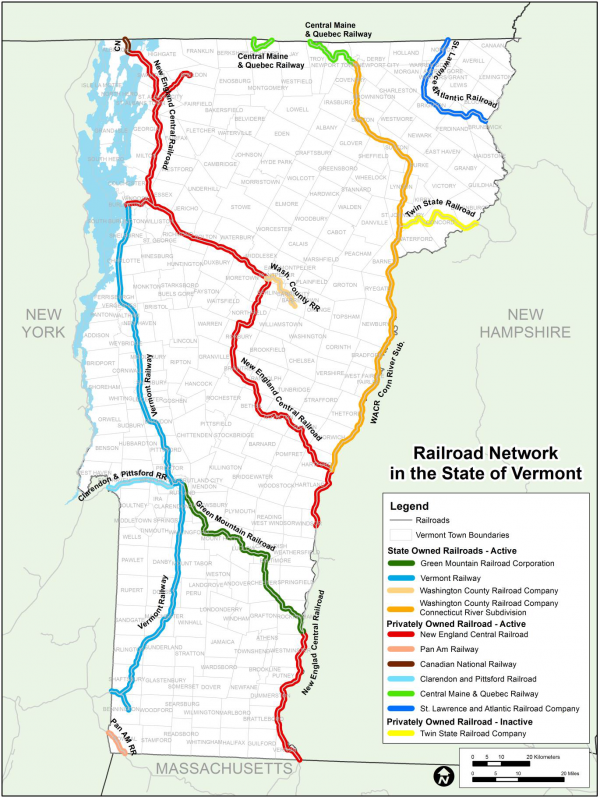
Vermont’s rail network encompasses approximately 578 miles of active rail lines. All of these lines are used for freight service with two routes also being used for intercity passenger service. Exhibit ES-2 illustrates the regional freight network. The State of Vermont owns 305 miles of the active rail network. The State acquired these lines when their former owners either filed for bankruptcy or announced that they would no longer provide service on these lines, or both. The first rail lines the State purchased were those of the Rutland Railroad after the company filed for bankruptcy and abandonment in 1962. The most recent was the acquisition of trackage now operated by the Washington County Railroad Connecticut River Line in 2003. Freight rail service in Vermont is provided by short line and regional railroads. In other parts of the nation, Class I railroads (carriers with revenues in excess of $467 million) serve as the railroad equivalent of the Interstate highway network, carrying freight between regional markets. By contrast, short line and regional railroads serve a gathering role, providing a “last mile” connection to shippers on relatively light density rail lines. In Vermont, similar to most other New England states, short line and regional railroads are the rail network.
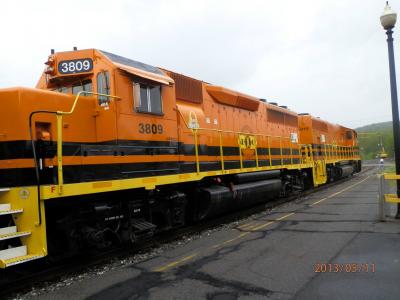 NECR. VTrans photo.
As such, most freight is handled by multiple railroads between origin and destination. On approximately 94 percent of the Vermont rail network, freight service is provided by one of two companies, Genesee & Wyoming, Inc. or the Vermont Rail System. Genesee & Wyoming is the nation’s largest short line holding company with over 113 subsidiary railroads, operating over 13,000 miles of track in North America. The company owns two railroads that pass through Vermont:
· New England Central Railroad;
· St. Lawrence & Atlantic Railroad.
The Vermont Rail System provides freight service on each of the State-owned rail lines under the following subsidiary railroads:
· Vermont Railway;
· Green Mountain Railroad;
· Washington County Railroad.
These rail lines are leased to the Vermont Rail System, such that the State is responsible for capital improvements on the lines, as well as maintaining most of the rail bridges, while the operator is responsible for ongoing track maintenance and freight operations. In addition to operating state-owned lines, Vermont Rail System also owns and operates the Clarendon & Pittsford Railroad. The Central Maine & Quebec Railway also provides service into northern Vermont, and the Pan Am Railway passes through the southwestern corner of the State. The Central Maine & Quebec Railway was created in 2014 from rail lines formerly owned by the Montreal, Maine & Atlantic Railway, which declared bankruptcy following the Lac Megantic disaster.
Passenger rail service in Vermont is provided by the National Passenger Railroad Corporation (Amtrak) through the Vermonter and Ethan Allen Express services. The Ethan Allen Express provides daily service between New York City, Albany, Schenectady, Saratoga Springs and Rutland, covering a total route distance of 241 miles.
Begun in 1996, the Ethan Allen Express operates on a daytime schedule totaling five hours and 30 minutes between endpoints. Fifteen of the train’s 241 route miles are in Vermont, and serves Vermont stations in Castleton and Rutland.
The Vermonter operates daily service between Washington, DC, New York, New Haven, Springfield and St. Albans on a daytime schedule totaling 13 hours and 45 minutes between endpoints, covering a route distance of 467 miles.
The Vermonter traverses 185 miles of its 611-mile route in Vermont, while serving nine passenger stations in the state. Between 2010 and 2012, substantial improvements were made to the Vermonter route in Vermont and New Hampshire.
 Financed by $50 million in federal High Speed Intercity Passenger Rail (HSIPR) funds and another $20 million by the host railroad NECR, most rail was replaced, and other upgrades were completed that eliminated slow orders and restored speeds up to 59 mph between St. Albans and White River Junction, and 79 mph south of White River Junction and Vernon. Prior to the upgrades, slow orders imposed 38 minutes of delay to the Vermonter’s travel time between Brattleboro and St. Albans.
Both the Ethan Allen Express and Vermonter services are subsidized through cooperative agreements between Vermont and other states. The Vermonter is supported by Vermont, Massachusetts, and Connecticut, while the Ethan Allen Express is supported by Vermont and New York State.
The Vermont portion of the subsidies for the two services is about $8.1 million per year, which Vermont pays to Amtrak for providing the services. Exhibit ES-3 displays the passenger routes that serve Vermont.
As in other states, Vermont’s rail network is primarily used to haul low value, bulky commodities long distances.
Some highlights of commodity flows in 2011 for Vermont include:
· Total tons carried were about 6.6 million;
· Most freight, 69 percent, travels through Vermont between other states; 26 percent travels to or from Vermont and other states; while 5 percent travels intrastate;
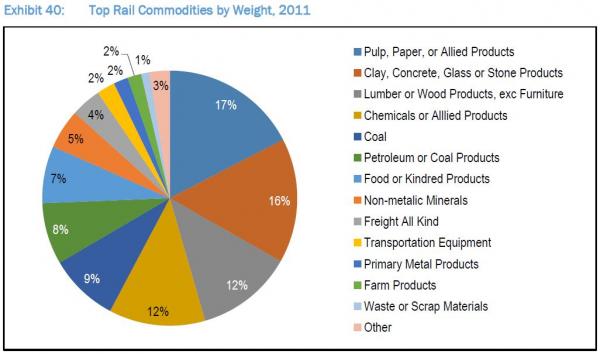
· The Vermont freight network carries a variety of commodities, with Pulp, Paper, and Allied Products; Clay, Concrete, Glass or Stone; Lumber or Wood Products; Chemicals and Allied Products accounting for about 57 percent of the total.
· Volumes shipped on the Vermont rail network have fallen dramatically in recent years, by about 40 percent between 2000 and 2011. Forecasts suggest that freight volumes should climb back slowly over the next 20 years, although Vermont freight volumes are dependent on relatively few shippers, so freight volumes could potentially rebound much sooner.
· New York State, Maine, Canada, and states in the Southeast are Vermont’s largest trading partners by tonnage of rail freight.
 The rail lines of the New England Central Railroad (NECR) and the St. Lawrence & Atlantic Railroads (SLR) are the most heavily used in the State. The Washington County Railroad (WACR) has the lowest freight density of the active freight lines. Highlights of passenger rail usage in Vermont include:
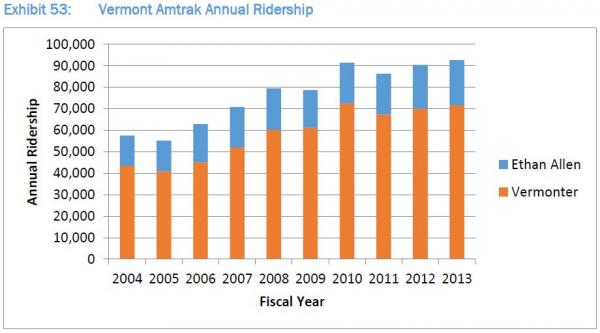
· In Federal Fiscal Year (FFY) 2013 (ends September 30), 101,126 passengers got onto or off of trains at stations in Vermont, of which the Vermonter accounted for 80,100, and the Ethan Allen Express accounted for 21,026;
· Passenger rail ridership has increased considerably in recent years, growing by 60 percent from FFY 2004 to FFY 2013;
· Essex Junction is Vermont’s busiest train station, followed by White River Junction, Rutland, and Brattleboro. Each station saw over 15,000 passengers getting on and off of trains in FFY 2013;
· New York City is by far the largest origin/destination for riders getting on or off of Ethan Allen Express trains in Vermont, accounting for around three quarters of the ridership in FFY 2013. New York is also the largest origin/destination for riders on the Vermonter, but other important origins/destinations include stations in Connecticut, Intrastate travel within Vermont, Massachusetts, and major metropolitan areas on the Northeast Corridor like Philadelphia or Washington, DC.
Vermont has adopted the following goals and objectives related to rail transportation:
· Maintain the State’s Rail System in a State of Good Repair
– Maintain all bridges to the 263,000 lbs carload standard
– Maintain track to appropriate FRA track class
– Remove slow orders – with priority along passenger rail routes
– Upgrade rail to continuously welded rail along passenger routes
– Rehabilitate passenger rail stations
· Expand the Rail System’s Capacity to Accommodate Growth Objectives
– Upgrade all bridges to the 286,000 lbs carload standard
– Upgrade to 115 lbs rail
– Eliminate vertical clearance obstacles
– Install platforms at new passenger stations
· Expand the Rail System’s Use
– Increase the use of rail by shippers and receivers currently using rail.
– Attract new rail shippers and receivers to locate along rail lines
– Preserve inactive rail corridors
– Implement new intercity passenger rail service along western corridor (Burlington, Vergennes, Middlebury, Rutland, Manchester, Bennington) and extend Vermonter to Montreal
– Exceed FRA Intercity Passenger Rail Performance and Service Quality indicators. – Increase existing and planned passenger routes to a minimum of FRA Class 4 Track in order to allow operating speeds to 79MPH
· Provide a Rail System that is Financially Sustainable
– Examine other passenger rail service providers in order to reduce operating subsidies
– Pursue federal grant opportunities to rehabilitate the rail network.
· Improve Intermodal Connectivity
– Integrate rail stations with local and intercity bus transportation
· Improve the Rail System to Support Economic Development
– Coordinate rail and economic development efforts
– Provide incentives for new and existing businesses to use rail.
– Support the development of transload facilities.
· Enhance Safety of the Rail System
– Reduce rail-highway grade crossing collisions
– Participate in disaster planning with local, state, federal authorities
 Improvements to the Vermonter both in Vermont and other portions of the route have boosted the speed and reliability of the service. Beyond the enhancements within Vermont, the rerouting of the Vermonter in Massachusetts is expected to reduce transit times by 25 minutes. Because passenger rail travel is more energy-efficient than highway travel, the 2011 Vermont Comprehensive Energy Plan established a goal of quadrupling intercity passenger rail ridership by 2030 to 400,000 on and offs at Vermont stations per year. Even with optimistic forecasts for passenger growth, Vermont will not be able to meet this goal with existing services. Therefore, if Vermont is to meet this goal, additional passenger rail services must be introduced. Services included in the Plan are described below.
Extend the Ethan Allen Express to Burlington – The Ethan Allen would be extended from its current terminus in Rutland to serve an additional station in Middlebury and Union Station in downtown Burlington. The rail line between Rutland and Burlington would be improved so passenger trains could reach a maximum of 59 miles per hour. The project would enhance mobility in western Vermont, providing a more direct connection to New York City and points on the Northeast Corridor. Burlington is Vermont’s largest metropolitan area and would be served by two Amtrak services, the Ethan Allen Express and the current Vermonter service at Essex Junction. Necessary upgrades include the upgrading of track, additional passing sidings, improved crossings, new wye tracks (triangular junction), and a new station platform at Middlebury. VTrans has begun improvements on this corridor with an $18.5 million project to improve the line between Rutland and Leicester, and estimates that completing the project would require another $26.4 million. VTrans also projects that the extension would add $1 million to annual Ethan Allen Express subsidies.
Extend the Vermonter to Montreal – Before the Vermonter service acquired its current name in 1995, it was the Montrealer, which was an overnight train to Montreal. This project would restore Vermonter service to Montreal but as a day train service. Doing so would enable Vermont’s economy to be more closely tied with the large nearby metropolitan area of Montreal. Ridership on the Vermonter would significantly increase. In March 2015 the United States Department of Homeland Security and The Government of Canada signed a preclearance agreement which will make new train service agreements easier by setting up an agreed upon process for border crossing, customs, and other cross-border activities.1 Given that over $90 million has been spent in recent years on the Vermonter corridor in Vermont and that the service would share the existing passenger rail corridor with the Adirondack through most of the route in Canada, VTrans does not anticipate significant capital costs associated with the extension. However, VTrans estimates that the Vermonter subsidy would increase by $2 million, associated primarily with the cost of cross-border operations, and additional expenses incurred in Canada. As a later initiative, Vermont would add a second Vermonter frequency, although this would require negotiations, not only with Canadian authorities and Amtrak, but also with other New England states.
Add New Service between Albany, NY and Burlington, VT – A new train would provide daily service between Albany and Burlington via Mechanicville, NY, North Bennington, Manchester, Rutland, and Middlebury. The service would improve mobility and boost the regional economy in southwestern Vermont. Currently, residents have limited public transportation options. The project would better connect southwestern Vermont with Albany, with further rail connections to New York City and points beyond. The project would boost the attractiveness of the region to tourists and visitors. Infrastructure improvements necessary to enable the service in Vermont are estimated to cost about $88 million, including a signal system, track improvements, crossing improvements, bridge improvements, and the cost of new stations. Operating subsidies for the service is estimated at approximately $4 million per year.
 According to VTrans, the annual available State funding available to cover capital needs is approximately $4 million. Over a 20 year period, this would total to around $80 million. While appropriations for rail activities by the Vermont legislature are much higher than $4 million per year, most VTrans funding for rail covers operating expenses, such as Amtrak service subsidies and is not available for capital expenditures.
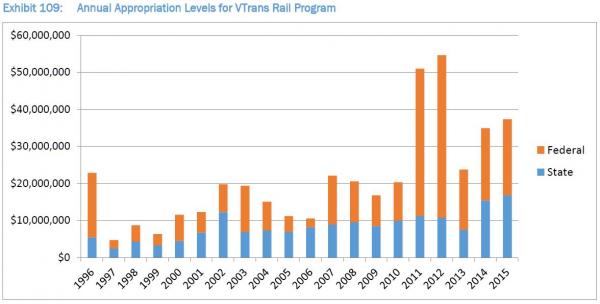
As shown in Exhibit 109 , federal funding levels for rail in Vermont have varied dramatically, from $2.3 million in Vermont Fiscal Year 2006 (ending June 30) to $43.8 million in 2012. Overall funding levels for rail in Vermont have increased over the past 20 years, from both state and federal sources. Since 2002, federal funding levels have averaged slightly over $15 million per year. A variety of federal funding sources have supported rail in Vermont, including grants, such as the TIGER Discretionary Grant programs and the High Speed Intercity Passenger Rail (HSIPR) program. Upgrades to crossings are supported by the FHWA Section 130 Crossing Improvement Program.
Vermont's congressional delegation sent a letter toAnthony Foxx, Secretary, US Department of Transportation, urging him to include the western corridor upgrade to the next TIGER grant.
Senators Leahy, Sanders and Congressman Welch said in the May 22, 2015, letter:
"We are writing to express our strong support for the application submitted by the Vermont
Agency of Transportation (VTrans) for funding under the TIGER 7 program. The Western
Vermont Freight-Passenger Rail Project is the final phase of an ambitious multi-year effort to
upgrade antiquated rail infrastructure to improve the movement of freight along the “western
corridor” and reestablish passenger service to Vermont’s most populous city for the first time
since 1953.
"There is significant enthusiasm in Vermont for extending Amtrak’s Ethan Allen Express route
from its current terminus in Rutland all the way to Burlington. This link will create important rail
connections between vital economic regions within Vermont, and enhance access to and between
the Northeast and Empire High Speed Rail Corridors.
"This project will a so greatly improve the movement of freight along the Western Corridor,
which will help relieve pressure on the overburdened USRoute 7. The project will benefit
many businesses and promote economic opportunities all along the route, which is especially
important because western Vermont lacks an interstate highway. Without access to modern
transportation infrastructure, businesses in the region are finding it increasingly difficult to
compete in the global economy.
"Completion of this project will mean we will finally realize the full environmental benefits of
diverting both cars and trucks from our roads. In fact, this project is a critical component of the
state’s efforts to reduce greenhouse gas emissions by fifty percent over the next twenty years, by
doubling rail freight tonnage and quadrupling rail ridership.
"This proposal will leverage considerable state, private and especially federal investment. The
latter includes a $30 million Transportation Improvement Project grant through SAFETEA-LU
and a 2010 FRA-funded study of expanding Amtrak service in western Vermont. Most recently,
the project received a $9 million TIGER 5 grant to upgrade 20 miles of track along the corridor.
While we were disappointed that DOT did not fund a similar application in the last TIGER (6) round,
it is time to complete this project and realize the full benefits of the federal investments made to
date. We very much appreciate you giving this application the serious consideration it deserves,
and if we can provide further evidence of our strong support, please do not hesitate to contact us."
Obligations from the $25 million earmark secured by Senator Jeffords have also been applied to improvements on the Vermont Railway. Vermont additionally received funds from the Federal Emergency Management Administration (FEMA) following the destruction from Hurricane Irene.
Because there is no consistent, dedicated federal funding source for rail transportation in the United States, and most funding for Vermont’s capital needs would have to come from federal sources, it is difficult to predict the money that would be available to fund the capital needs identified in this Plan.
Fortunately, Vermont has been successful in securing federal funding for rail in the past. But it is not certain that VTrans will be as successful in the future. Furthermore, the largest single source of federal money over the past decade was the $50 million federal grant to upgrade the Vermonter route, funded through the American Recovery and Reinvestment Act (ARRA).
But ARRA represented an unprecedented amount of money available for rail, and it is questionable whether such a funding source would become available again over the next 20 years.
Nevertheless, if funding for rail in Vermont were to be consistent with previous levels since 2002, then available funding over the next 20 years is estimated to be approximately $380 million ($15 million federal x 20 years + $4 million state x 20 years). This compares to $665.6 million in needs that have been identified in this Plan.
Thus, the shortfall would be $285.6 million or 43 percent of the total. Exhibit 110 displays annual investments per the phasing of projects identified in Exhibit 104 and Exhibit 105. These amounts assume that the investments are spread evenly over the period of each initiative. The funding assumes that projects are funded 20 percent by the State, and 80 percent by the federal government.
Of the $665.6 million in capital needs, efforts to upgrade Vermont’s passenger rail routes to FRA Track Class 4 (79 mph) standards represent $255.9 million or 38 percent of the total. Delaying upgrades of passenger rail lines to FRA Track Class 4 standard beyond the 20 years of this Rail Plan significantly closes the funding gap, so that the identified needs are $409.7 million or $29.7 million higher than the assumed funding levels.
Beyond delaying the upgrade of passenger rail lines to FRA Track Class 4 standards, the application of asset management techniques as described on page 115 may also help to close the funding gap. VTrans could look for areas where investments provide a level of service that is “good enough” for rail asset users rather than necessarily ideal.
As an example, in order to accommodate 286,000 pound railcars, railroad track infrastructure generally must have rail of at least 100 pounds per yard, two-thirds of ties in good condition, and ballast in good condition.
While trackage meeting these minimum conditions may not be ideal, it could suffice for railroads to operate 286,000 pound railcars. The same may be the case for railroad bridge upgrades, where the scope of improvements may range from upgraded replacement to good enough to meet users’ needs.
Source: VTrans 6.19.2015 SEE FULL REPORT HERE. VERY TOP PHOTO: Amtrak in Roxbury. copyright Kevin Burkholder Steel Wheels Photography steelwheelsphotography.