Lake Champlain Committee (LCC) The Lake Champlain Basin Program released its 2015State of the Lake reporton June 30. The report states that, “although water quality trends in Lake Champlain are cause for concern. . .more than 85 percent of Lake Champlain’s water is consistently of excellent quality and another 13 percent of the water is usually in quite good condition. In the remaining 2 percent of the Lake, conditions are seasonally alarming. The most compromised parts of the Lake are St Albans and Missisquoi Bays … and the South Lake”.
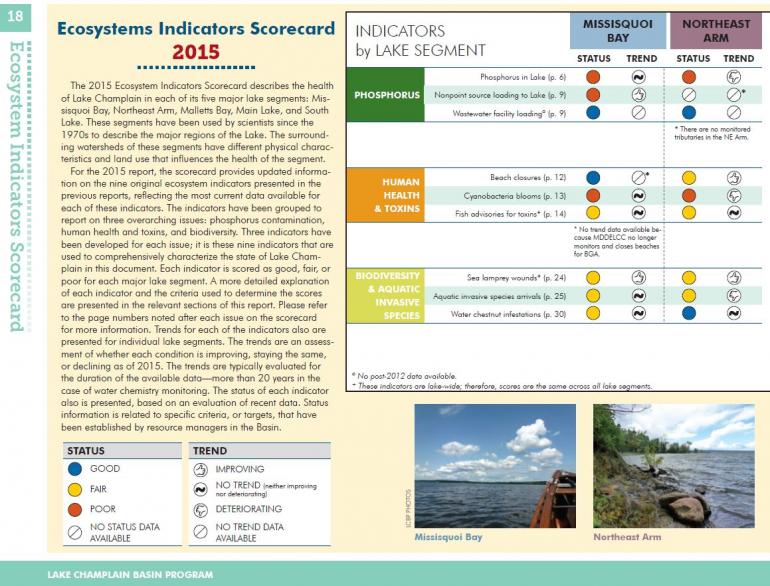
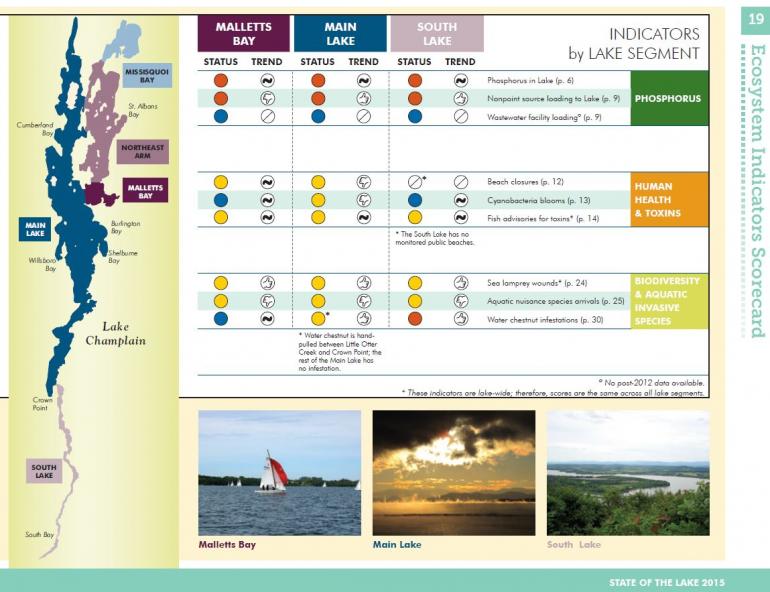
The State of the Lake report offers information about lake conditions related to phosphorus, beach closures, fish consumption advisories, invasive species, and climate change. It updates the last such report which was issued in 2012. A two-page central spread (SEE BELOW) condenses the information down to nine key indicators and provides information about status and trends of each indicator for each of the five major lake segments: Missisquoi Bay, the Northeast Arm, Mallets Bay, the Main Lake, and the South Lake. The indicators offer a mixed review of how well the lake is doing.
“Phosphorus concentrations have not decreased significantly in any areas of Lake Champlain, despite reductions in the amount of phosphorus entering the Lake from several of its tributaries. Long-term trends since 1990 indicate that phosphorus concentrations in several segments continue to increase.”
The report cites no trend in in-lake phosphorus concentrations for four lake segments, while concentrations are increasing in the Northeast Arm. Three lake segments show declines in annual nonpoint source loading, there are increases in Mallets Bay and no trend for the Northeast Arm. There have been more beach closures in the Main Lake, fewer in the Northeast Arm, no change in Mallets Bay, and insufficient information for Missisquoi Bay and the South Lake.
There is no change in trends for blue-green algae blooms for three lake segments but more blooms in the Northeast Arm and Main Lake.
Sea lamprey wounding rates have decreased in all lake segments.
US Senator Patrick Leahy sent this statement following the report:
"Knowledge about the Lake informs decision making, and ongoing monitoring and reporting on Lake Champlain is a key to effective action and progress. That’s whyI continue to work to secure federal support for the Lake Champlain Basin Program.
"This report shows that most of Lake Champlain is in good condition, and that is great news. With very good water quality overall, the Lake continues to support healthy and diverse ecosystems. Twenty-five years of controlling the sea lamprey threat is delivering results. More, larger and healthier fish are being caught, and diverse water bird communities are thriving.
"We all would love to see this report show improving water quality across the board, but it does not. Years of continuing effort have helped to blunt trends that would have greatly worsened without that work. We know that it will take years of hard work to bend those lines further in the right direction. We need to stay on that mission and continue redoubling our efforts until we reach our goals for the Lake. With a large and dynamic ecosystem like Lake Champlain, there is no standing still. We’re either advancing, or slipping behind.
"It is discouraging that the Lake hosts at least one more invasive species since the last report, the spiny water flea. Whether or not the spiny water flea arrived through the Champlain Canal in New York, we know that the canal is an open door for other unwanted species. I hope the State of New York will apply the funds I have worked to secure to fix that problem before the next State of the Lake Report.
Across the board, at every level of government, we have made a considerable investment in Vermont’s “Great” Lake. We must continue that progress so that we do not slip backward on the progress we have made to protect and preserve Lake Champlain."
The Basin Program’s next major task will be updating Opportunities for Action, the plan for coordinating and directing the actions of federal and state partners to improve and manage the state of the lake. You canread the report onlineordownload a PDF. Lake Champlain Basin Program