

by Timothy McQuiston Vermont Business Magazine The massive earthworks at the Rutland Southern Vermont Regional Airport is the largest of its kind in New England. The top three largest employers represent health care (Rutland Regional Medical Center, 1,300 employees), high-end manufacturing (GE Aircraft Engines, 1,000 employees) and hospitality (Killington/Pico Ski Resort, 800 employees). Rutland downtown is as good as it’s been in anyone’s memory. Higher education, until recently a weakness, is becoming a significant contributor to the economic landscape. But all of that is not what local development specialists mention first when talking about the local development: It’s energy innovation.
“We’re leading the way in the state with respect to energy innovation and sustainability and knocking down the barriers between the competing elements of adaptation and mitigation regarding climate change,” long-serving Rutland Mayor Chris Louras said.
Brennan Duffy, CEcD, executive Director of the Rutland Redevelopment Authority, said that his organization’s marketing, given the limited dollars, is directed at energy efficiency, solar development, environmental technologies.
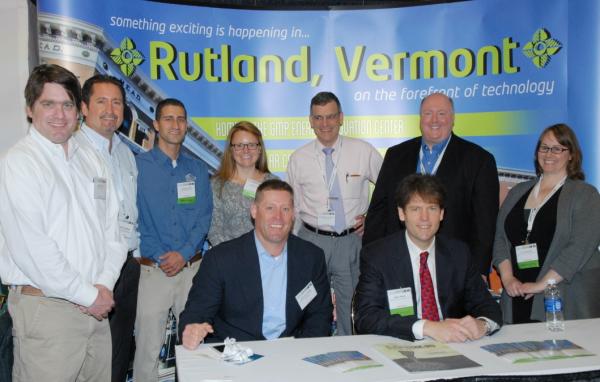 Front, Brennan Duffy, RRA, and Mark Werle of Ryan Smith & Carbine, Ltd. Standing, left to right, Mark Joyce and David Hughes from Foley, Craig Ferreira and Betsy Ide from GMP, Rutland Mayor Chris Louras, and John Valente and Erin Gilmore of Ryan Smith & Carbine. VBM photo
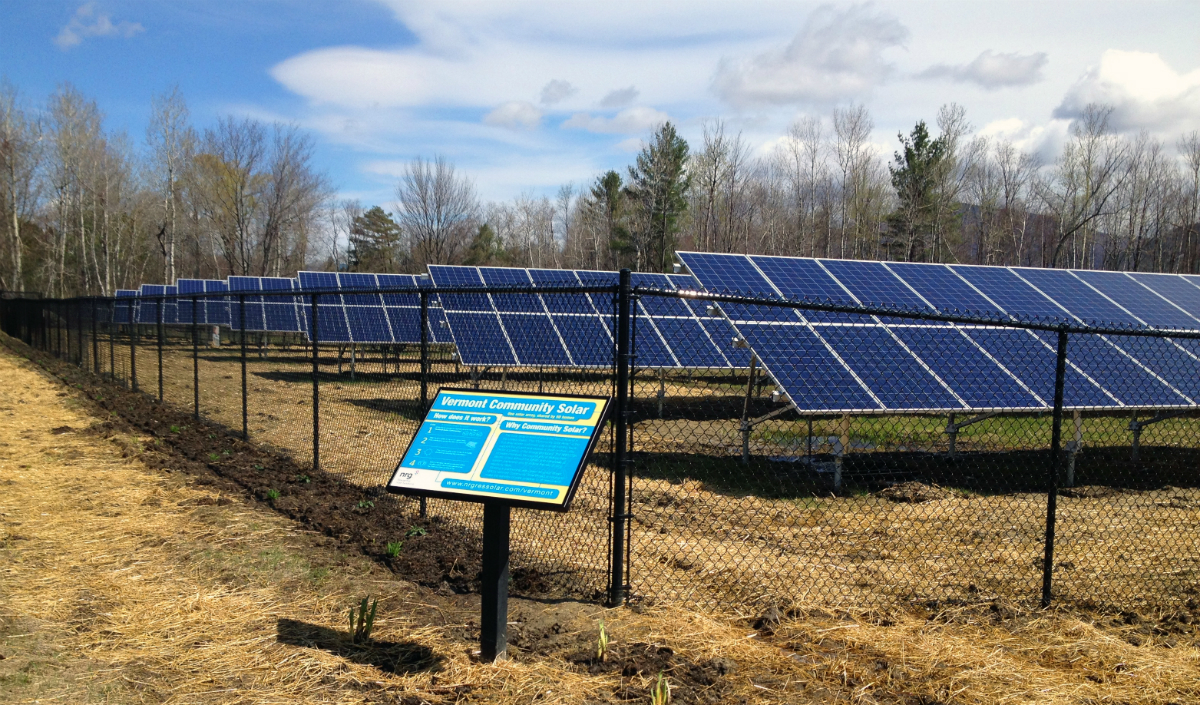
The RRA, and other local stakeholders, have collaborated with Green Mountain Power, which has poured millions of dollars into its Energy Innovation Center and local solar projects, to make Rutland the “solar capital of New England” with the most solar generation of any city in the region per capita.
Using the old landfill, GMP is developing a solar farm and electric storage facility. Using the latest in battery technology, the concept is to have backup power, fueled by solar, as another emergency source of power.
“GMP has also helped other solar developers and has been cognizant that there is limited developable land in the city,” Duffy said, “which in some cases might be better used for other development projects other than for the siting of a solar array.”
Rutland is partnering with GMP and other energy firms, Louras said, to develop energy models which other communities, here and around the country, can adopt.
Steve Costello, GMP’s vice president for generation and energy innovation in Rutland, said, “The regional economy feels stronger than it has in years. GMP, working with the city, Downtown Rutland Partnership, local colleges and other partners, has made energy innovation a focal point for economic development, which has had a significant impact on the historic downtown. Starting with the purchase of a dilapidated department store, the largest vacant space in the city core, GMP has had a key role in the revitalization of downtown Rutland. The former store is now GMP's Energy Innovation Center, a gold-LEED-certified facility, where employees are working to create the Energy City of the Future, and educate customers and students alike on how to use energy smartly and efficiently. Downtown occupancy is now at the highest level in generations.
“Over the past couple of years, dozens of new businesses have opened downtown, including four solar companies, Small Dog Electronics, The Bakery, Cape Air and other retail and service companies.”
Costello said GMP has invested millions in the region and will continue to do so.
“While various elements of GMP's work in Rutland are also taking place in other parts of the country,” he said, “the Department of Energy tells us that our comprehensive approach in Rutland is the first of its kind in the nation. Rutland used to be the marble capital. Soon it will be the Solar Capital of New England and the Energy City of the Future.”
Along with the solar emphasis, and incentives that go with it, Duffy has a valuable card to play, especially for manufacturers.
There is excess sewer/water capacity, he said, so Rutland can offer new developers a discount in the base rate for five years, which could save a large user hundreds of thousands of dollars. Duffy said this ultimately would help all ratepayers because once those companies become established, they would be paying regular water rates. The companies must meet certain guidelines for investment and employment to get the water deal.
“The incentive would be available for any business,” Duffy said.
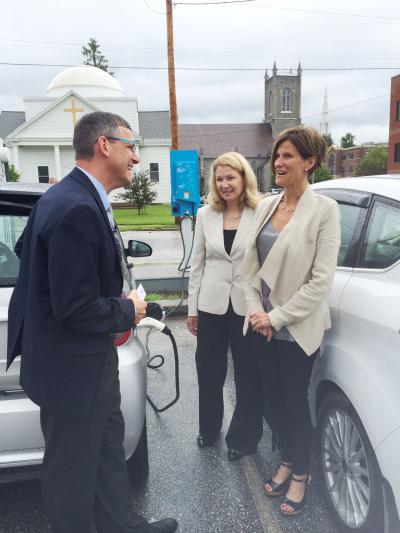 Mayor Louras "fills up" his car at a charging station in Rutland in June with Mary Powell of GMP and Denise Wilson of NRG. Vermont is the first New England state to be added to NRG EVgo’s national public fast-charging network. STORY
The city taxes solar installation so that money is in turn used for economic development incentives: Loans and grants and workforce training. That last part is significant.
“There are workforce development challenges facing the entire state and I see that as an opportunity rather than as a challenge, frankly, and Rutland shares that challenge and opportunity with the rest of the state,” Louras said.
“We just had a meeting a couple of days ago with the state Workforce Investment Board, that I’m a member of,” Louras told VBM in late May, “and Dan DiBattista, who is the plant manager at General Electric (Rutland), discussed the need to address workforce development, not just for the production workforce, which is critical to ensure that they’ve got the individuals to do the work on the line, but more importantly for those middle and higher managers, who provide the leadership.”
“The quality of workers we have in Rutland, using GE as an example, are second to none,” he said. “The individuals and the workforce that’s in Rutland, they’re top notch. However, it’s a function of numbers and a function of training. We’ve got to make sure that as the pool of individuals who work in the industries in the Rutland area are aging, we can then backfill with younger folks. And that’s where the challenge is. The problem is not the numbers we have now, but rather the numbers we’re going to have in the future.”
Retail & Hospitality
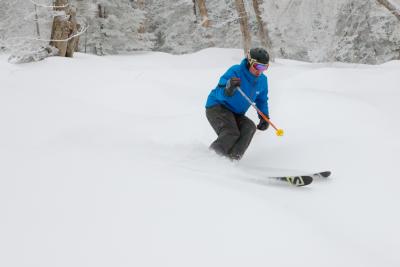 Killington skiing in April. They were still on the slopes into June. Courtesy PJ McDaniel/Killington
Despite being nearly June, Killington (at deadline) was still open for skiing on the weekends. Hospitality – and the ski industry in particular – has had some of its best years ever lately and has helped the state’s economy stay upright following the recession.
For retail, the message has been more mixed. The Diamond Run Mall, just south of the city, has lost two of its three anchor tenants – Sears and JC Penney – and with it about 100 employees.
Duffy said he’s not sure the what mall owners are planning to do
“I wish they’d be more forthcoming, frankly,” he said. But, “I don’t think it’s a lost cause at this point.”
The mall has always been controversial and still pays the city a diminishing amount of compensation to offset lost retail to the downtown. And while downtown is doing much better despite all that, a failing mall would be a blot on the local economy.
The Redevelopment Authority, in fact, was formed at the same time the mall was developed, in 1989, as a response to its possible impact on the city.
“I have a lot of respect for Jeff (Wennberg, Rutland mayor at the time). I think he got the best possible deal for the city,” Duffy said.
Kmart remains, as do other popular retailers like Old Navy.
And while the Mall is struggling, “Retail in downtown is doing very well,” Duffy said. He mentioned the success of Hobby Lobby as an example of the strong marketplace and Phoenix Books is expanding from Chittenden County.
Costello said of the downtown, “First floor occupancy, after hovering in the high 70s and low 80s for years, is now at 96 percent, with just a handful of street-front spots available.”
The Paramount Theatre (Coming soon: Zappa plays Zappa and The Wiggles) is the centerpiece of the arts scene and is looking to do more with the colleges. Also, a recent study found the city could use another hotel, Duffy said.
Instead of nearly everyone finding accommodations on the mountain and having to travel down to Rutland and back at night, Duffy said instead they could stay in Rutland, shuttle up to ski, and then come back and stay in town and shop and go to the Paramount and enjoy the new restaurants and bars.
Rutland development officials are now looking to re-develop the upper floors with housing to increase the local population, which would further enhance the vibrancy of downtown.
It’s important to make sure that there is a diverse retail sector, Duffy said.
Capital, Louras said, continues to be a challenge, “but we’re able to find work-arounds when we work together and collaborate.”
“Phoenix Books,” he said as an example “is using the CSE, the Community Supported Enterprise model, where 50 people put up $1,000 each in order to provide the working capital to get an independently owned bookstore into downtown Rutland.”
“As far as Rutland is concerned,” Louras said, “we’re not transitioning, we have transitioned the community to be a destination, not just in the region but throughout southern Vermont. We’ve gained a reputation as a community that has re-established itself through Renaissance as a place where things are happening. We’re seeing that in the retail sector and in the restaurant and service sectors as well, that people are coming to Rutland from the surrounding communities and also folks are coming down from Killington to enjoy what we have going in downtown Rutland.”
Duffy said, “Everywhere in Vermont is probably changing.” He added that, “Conventional manufacturing is still important, but not something to just focus on.”
Transportation
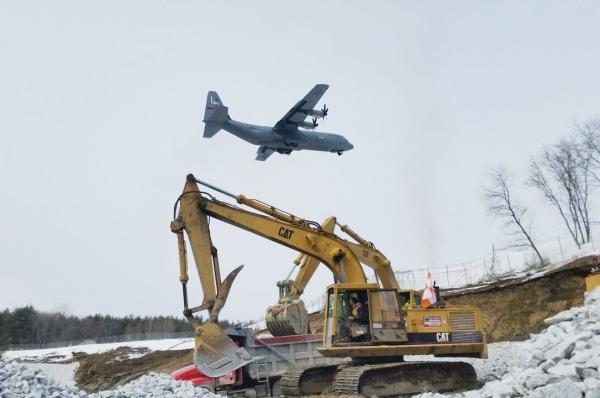 Markowski Excavating at Rutland Airport. Courtesy Markowski
While still a rail hub of the region, transportation is an ongoing challenge. The Route 7 corridor can still be a slog of stop lights and stop and go traffic, despite upgrades in recent years.
Duffy hopes that downtown transportation grants will make the historic gateways to the city more inviting, especially at Strongs Avenue coming off Route 7 into the downtown. Between the grant and city matching funds, they have a $300,000 budget to work with.
As for rail, the region is hoping to gain a federal TIGER grant (Transportation Investment Generating Economic Recovery) to upgrade the passenger line to Burlington and ultimately Montreal, which would benefit commerce and especially hospitality across the region. There is no other sufficient funding available without TIGER.
“We do have the challenge with the transportation infrastructure,” Louras said, “but in talking to the business leaders in the community, specifically in manufacturing, while it’s a challenge, it’s not a barrier. And workforce development is something we’re more concerned about than transportation, frankly, at this time.”
Meanwhile out at the Rutland Southern Vermont Regional Airport, CapeAir is doing well with its service to Boston and they’re trying to get service to the New York area.
The airport received a federal grant last July of $8.1 million to make to make safety improvements to the airport located in North Clarendon.
The grant, awarded as part of the Federal Aviation Administration’s Airport Improvement Program, extends the runway an additional 300 feet (5,000-foot runway), which will provide a larger margin of safety and allow departing aircraft to take on more fuel before takeoff.
The grant will primarily be used to construct FAA-compliant runway safety upgrades, including a massive retaining wall and an EMAS (Engineered Material Arresting System in the event that an aircraft overruns the runway.) The EMAS is a crushable material that slows and stops a plane.
Upwards of $7 million will go to the safety elements, said David Markowski of Markowski Excavating, Inc in Florence, which is doing the work.
Markowski said he’s been able to hire more workers and push up his workforce to 70 employees, while contracting out for another 12-15 trucks. “Everything has to be imported in.”
He said the 750-foot-long retaining wall, which reaches 75 feet (the center piece of the upgrade, which also includes other safety upgrades) is the largest such airport safety project of its kind in the region.
“It’s a major project for the area,” Markowski said. He said it will bring the airport up to FAA standards.
There is so much extra fill, he said they’re using it (50,000 cubic yards) to build and donate a ball field to the town of Clarendon.
The colleges
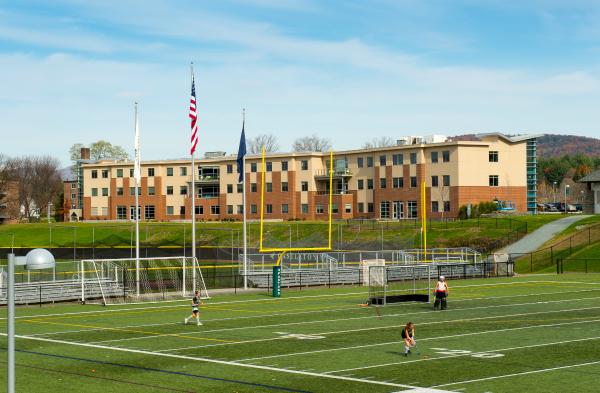 Castleton's Hoff Hall. Courtesy CSC.
The colleges – Castleton State, College of St Joseph and CCV – have been more active lately and are contributing to the vitality of the area by adding economic development and more student activity into the mix. Castleton is doing more in the city and the city is working with the state college.
James Lambert, Director of Communications for the College of St Joseph, said the private school is very much in a growth phase.
“The College of St Joseph is currently expanding its offering in Health Science as it works toward accreditation on what would be the state’s first Physician Assistant program and welcomes its first cohort to its fully accredited Radiologic Sciences program in fall of 2015,” he said.
“Contingent upon accreditation, the college plans to move forward with a $12 million renovation of the historic Marble building and former Omya labs in Proctor. This health science facility will house the PA program classroom, skills lab, simulation lab, computer lab, student lounge, faculty lounge, two conference rooms, ADA compliant restrooms, lockers, shower room, anatomy lab, reception, faculty and staff offices, resource room. Also, break out rooms, equipment and file storage space, copy center room, food service, and exercise/yoga room. The target date for completion of renovations is spring 2016. The buildings were donated to the college by Omya Inc.
“The expansion of the college will have a significant economic impact,” Lambert said. “The jobs created by the expanded offerings are projected to have a positive annual economic impact of more than $1.2 million per year, according to a report by the Rutland Economic Development Corp.”
Castleton State College, which prefers being referred to as just Castleton, is already well into expansion and is building upon athletic and housing upgrades.
Speaking for the college, Jeff Weld, Director of College Relations and Sports Information, said, “Rutland continues to battle aging infrastructure but with a renewed positive attitude. Castleton remains an integral part of the renewed focus on the arts, community engagement and entrepreneurship. Within the last two years the college has opened the Castleton Downtown Gallery to rave reviews, and has seen its efforts at the newCastleton Downtownlocation reap rewards for not only the college, but the region’s economy. The future is bright in Rutland County, thanks in large part to strong leadership, a clear vision for what Rutland can become, and engaging the community in achieving that vision.”
For general economic development in the region, he said, “Castleton's investment in the Spartan Arena for the past seven years has contributed greatly to economic development and community recreation in Rutland Town and the region, and the installation of the new Spartan Dome later in 2015 will bring new visitors to the area, providing a new regional recreational facility, operating as a laboratory of learning for Castleton students and for the betterment of the community. Castleton continues to contribute several hundred students to the Rutland area service learning workforce every semester, with many of them converting their volunteerism and internships into full time jobs upon graduation.”
Weld said the state could help the college, and therefore the region, by putting more into higher education, a common refrain among the public institutions here.
“Castleton continues its growth and development despite only 9 percent of its budget coming from state government. Therefore, increasing undergraduate and especially graduate enrollment, along with new and creative entrepreneurial initiatives that serve our students as well as Vermont, will determine the college's future success as it becomes more akin to a small public university in the future,” he said.
Natural Gas Pipeline
Rutland Mayor Christopher Louras told VPR in February, after Vermont Gas canceled the Rutland phase of its gas pipeline extension, that he was shocked by the news, which he considers a major blow to Rutland's future business prospects.
"My reaction and Rutland's reaction as a whole will be the same, which is disappointment frankly,” Louras said. “The fact of the matter is we had been working for years on this – it has now delayed the project and it will not be coming any time clearly before 2020 probably out to 2025."
The Rutland region in particular is still smarting from not getting an Interstate highway as promised 50 years ago. The gas pipeline is seen as another major economic development opportunity that could go begging.
Vermont Gas President Don Rendall said Vermont’s only natural gas pipeline company has not given up on Rutland.
Rendall is being cautious and despite very much wanting to run a pipeline farther south, he can’t guarantee when the economics of the project would be feasible.
“We’re aiming to have a good look at the Rutland question in late summer,” Rendall told VBM. “That’s what we’re aiming for, is to get some preliminary numbers. We’ve learned our lesson here. We haven’t picked a route. We’re not going to have a particular route. We’ve got a lot of work to do before we would ever have a route for a project like that, because that involves sitting down with communities and landowners and individuals to see how that would work. But we should have – let’s call it a 40,000-foot view – by the end of the summer.”
In the meantime, Milton-based NG Advantage is trucking compressed natural gas to some industrial customers in Rutland County. Smaller businesses and residential customers, however, will have to wait for a more comprehensive solution.
Redux
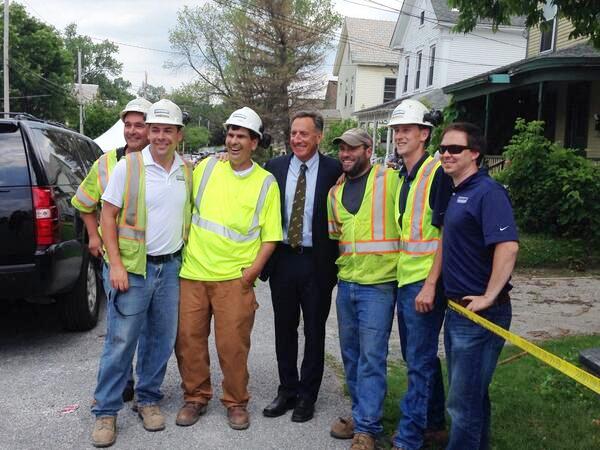 As for the revitalization of Northwest Rutland, Governor Shumlin announced a $1.25 million Vermont Community Development Program award to the City of Rutland last July. In partnership with Rutland Redevelopment, NeighborWorks of Western Vermont will use the funds to improve blighted properties and create homeownership opportunities.
The funding is one element of a broader revitalization effort that also includes infrastructure improvements, a new vacant building ordinance, municipal tax stabilization, public safety measures, community building and gardens.
Duffy said he hopes to see significant progress on this project by this time next year.
“These things take longer than you would want,” he said.
Overall, Duffy said, “I think there’s been really good growth the last couple of years.”
“I’m not sure we need to change and go after the next big thing,” Louras said. “I think we’ve already done that: We’re ahead of the curve on energy innovation and we just need to nurture that sector. For the Rutland area I think it’s about, in one word, sustainability. Whether it’s sustainability in the energy sector or sustainability in the local food sector. We also see that as part of our future: the farm-to-market model as well as the value-added model for locally grown foods as well.”
Costello said, “Through Project VISION, a city-lead effort that includes nearly 300 people and organizations, all of these issues are being addressed. Crime rates have been slashed, community pride is growing, and there is a sense of optimism in Rutland I haven't felt since my childhood. My own grandfather owned a store in downtown more than 80 years ago, and I think he'd be proud of what Rutland has accomplished in the past few years.”
The regional data tends to support the enthusiasm, at least modestly.
The Rutland County unemployment rate for March 2015 (unadjusted and the most recent available) was 4.3 percent. While that is still higher than the statewide average of 3.9 percent, compared to the same time last year (4.6 percent), progress has been made. The labor force has increased to 32,150 and the number of total employed in the region increased in one year by 550 to 30,750.
“The community and region are small enough that it's easy to pull people together to get things done,” Costello said. “The Gift-of-Life Marathon, for example, which set the national record for a one-day blood drive 18 months ago, still holds that record. I don't believe a large community will ever break it.”
Duffy said, “The general feeling is that Rutland is heading in the right direction, right now.”
This article was first published in the June issue of Vermont Business Magazine