

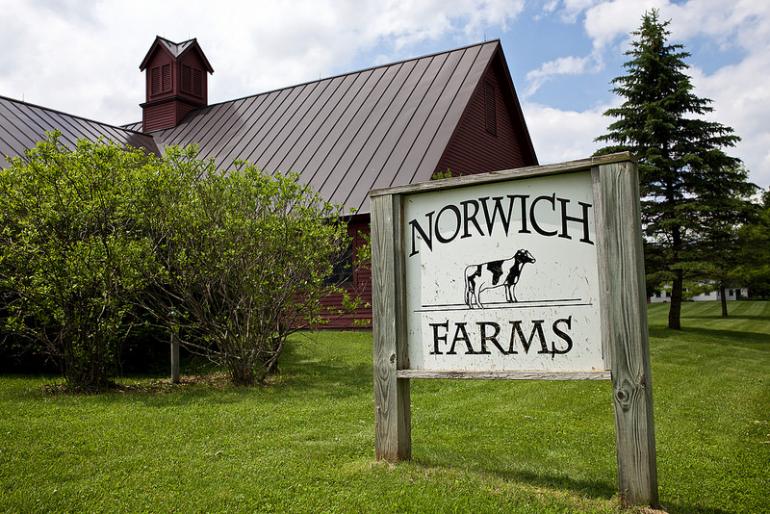
 Vermont Tech opened the doors today to the recently donated Norwich Farms dairy farm. The donation encompasses an approximately 350-acre, 40-stall operational dairy farm on Turnpike Road in Norwich, Vermont, along with three residential buildings and multiple barns. Vermont Tech’s plans for the property include the development of a residential dairy intensive educational experience, delivered on the farm and relying on a fully operating herd. The layout and nature of the facility offer a strong environment for teaching and learning and will provide students with high quality learning experience.
“This donation is unprecedented for the college and enables Vermont Tech to provide students with an intensive residential agricultural education that’s diverse and second to none,” said Vermont Tech President Dan Smith. “The donation allows Vermont Tech to expand and diversify our educational offerings to better serve students and Vermont agriculture. We are deeply committed to the vibrancy of the working landscape and the success of our local farms. Moreover, our partnership with the Upper Valley Land Trust ensures that long term conservation objectives of the Upper Valley community are met.”
Along with Smith, VSC Chancellor Jeb Spaulding, VSC Board Chair Martha O’Connor, Deputy Secretary of Agriculture Diane Bothfeld, Vermont Tech Professor Dr. Chris Dutton, and Representative Jim Masland were present at the ceremony. Masland also serves on the Vermont State Colleges Board of Trustees.
The farm operation in Randolph Center is exploring a phased plan to move into beef production, teaching the next generation of farmers in a rapidly growing sector of Vermont agriculture.
The Norwich farm facility reinforces Vermont Tech’s leadership position in post-secondary applied agricultural education. With the farm, Vermont Tech will be able to provide full-immersion, applied learning experiences for its students to develop expertise in the practical aspects of dairy farming, food production and the food system.
Vermont Tech’s highly regarded specialized dairy farm education will be adapted to include a concentrated intensive semester. During the year, students will spend a semester operating the Norwich Farm in close connection with faculty and working as teams on farm operations, laboratory exercises and classroom study. Living and working on the farm for 16 weeks, students benefit from real-world learning experiences. The college will also explore the delivery of farm-based intensives in shorter format summer experiences for students from other colleges.