

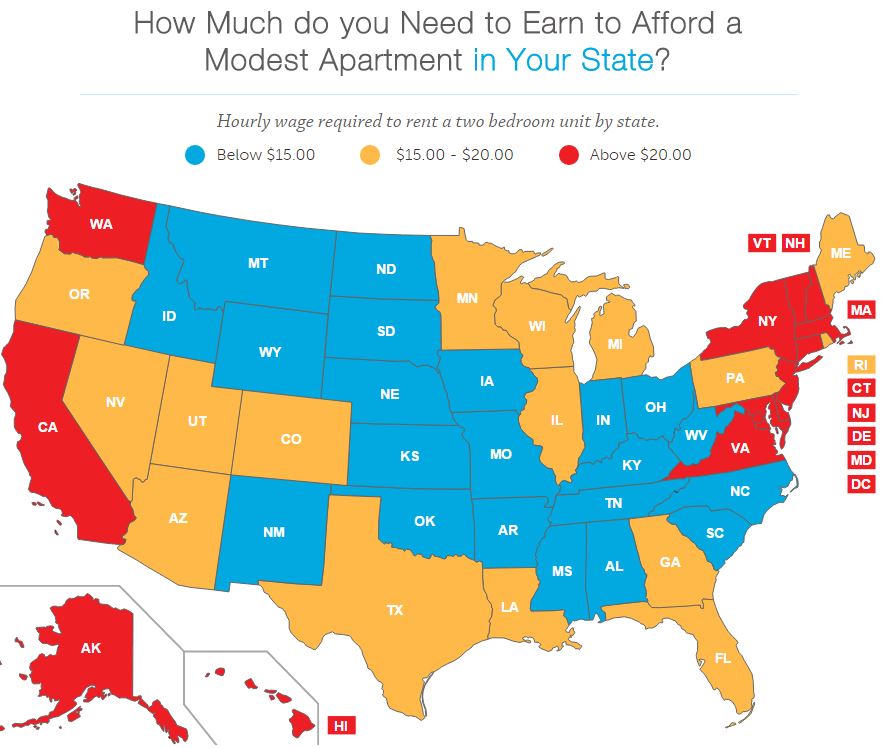
Vermont Business Magazine In order to afford a modest, two-bedroom apartment at the Fair Market Rent in Vermont, renters need to earn$20.68 per hour, or$43,017a year. This is Vermont’s 2015 Housing Wage, revealed in a report released today. The report,Out of Reach 2015, was jointly released by the National Low Income Housing Coalition, a Washington, DC-based research and advocacy organization, and the Vermont Affordable Housing Coalition.
The Housing Wage is the hourly wage a family must earn, working 40 hours a week, 52 weeks a year, to be able to afford the rent and utilities for a safe and modest home in the private housing market. While rents generally align with median income (see data and map below), Vermont ranks 13th highest in average rent but 21st highest in median household income.
“Rents in Vermont continue to rise every year, making it harder and harder for low wage, service sector workers and people living on fixed incomes to get by,” said Erhard Mahnke, Coordinator for the Vermont Affordable Housing Coalition. “With a Housing Wage of over $20 an hour for the first time, ordinary Vermonters must pay an ever-increasing portion of their income for rent, leaving little left for other basic necessities and often precipitating them into the downward spiral of homelessness.”
Even though Vermont’s minimum wage was increased last year, a family must have2.3 wage earners working full-time at minimum wage, orone full-time earner working 90 hours a week, to afford a two-bedroom apartment at theaverage statewide Fair Market Rent of $1,075.A full-time minimum wage worker in Vermont can only afford $476 for rent and utilities, leaving a gap of just under $600 between what they can afford and the cost of the average two-bedroom apartment. While it is possible for a household to work more than one job to make ends meet, a 2011 Vermont study showed that 62% of the state’s households had only one, or less than one full-time worker.
“With rents going up steadily and a one percent vacancy rate statewide, it is not surprising that we are seeing increased homelessness, and for longer periods of time, especially among families with children,” said Sara Kobylenski, Executive Director of the Upper Valley Haven in White River Junction and Co-Chair of the Vermont Coalition to End Homelessness. “To make headway, we need more affordable homes, coupled with rental subsidies and supportive services for our lowest income Vermonters and those with special challenges.”
Greater investments in affordable housing and ending homelessness are needed at both the federal and state levels. Unfortunately, federal funding for housing, community development and rental assistance have suffered deep cuts over the last several years.Recent proposals in Congress are to eliminate funding for the National Housing Trust Fund – the first new federal housing program since the early 1990’s.Vermont’s own fiscal woes have resulted in cuts to the Vermont Housing Conservation Board for next year, while funding to alleviate homelessness has not seen the increases needed to make lasting progress, and the state’s safety net continues to fray further.
Additional Facts:
- ThenationalHousing Wage is $19.35in 2015.
- Vermont isthe 13th most expensive statein the nation for renters (including DC).
- Vermont is theninth most expensive statefor non-metropolitan/rural areas.
- TheHousing Wage is up 29%since the Great Recession began in 2008.
- TheHousing Wage inthe greater metropolitan area ofBurlington is $25.54, 24% higher than the state average.
- AVermont renterwith a full-time job at the mean renter wage of $11.78 an hourcan only afford $613for rent and utilities, leaving them with an affordability gap of over $460 for a two-bedroom apartment.
- Someone with a disabilityliving on Supplemental Security Income (SSI)can only afford $236, leaving them $839 short for a two-bedroom, and $600 short for a one-bedroom apartment.
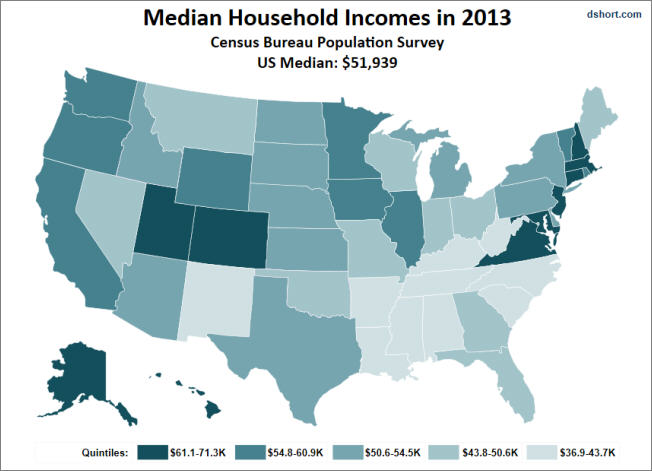
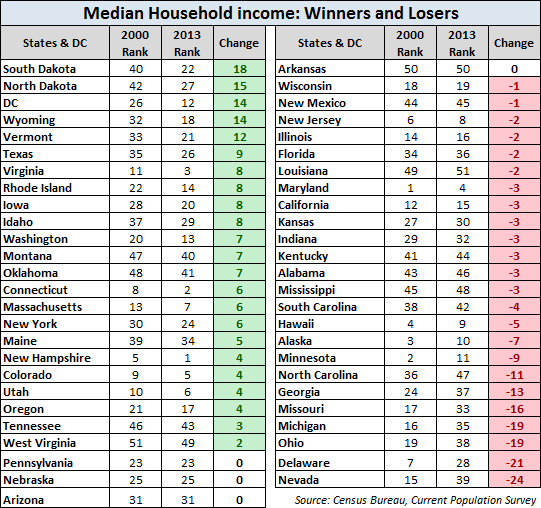
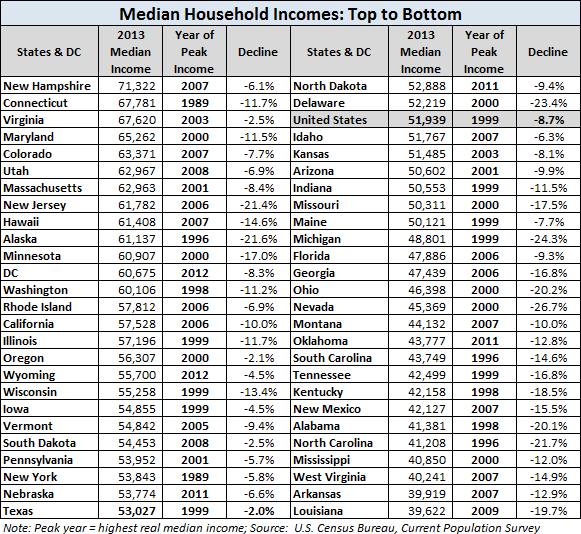 Vermont's median household income was $54,842. Vermont is ranked 21st in the US in median household income ($51,939). The 2014 numbers will be released by the Census Bureau later in the year.
Every year,Out of Reachreports on the Housing Wageand other housing affordability datafor every state, county, metropolitan area, and combined non-metropolitan area in the country. The report presents housing costs nationwide, highlighting the gap between what renters earn and what it costs to afford rent at fair market value.For additional information, visit:www.nlihc.org/oor/2015.
The Vermont Affordable Housing Coalition is a statewide membership organization dedicated to ensuring that all Vermonters have decent, safe and affordable housing,
particularly the state’s low and moderate-income residents, elders, people living with homelessness, and people with disabilities.
For more information on the Vermont Affordable Housing Coalition, visitwww.vtaffordablehousing.org.
The National Low Income Housing Coalition is dedicated solely to achieving socially just public policy
that assures people with the lowest incomes in the United States have affordable and decent homes.
For more information on the National Low Income Housing Coalition, visitwww.nlihc.org
Source:Vermont Affordable Housing Coalition 5.19.2015