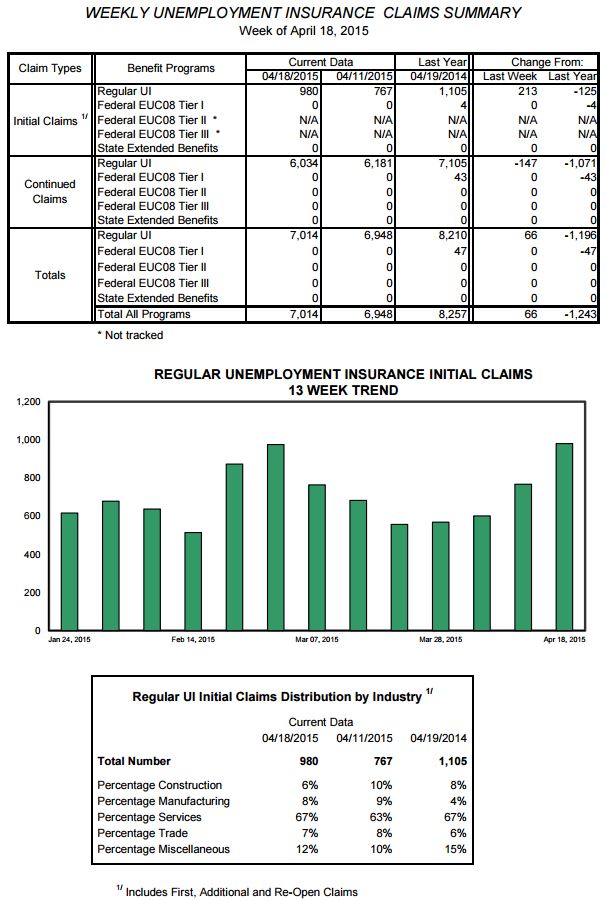
Vermont Business Magazine Weekly unemployment claims rose again forthe week of April 18, 2015, and are near 1,000 for the first time in nearly two months. The transition from the end of the winter recreation season is resulting in a seasonal increase in unemployment claims. There were 980 new, regular benefit claims for Unemployment Insurance in Vermont, an increase of 213 from the previous week's total, but 125 fewer than they were a year ago.
Altogether 7,014 new and continuing claims were filed, an increase of 66 from a week ago but 1,196 fewer than a year ago. The Department processed 0 First Tier claims for benefits under Emergency Unemployment Compensation, 2008 (EUC08), the same asthe previous week.
 There were no Second Tier claims for benefits processed under the EUC08 program. There were zero Tier III claims. The Tier I, II and III programs expired on December 28, 2013. Congress would need to act to renew these extended benefit programs.SEESTORY
The total for all programs was 7,014 claims, 66 more than last week, and 1,243 fewer than the same time last year. For the week by industry, Services claims dominated total claims in all sectors, making up over 650 of all claims, or 67 percent.
The Unemployment Weekly Report can be found at:http://www.vtlmi.info/. Previously released Unemployment Weekly Reports and other UI reports can be found at:http://www.vtlmi.info/lmipub.htm#uc
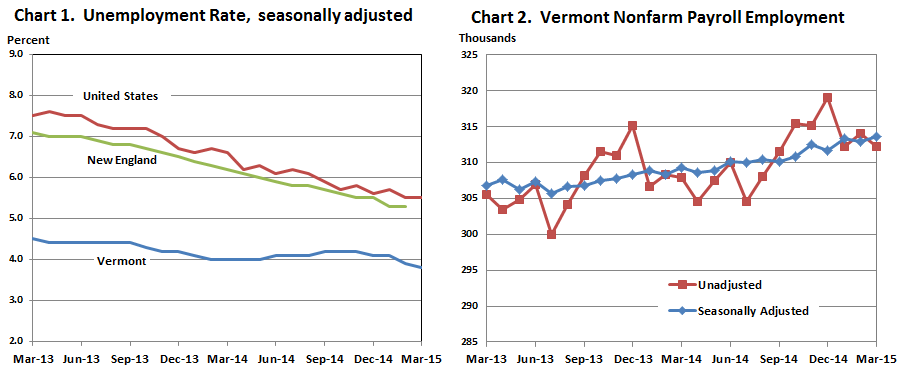
Vermont's unemployment rate fell one-tenth 3.8 percent in March, as total employment grew modestly. SEESTORY.
NOTE: Employment (nonfarm payroll) - A count of all persons who worked full- or part-time or received pay from a nonagricultural employer for any part of the pay period which included the 12th of the month. Because this count comes from a survey of employers, persons who work for two different companies would be counted twice. Therefore, nonfarm payroll employment is really a count of the number of jobs, rather than the number of persons employed. Persons may receive pay from a job if they are temporarily absent due to illness, bad weather, vacation, or labor-management dispute. This count is based on where the jobs are located, regardless of where the workers reside, and is therefore sometimes referred to as employment "by place of work." Nonfarm payroll employment data are collected and compiled based on the Current Employment Statistics (CES) survey, conducted by the Vermont Department of Labor. This count was formerly referred to as nonagricultural wage and salary employment.