

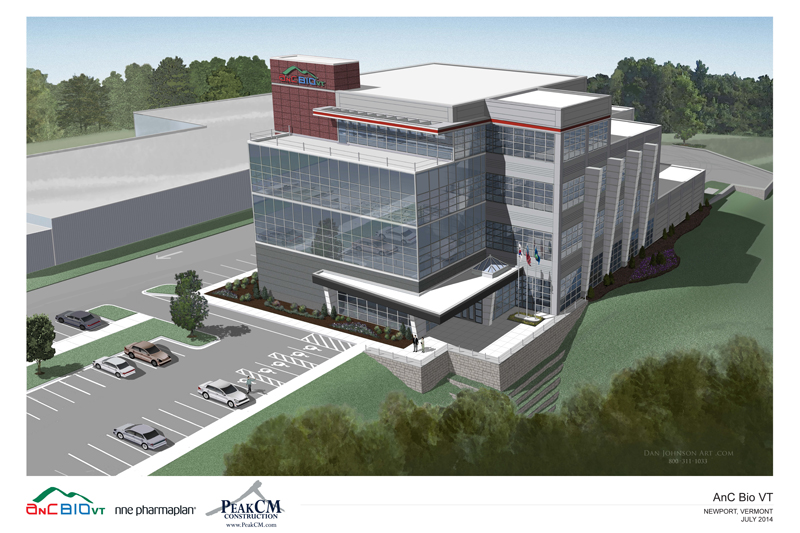
by Timothy McQuiston If you build it, they will come. That was message from Jay Peak’s Bill Stenger and his team of scientists and marketing specialists regarding the proposed AnC Bio plant in Newport. And for the first time, Stenger put a date on when it would be built. At a press conference Monday in Jay, Stenger said they would break ground on the $100 million project May 14 and be open for business in the fall of 2016.
“The ground is ready and we will commence construction on May 14. We’re very, very excited about this,” Stenger said.
Stenger said the debt-free, state-of-the-art facility (on the grounds of the former Bogner plant and now called the Jay Peak Biomedical Research Park, LP) will take about 18 months to build and its clean rooms will need to get FDA certification. When the facility opens in the fall of 2016, it will employ about 300 technicians, administrators and scientists, which he anticipates ramp up to 400-450 once fully operational.
Stenger said he’s raised $77 million of the funding, which will allow for the construction of the plant. EB-5 immigrant investors will account for 90 percent of the money needed, with the developers, himself and partner Ariel Quiros also having “skin in the game.” He said he needs to, and expects to, raise another $20 million in EB-5 funding from 40 more investors. Those funds will go into escrow until the state Department of Financial Regulation releases them from escrow.
The DFR recently took over the regulation of EB-5 projects from the Vermont Agency of Commerce & Community Affairs because of the complexities of these security-like investments. The groundbreaking of AnC Bio was to have taken place last fall.
The clean room is first and foremost of the three business aspects of the facility. This is where research, development and manufacturing of stem cells, biomedical devices and other healthcare-related products requiring this specialized facility can be produced.
Typically, chief scientist Dr Ike Lee said, a large firm like Biogenesis, perhaps or a pharmaceutical company or a hospital, will have a product it wants to develop will come to such AnC Bio to do the testing and ultimate manufacture of, say, a stem cell product targeted for a very specific medical treatment.
AnC Bio will not be doing the initial research, but with heavy FDA regulation, the developer will want a single facility that it can both develop and ultimately bring to market in one already-approved facility. Switching facilities after production had begun would otherwise require new FDA approval and the time and money that would additionally require.
By using AnC Bio, the developer of the new stem cell product would not have to build their own facility and would not have to get their own certification.
Stenger and Lee said there is a vast worldwide market for a clean facility such as this.
AnC Bio will succeed where its Korean counter-part has not for two reasons, Stenger said.
First, the Korean AnC Bio (separately owned) was built before the market was ready. Second, and this is where the EB-5 funding becomes so important, is that the Vermont facility will be fully capitalized and debt free when it opens. The Korean plant, Stenger said, suffered from a staggering debt load and without a revenue stream to support it.
Consultant Dr Jane Andrews of Frost & Sullivan presented her firms marketing analysis of the need for this facility and the worldwide potential as a clean room and as an associated manufacturing facility for stem cell and biomedical equipment products.
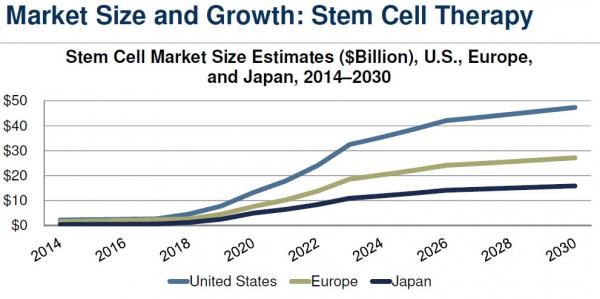 “There is little or no competition,” Andrews said. “AnC Bio is building their facility at a very opportune moment.”
Given that much of stem cell treatment is for cancer and heart treatment, the aging global population will mean there will be a greater need. She said in the world today, there are more 60-year-olds than there are 5-year-olds.
“There is a large market for stem cell therapy,” she said and a limited number of facilities.
The stem cell market is valued at $1.4 billion now, but she said it’s expected to be a $160 billion market by 2030.
“Cell therapy is something that’s happening during our lifetime. It’s very exciting,” Andrews said.
“The facility,” Stenger said, “is the goal.”
Ike Lee said stem cell therapy is mostly targeted toward cancer and cardiovascular treatments. Because of the high failure rate of developing stem cells (a 20 percent success rate would be considered very successful), there is a great need for more stem cells.
Lee also said AnC Bio will avoid some of the political problems other research facilities have had using fetal stem cells, as AnC Bio will focus on adult stem cells, which must be “de-differentiated” and then “re-differentiated” to use for therapeutic purposes.
Today, he said, there are simply not enough stem cells available for the research, development and manufacture of curative products.
The Vermont facility will have no debt, Stenger said, and the market is ripe. EB-5 has provided the capital without the impatient demands of a private equity investor from Silicon Valley and without a staggering loan repayment to a commercial lender.