

by Elizabeth Hewitt vtdigger.org Even after Vermont lawmakers find a way to mend the 2016 budget, there’s more bad news ahead. Vermont will have to find at least $48.8 million to solve funding gaps in FY 2017 and FY 2018, according to projections from the Joint Fiscal Office. As it stands, Vermont lawmakers are facing down a budget gap of at least $112 million in the current fiscal year.
Lawmakers have yet to determine how to fill the remaining gap between the $94 million that the governor’s budget filled and an additional $18.6 million stemming from a revenue downgrade in January.
Representative Mitzi Johnson, D-South Hero, chair of the House Appropriations Committee, said Monday she hopes to have a proposal for a balanced budget by the end of the week.
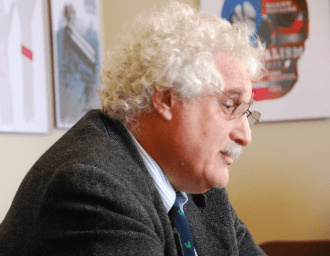
Steve Klein, of the Joint Fiscal Office, in Senate Finance on Wednesday. Photo by Elizabeth Hewitt/VTDigger
According to documents that Steve Klein, chief fiscal officer of JFO, presented to the Senate Finance Committee on Wednesday, it’s likely that lawmakers will call on one-time funds to balance the budget this year.
One proposal is to use as much as $3.8 million from the funds for the Vermont Housing and Conservation Board from the Capital Bill. JFO estimates that one-time federal money could amount to $3.4 million, while the state’s “rainy day fund” could provide about $7 million in relief.
Those funds could help lawmakers solve the gap in the FY2016 budget, but if they are used up this year, the state will not be able to fall back on those sources again.
“We need to figure out how to make structural changes that will produce savings next year,” Klein told lawmakers.
Other funding sources are set to expire over the next few years. In FY 2017, money that U.S. Sen. Patrick Leahy secured to boost federal support for Medicaid will expire, leaving a $17 million gap. Revenue from a settlement with tobacco companies in the 1990s will cease to be available in FY 2018, which means a loss of $12 million for the state.
Klein says many of the factors that will contribute to the state’s gap over the next few years are not yet clear.
For example, a small shift in the federal match assistance percentage that determines what portion of Medicaid is paid by federal funds and what portion is picked up by the state, could have a big impact on the state’s finances, Klein told lawmakers.
Currently the federal government covers 54 percent of Medicaid costs, leaving the state to pick up the remaining 46 percent. Over the last six years, the federal share of Vermont’s Medicaid expenses has been decreasing, according to the JFO.
The change in FMAP rates for FY 2017 will be available at the end of this month.
Meanwhile, the long-term impact of decisions that the Legislature makes toward the budget this year could produce myriad results over the next few years.
If lawmakers follow through on the governor’s proposal to find $10.8 million in state labor reductions, for instance, it is likely that the state will be replacing some of those positions in the next few years, according to JFO officials.
“Very often when you do these very dramatic cut programs, in a very short while those positions start reappearing,” said Stephanie Barrett, associate fiscal officer of JFO.
Sen. Tim Ashe, D/P-Chittenden, Finance Committee chair, asked Klein to present the long-term financial view, so that legislators can weigh the options for responsible ways to raise revenue and produce savings.
“Not only does it help us make better decisions, but it will not have us in crisis mode in 2016,” Ashe said.
According to Sen. Jane Kitchel, D-Caledonia, chair of the Senate Appropriations Committee, one of the major challenges facing her committee is how to best address the budget issues in the foreground while thinking of long-term strategy and sustainability.
“When you look at that outer year…how do we make decisions right now that are going to not exacerbate it but actually help make it manageable,” Kitchel said.
Kitchel said that she and her fellow lawmakers are looking to make structural changes for fiscal longevity, but noted that in some cases it takes a longer timeline to make thoughtful reforms.
“Budgets can be challenging every year,” Jim Reardon, commissioner of the Department of Finance and Management, said by phone on Wednesday.
“The most important thing is that we get the state FY 2016 budget on some reasonable path of fiscal sustainability so that we’re better positioned to meet future challenges in subsequent budgets,” Reardon said.