

Vermont Business Magazine The Nuclear Regulatory Commission and Entergy filed responses today with the US Atomic Safety and Licensing Board opposing the State of Vermont's request for a hearing. The state opposes the NRC's decision to alter the existing Vermont Yankee nuclear power plant emergency warning system. Entergy is the owner of the Vernon plant and as owner has been responsible for the warning system. The NRC, in a split decision, ruled earlier this year that because the plant shut down in December, Entergy could discontinue offsite emergency planning activities and reduce the scope of its onsite emergency planning. The stated requested an ASLB hearing to revisit this issue last week.
The regulation is based on the contention that a nuclear plant that is no longer in operation presents less of a threat to public health. The state, on the other hand, said that no one, including the NRC, knows what level of threat the plant presents because it had not been thoroughly studied. Entergy, typical in a nuclear plant shutdown, asked to reduce emergency planning requirements and to revise the Vermont Yankee emergency plan. It stated today, and the NRC agreed, that Vermont's objections were not germane to Entergy's request.
The NRC stated:
"The NRC has historically granted emergency planning (EP) exemption and license
amendment requests for permanently shutdown and defueled facilities that would allow them to
discontinue offsite emergency planning activities and reduce the scope of their onsite
emergency planning. This is because, although the Commission’s EP regulations do not
distinguish between operating and permanently shutdown and defueled facilities, the risk of an
offsite radiological release is significantly lower and the types of possible accidents are
significantly fewer at a permanently shutdown and defueled facility than at an operating facility."
The state's concerns include whether Entergy has done enough work to determine what level of contamination currently exists at the plant and whether Entergy will have enough money to fund all of the needed work.
 “We are not going to stand aside while Entergy plows forward with plans that have not been properly evaluated from a financial or environmental standpoint,” said Vermont Attorney General Sorrell in written comments March 6.
“The NRC has a duty to scrutinize Entergy’s plans and address the many valid points we have raised in today’s filing,” Sorrell continued.
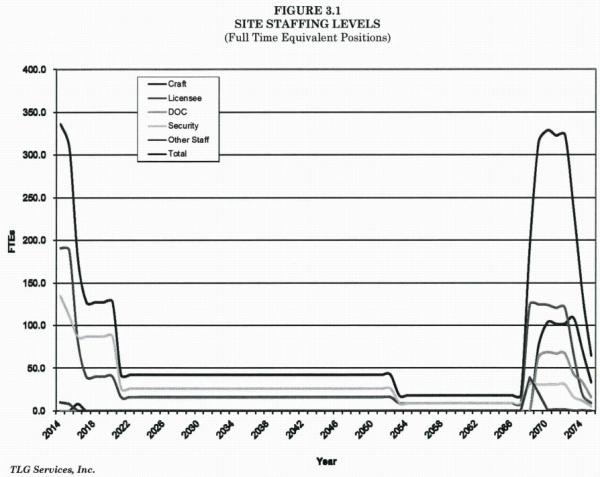
“The financial assumptions that drive this decommissioning plan out many decades are not tenable (the Entergy plan timeline began August 2013 and would take 59 years to complete, or about 2072; Entergy has suggested that it would probably conclude sooner than that),” said Christopher Recchia, Commissioner of the Department of Public Service. “We will work constructively to advance the schedule so that the site is restored as soon as possible. I am pleased with the level of detail and seriousness of our joint comments filed today, and I hope the NRC takes them to heart,” he added.
“This filing makes clear that additional information is required to ensure that Entergy’s plan to investigate and remediate non-radiological contamination on site is the most protective of human health and the environment,” said David Mears, Commissioner of the Department of Environmental Conservation in the Agency of Natural Resources. “The Agency urges the NRC to require that Entergy respond to the Agency’s request for additional information,” he added.
William Irwin, Radiological & Toxicological Sciences Chief at the Department of Health, said that “with the possibility that large amounts of radioactive material will be stored at the site for decades, there is too little detail about radiological environmental monitoring and emergency preparedness provided in the PSDAR, and we encourage the NRC to have Entergy provide the additional information we have requested.”
RELATED:
State of Vermont requests NRC address concerns with Vermont Yankee decommissioning plan
The NRC, however, stuck to its original opinion, writing:
"The US Nuclear Regulatory Commission (NRC)
staff (Staff) files this answer opposing the “State of Vermont’s Petition for Leave to Intervene,
and Hearing Request” (Petition) filed by the State of Vermont, through the Vermont Department
of Public Service (Vermont). In its Petition, Vermont challenges proposed changes in
emergency planning at the Vermont Yankee Nuclear Power Station (Vermont Yankee or VY)
that the licensee (Entergy) has requested – changes that reflect the changed circumstances associated
with the facility’s transition to a permanently shutdown and defueled condition. As set forth
below, the Atomic Safety and Licensing Board (Board) should deny Vermont’s Petition because
its two proposed contentions do not satisfy the Commission’s contention admissibility standards."
The NRC first states that Vermont does not have a legal standing and then states that even if it did, the NRC still made the correct decision:
"Even if the issues that
Vermont raises could be considered in this proceeding, they would be inadmissible: they are
unsupported and devoid of necessary expert analysis; they fail to raise genuine disputes with
the license amendment request of material issues of law or fact; and they raise issues beyond
the scope of this proceeding and not material to the findings the NRC must make to grant the
license amendment request."
The NRC thus concluded:
"The Board should deny Vermont’s Hearing Request for
failing to proffer an admissible contention."