

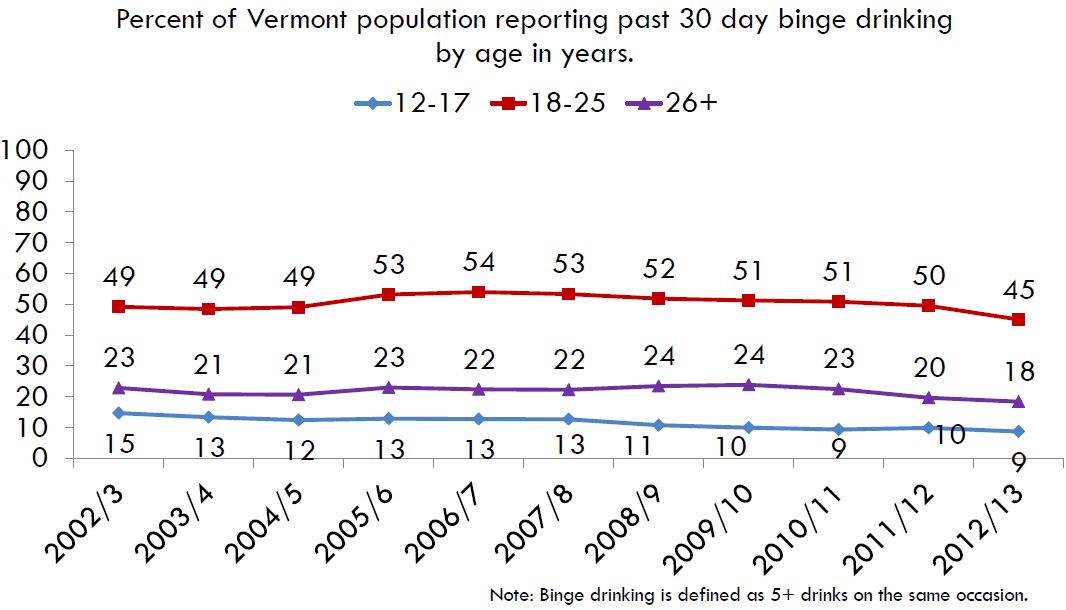
Governor Peter Shumlin joined with Department of Health officials, substance abuse prevention providers, and community groups on Wednesday to announce that binge drinking, marijuana use, and prescription pain reliever misuse dropped among young adult Vermonters between 2011/2012 and 2012/2013, according to the latest report of the National Survey on Drug Use and Health (NSDUH). While the governor said he welcomed the good news, he cautioned that much work remains and outlined steps the state is taking to continue progress in the battle against drug and opiate addiction in Vermont.
“This is really encouraging news,” Shumlin said. “It’s a testament to the hard work of those who are on the front lines every day battling drug abuse in Vermont. Their hard work and dedication is making a difference. While this is good news, we can’t for one minute let up. There are still big challenges we need to overcome.”
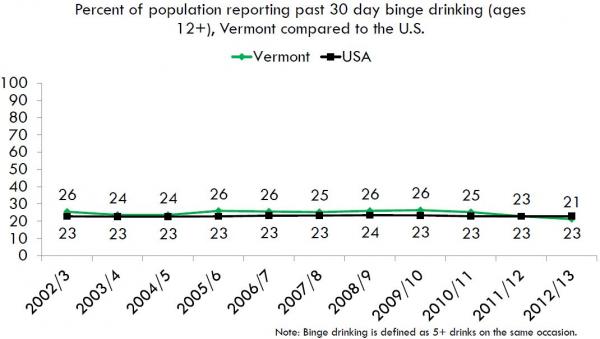
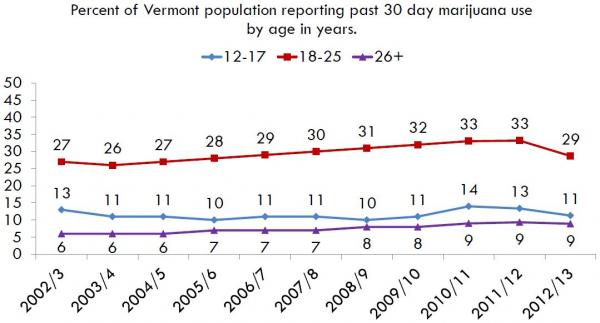 According to the NSDUH, past 30-day binge drinking fell from 50 percent to 45 percent, past 30-day marijuana use fell from 33 percent to 29 percent, and past-year prescription pain reliever misuse fell from 12 percent to 9 percent among Vermonters age 18 to 25. This translates to approximately 3,000 fewer high risk drinkers, 3,000 fewer marijuana users, and 2,000 fewer people misusing painkillers in the 18 to 25 age group.
The results come from the NSDUH, which is an annual nationwide survey funded by the Substance Abuse and Mental Health Services Administration, an agency of the U.S. Department of Health & Human Services. The survey provides national and state-level data on the use of tobacco, alcohol, illicit drugs and mental health in the U.S. Data is collected by administering questionnaires to a randomly selected and representative sample of the population age 12 and older through face-to-face interviews at their place of residence. The NSDUH report on Vermont can be found here: http://healthvermont.gov/adap/clearinghouse/documents/nsduh_report_vermont_201501.pdf
“These numbers are meaningful,” said Health Commissioner Harry Chen, MD. “They show that young adults have been moving away from harmful use of alcohol and drugs. Reducing the burden of alcohol and drug addiction is a continuing priority for the Health Department and our work with the community coalitions and regional Partnerships for Success.”
“Young adults are difficult to reach and their behaviors are hard to change,” said Deputy Health Commissioner Barbara Cimaglio. “This is a crucial time in their lives when habits form and behaviors are established. We want those behaviors to be healthy.”
In addition to the drop in high-risk drinking, marijuana use, and prescription pain reliever misuse, Vermont has made significant progress addressing the challenges of opiate addiction in the last year. Since the Governor made opiate abuse the focus of his 2014 State of the State Address, Vermont has increased the number of people in treatment by almost 1,000; distributed over 800 Naloxone Opioid Rescue Kits, of which over 80 have been used to reverse a suspected overdose; and screened almost 13,000 Vermonters using an evidence-based protocol to identify those with substance use disorders and get them access to early intervention and treatment services.
In addition, the Governor announced today more progress the state is making in its effort to combat opiate addiction:
· In a difficult budget year, the Governor’s proposed budget increases by 16 percent overall drug treatment spending, an increase of over $5 million.
· Vermont is making progress implementing Act 195, the state’s comprehensive pre-trial services law designed to bypass the court process for those people addicted to drugs and who can be safely treated in a community setting. Vermont’s first director of Pretrial Services, Annie Ramniceanu, who was hired in September, coordinated a statewide training in December for judges, prosecutors, and defenders on the screening instruments required by Act 195. In the coming weeks, the state will begin hiring the county and regional pretrial monitors to provide precharge and pretrial services in every county in the State.
· With input from the prosecution, defense, and Ramniceanu, the judiciary has made important revisions in the court citation form to be printed and published soon, thereby informing Vermonters about pretrial services and their rights at the time they are issued a citation by police.
· The Health Department’s 12 district offices have coordinated community forums and follow-up events in all regions of the state. Community teams have developed action plans with strategies for prevention, intervention, recovery and law enforcement, and identified resources already available, resource gaps, action steps, and how they will measure success. The Springfield team decided to create a roadshow/mini forum to take to each community to share information, gain input and engagement. They are also exploring the idea of creating a law enforcement/community agency collaboration similar to Rutland’s project VISION, doing a needs assessment with addicts and people in recovery, and starting a ‘Wit’s End’ parent support group.
· For 2015, the Health Department has developed a safe storage and disposal of prescription drugs campaign, including outreach materials and social media messaging for each month of the year.