

The Vermont Mayors Coalition today announced its 2015 legislative session goals and its commitment to collaborate on and advocate for these areas of common interest to their cities and towns. At a news conference in the State Capitol’s Cedar Creek Room, the Coalition released its Legislative Policy Summary for the 2015 legislative session, including calls for: Education Funding Reform; and Waterway Protection from Stormwater Run-off. For education reforms, the mayors stated that rising property taxes are creating a housing situation which is unsustainable for many Vermonters, at the same time that the number of children is going down while outcomes are static.
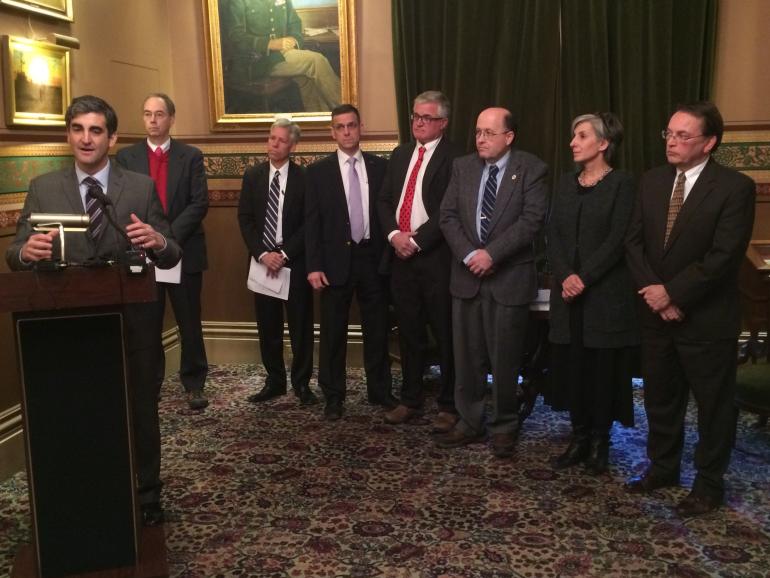 Left, to right, Weinberger, O'Brien, Hollar, Louras, Benton, Monette, Gamache and Lauzon. Courtesy photo.
The Vermont Mayors Coalition was created in 2013 by Vermont’s eight mayors and includes:
· Bill Benton, Vergennes;
· Liz Gamache, St. Albans;
· John Hollar, Montpelier;
· Thom Lauzon, Barre;
· Chris Louras, Rutland;
· Paul Monette, Newport;
· Mike O’Brien, Winooski; and
· Miro Weinberger, Burlington.
All eight Vermont mayors attended the news conference. The mayors offered the following statements about the issues of common interest they are collaborating on and advocating for during the 2015 legislative session:
Burlington Mayor Miro Weinberger: “The Legislature has an opportunity this year to make major progress on two large, complex issues that threaten the future of the state and the cities we represent. The Vermont Mayors Coalition will work hard this session to see that action is taken to keep our education system strong and financially sustainable and to create a fair, effective, and efficient system for protecting our waterways.”
Montpelier Mayor John Hollar: “It is critical for the fiscal health of our cities that we get control of rising education expenses. We are encouraged that the Legislature is making this issue a top priority.”
Newport Mayor Paul Monette: “As a member of the Vermont Mayors Coalition, I urge the Legislature to pass comprehensive educational reform, including school consolidation and the elimination of unfunded mandates. Municipalities have worked hard to control spending only to have the savings offset by unsustainable education property tax increases.”
Rutland Mayor Chris Louras: “Rutland City has been wrestling with federally mandated water quality standards for years, and we understand cleanup is a statewide problem that needs a statewide solution, recognizing that resources are limited and must only be spent where it will make a real and measurable difference.”
Vergennes Mayor Bill Benton: “The Vermont Mayors Coalition, after thoughtful discussion, has offered unanimous support for two important legislative initiatives. We support education cost containment and a review of district governance, as well as fair and equitable efforts at water quality throughout Vermont. We hope that the Legislature will consider our priorities this session and make real progress toward meaningful change.”
Winooski Mayor Mike O’Brien: “Again this year, the Vermont Mayors Coalition has worked collaboratively to identify issues that are important to our respective communities and to the State as a whole. We are asking the Legislature to address them and pass meaningful legislation during this session.”
# # #
Vermont Mayors Coalition
Legislative Policy Summary
2015 Legislative Session – January 13, 2015
The Vermont Mayors Coalition is advocating for state action to support municipalities in the following two important issues:
· Education Funding Reform
· Waterway Protection from Stormwater Run-off
Education Funding Reform
The Vermont Mayors Coalition recognizes that the most significant challenge our state faces today is maintaining and improving the quality of our public school education system while also addressing the rapid and continuous three-decades long rise in education property taxes. This rise threatens to make housing unaffordable for low- and moderate-income families, and it siphons funds from municipal budgets that otherwise would be available to invest in much-needed infrastructure improvements and other priorities.
Moreover, while the current system is producing many positive outcomes, it is not adequately serving all of our children. Although Vermont now spends more per pupil on average than any other state, education outcomes for low-income students are largely unchanged since 2007. The current finance and governance systems also create significant inequities throughout Vermont, as students have access to vastly different course offerings and other opportunities depending on where they live.
Vermont’s extremely low student-teacher ratio of ten students per teacher (compared to a nationwide average of 15:1) is a primary driver of rising education property taxes. A system in which 20% of the classrooms include only two to nine students cannot be sustained. We must bring our student-teacher ratio closer in line with the national average to control rising education tax rates.
The Coalition urges the Legislature to adopt education reform legislation based on the following principles:
· Specific and meaningful cost containment. A variety of proposals have been suggested, including a cap on per pupil spending coupled with a local surcharge for spending that exceeds that amount. Rather than advocate for a specific approach, the Coalition urges the Legislature to take action to restrain school spending.
· A more rational governance structure. There are more than 300 school districts and supervisory unions in Vermont. As student populations have declined statewide, the large number of districts has made it impossible for many districts to adapt and operate in an efficient manner. Many small districts also do not have the resources to meet the needs of our diverse student population. The Coalition encourages the Legislature to reduce the number of school districts.
Waterway Protection from Stormwater Run-off
The Coalition recognizes that polluted stormwater with excess nutrients like phosphorus flowing into Vermont’s lakes and streams is a serious problem that must be addressed more vigorously than it is today. The Coalition supports efforts to strengthen investments in controlling this source of water pollution as long as it is:
· Effective: The state needs a new, comprehensive system of stormwater control interventions that targets the major drivers of water pollution, a comprehensive funding strategy, and – after too many years of minimal progress – meaningful improvements in water quality.
· Fair: All Vermonters benefit from healthy lakes and streams and, therefore, all Vermonters should contribute to the stormwater protection system. The Coalition opposes a funding strategy that places a disproportionate burden on municipalities and municipal stakeholders.
· Efficient: The state’s finite stormwater protection resources should be expended by consideration of a number of project goals, including: significant level of phosphorus reduction; high impact; ability to achieve rapid resolution; and low cost.