

by Timothy McQuiston Vermont Business Magazine The Jay Peak receiver and his team will finally get paid. The federal court in Miami on Tuesday ordered that funds from the Citibank settlement be used to cover the pay and expenses of $1,953,467.59 for receiver Michael Goldberg and his associates now running Jay Peak and Burke Mountain resorts. Goldberg is also setting up plans to find a resolution for the creditors and immigrant investors caught up in the $200 million, EB-5 fraud case. The SEC has sued resorts owner Ariel Quiros and president Bill Stenger in the case. Stenger has settled his SEC case. The state and US Attorney for Vermont is also considering legal action.
Goldberg alone was owed $316,533.25 on 830.30 billable hours through October 31. Goldberg notes that he and his associates also have worked at discounted fees (According to the court documents, Goldberg and his partners charge upwards of $690 an hour, but in this case, all partners are billing at $395. Associates' rates, which extend up to $340, have been set as $260. Paraprofessionals, who regularly bill from $220 to $295, are billed at $175.).
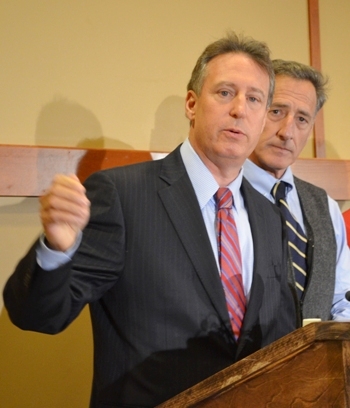 Michael Goldberg and Governor Shumlin at Jay Peak last April. VBM photo.
In agreeing with Goldberg, US District Judge Darrin Gayles writes in the Order that, "This case involves a complex receivership. In the seven months since the SEC filed this action, the Receiver and his professional team have expended considerable effort in managing the receivership entities. The professionals have provided valuable services, including locating additional funds for the receivership estate, disposing of assets, and negotiating settlements--all to the benefit of the investors and creditors. In addition, the professionals have operated and maintained a large ski resort, working for months without pay and at significantly reduced rates. Considering the work performed and the results achieved thus far, it is ... ORDERED AND ADJUDGED that the Motion [ECF No. 241] is GRANTED. The Receiver is authorized to pay the professionals detailed in the Motion (i) fees in the amount of $1,883,900.95 and (ii) reimbursement for expenses in the amount of $69,566.64 for work performed from April 4, 2016 through October 31, 2016. The Receiver shall use funds from the Citibank Settlement to pay the fees and expenses. DONE AND ORDERED in Chambers at Miami, Florida this 13th day of December, 2016."
Court Documents:
BACKGROUND
On April 12, 2016, the Securities and Exchange Commission (“SEC”) filed a complaint [D.E. 1] (“Complaint”) in the United States District Court for the Southern District of Florida (the “Court”) against the Receivership Defendants, the Relief Defendants, William Stenger (“Stenger”) and Ariel Quiros (“Quiros” and with the Receivership Defendants, Relief Defendants and Stenger, the “Defendants”), the principal of the Receivership Defendants, alleging that the Defendants violated the Securities Act of 1933 and the Securities Exchange Act of 1934 by making false or materially misleading representations to investors.
According to the Complaint, the scheme involved securities offerings made on behalf of seven limited partnerships connected to Defendant Jay Peak, Inc. The first six offerings were associated with construction and renovation at the Jay Peak ski resort, additional hotels, condominiums, a water park and accompanying facilities (collectively, “Jay Peak”). The seventh limited partnership purported to raise funds to construct a biomedical research facility. An unrelated offering was promoted to fund the construction of a ski resort on Burke Mountain. The limited partnerships were funded through foreign investors pursuant to the federal EB-5 immigration program. However, based on a preliminary forensic accounting, the Receiver has discovered that a large amount of the funds earmarked for certain projects were diverted to other projects and to expenses unrelated to the limited partnerships.
On April 13, 2016, upon the SEC’s Motion for Appointment of Receiver [D.E. 7], the Court entered an Order (“Receivership Order”) [D.E. 13] selecting Michael Goldberg as the Receiver over the Receivership Defendants and the Relief Defendants (the “Receivership Order”). Relevant to this Application, the Receivership Order authorizes the Receiver to appoint professionals to assist him in “exercising the power granted by this Order …” See Receivership Order at ¶ 4. Moreover, the Receiver and his professionals are entitled to reasonable compensation from the assets of the Receivership Defendants, subject to approval of the Court.
The Receivership Order directs the Receiver to file “no less than quarterly” applications for reasonable compensation. Id. However, due to the expenses associated with (i) operating the Jay Peak during the off-season, (ii) preparing the hotel on Burke Mountain (“Burke”) for opening, and (iii) maintenance and repairs at Jay Peak and Burke, the professionals agreed to defer payment of their fees. On July 22, 2016, the Receiver filed a Motion to Extend the Deadline to File Quarterly Applications for Professional Compensation [D.E. 189]. The motion, which was approved by Order of the Court, extended the deadline for filing fee applications until such time as the Receiver believes there are sufficient funds available to compensate the Receiver and his professionals or otherwise petitions the Court for an award of reasonable fees. See D.E. 194. Due to the settlements and recoveries described herein, the Receiver believes there are funds available to pay professionals, which will not take away resources from operating, maintaining and preserving the assets of the Receivership Entities.
The settlement with Citibank, N.A. will bring $13,300,000 into the receivership estate. In exchange for the $13,300,000 payment, the Receiver has agreed to (i) to settle and compromise all claims relating to the SEC Action that the Receivership Entities could bring against Citibank, (ii) to obtain entry of a bar order enjoining any person from bringing any claims relating to the SEC Action or the Receivership Entities against Citibank. The settlement resolves a dispute over the sum of $15 million which Quiros pledged to Citibank as collateral for a personal line of credit in an amount not to exceed $15 million.
The Receiver also negotiated a partial settlement with Raymond James & Associates, Inc. and Raymond James Financial, Inc. (collectively, “Raymond James”), arising out of the settlement the State of Vermont reached with Raymond James. When Raymond James settled with the State of Vermont, the State of Vermont directed Raymond James pay the Receiver $4.5 million (the “RJ Funds”) to be held for the purpose of reimbursing claims to EB-5 investors. Raymond James and the Receiver reached an interim agreement to help the Jay Peak resort remain operational and to maximize its value to investors and creditors.
Pursuant to the agreement, the Receiver is permitted to use up to $1.5 million of the RJ Funds to pay expenses associated with the Receivership Estate’s operations (the “Borrowed Amount”). However, the Borrowed Amount may only be used for payroll expenses incurred in the ordinary course for day-to-day operations, not for any other purpose associated with the administration of the Receivership Estate including, but not limited to professionals’ fees (and will not be used to pay the fees requested herein). The Receiver is required to repay the Borrowed Amount by April 1, 2017 with the first available funds generated in the Receivership Estate (but not with the proceeds of any line of credit). The Receiver continues to review potential causes of action against the principals of the Receivership Defendants and various third parties. These claims may include common law claims and claims under fraudulent transfer statutes. While the Receiver cannot yet predict the likelihood, amount or cost-effectiveness of particular claims or the claims as a whole, the Receiver continues to diligently evaluate claims against third parties.
Source: UNITED STATES DISTRICT COURT. SOUTHERN DISTRICT OF FLORIDA. CASE NO.: 16-cv-21301-GAYLES. 11.22.2016 & 12.13.2016