

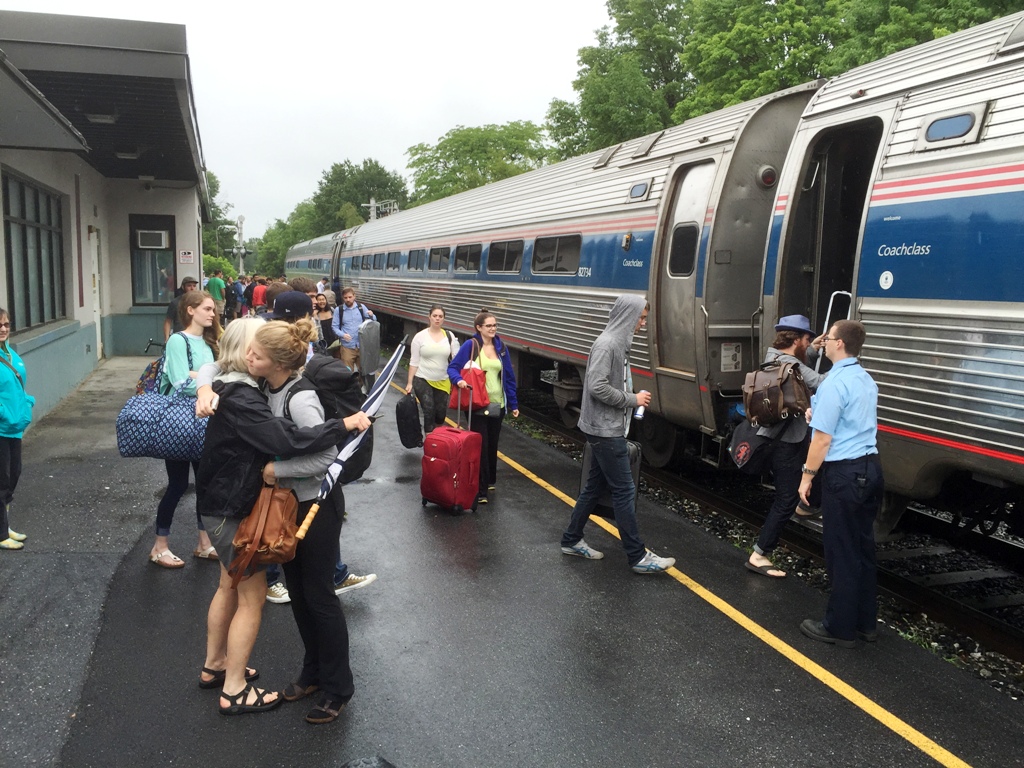
Amtrak passengers board the Vermonter in Essex Junction for the trip south. While state officials and rail supporters expect to bring passenger rail from Rutland to Burlington by 2021, linking that service to the existing Vermonter service could involve considerable capital expense. VBM photo.
by CB Hall Vermont Business Magazine The State Transportation Board has wrapped up its annual fall series of public forums in mid-November, and this year's theme for the sessions – Vermont's railroads – has sparked considerable interest in a mode of transportation that, some Vermonters say, is very much underused. Each year, the autumn events focus on a different aspect of transportation in the state. This year, according to the board's executive secretary, John Zicconi, attendance at the seven forums was “above our normal attendance in the last five years.”
Vermonters “do believe a healthy rail network is good for the economy,” he said. “We noted a general support for getting as many trucks off our roads as possible, and how rail is a piece of that puzzle.”
In announcing the series in September, the board listed passenger rail expansion, life with railroads as neighbors, rail safety, rail-side development, truck traffic through villages and town centers, and commuter rail prospects for Burlington and Brattleboro as key topics for consideration.
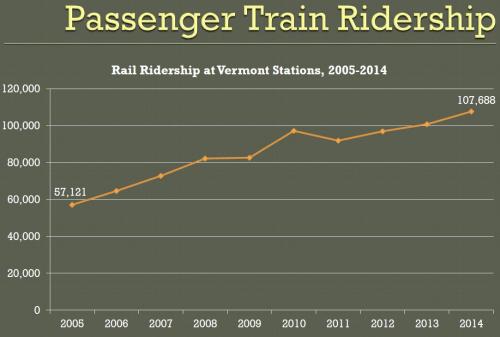
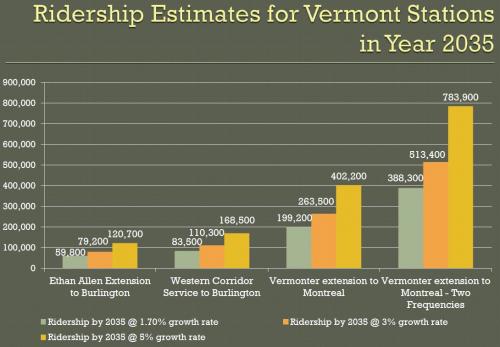
 In passenger rail development, plenty is happening in Vermont, and passenger rather than freight issues appeared to dominate the discourse at the forums. Both of the state-sponsored Amtrak services – the New York City-to-Rutland Ethan Allen Express and the Washington, DC-to-St. Albans Vermonter – are slated for extension.
The Ethan Allen will shift its northern terminus from Rutland to Burlington in early 2021, Agency of Transportation (AOT) rail program director Dan Delabruere anticipated in an interview for this article. He was less certain about when the Vermonter's terminus will move north from St. Albans to Montreal. That depends on when the federal government passes legislation allowing U.S. Customs and Border Protection to work on foreign soil – at a customs pre-clearance facility in Montreal which is a crucial element in extending the Vermonter's route.
“We really don't have any control over that,” he said. “There's still a lot to do.”
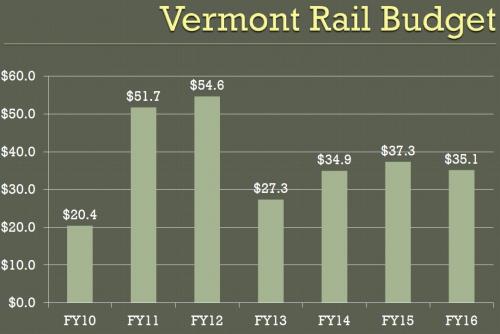
Both moves are expected to attract substantial new ridership, but the finance questions are less clear. Delabruere hesitated to put a price tag on any possible increase that the extensions would occasion in the state's subsidies for Amtrak. Currently the state pays about $7.3 million annually to support its two Amtrak trains.
The state is meanwhile investigating the feasibility of commuter rail service linking St. Albans and Montpelier with Burlington. Zicconi said that “people in general are supportive of the concept, but people want to see the details” meaning, in particular, “how much bang for the buck.”
The AOT is charged with submitting its feasibility study to the Legislature in January. Boston-based consultant HDR is currently wrapping up work on the analysis.
The idea carries with it the possibility of a commuter rail stop at the GlobalFoundries plant in Essex, where some 3,000 people work. The potential exists for coupling a commuter stop there with a rail-industrial park, according to an analysis undertaken by the Vermont Rail Action Network (VRAN), an advocacy group, in 2014. VRAN worked with environmentalists and the state's railroads to identify rail-adjacent parcels of five acres or more throughout the state that were not prime agricultural land or wetlands, said Lee Khan, who chairs the group's board of directors. That search identified the Essex tract as a “perfect location” for light industry – it's zoned for such - with hundreds of acres of available property adjacent to the railroad, she said.
She emphasized, however, that the initiative had yet to move beyond the conceptual stage.
George Tyler, president of the Essex Junction Board of Trustees, said there had been “some discussion” of the rail-industrial park idea, and confirmed that the concept had not advanced to details. However, he said that a specific allowance for the possibility constituted “one of the revisions we want” in the village's building and zoning code, which is currently undergoing a rewrite. The current code does not provide specific guidance on the idea, he said.
“But the planning commission would have to look at and pass on at any specific plan” for the project, he cautioned.
David Blittersdorf, CEO of Williston's AllEarth Renewables, which manufactures solar-energy equipment, liked the idea. He looked forward to moving to “a business park where my employees can get to work without driving and use mass transit, whether it's rail bus, walking, riding their bikes."
But for him it's more than a matter of his employees getting around. “We move our merchandise out of Vermont and around the country. I'm looking for a way to move our product by rail rather than trucks. It saves money and it's less carbon.“
Essex Junction already has an Amtrak station, but it's on the wrong side of the rail junction where a commuter train from Montpelier would turn towards Burlington. The state's commuter rail study is therefore proposing a new station, "Essex South," to serve that traffic more conveniently. The village has been seeking funding to improve the existing station, but had not been consulted by the authors of the commuter rail study on any coordination of local plans, Tyler reported.
"I'd strongly advise the state to include us in any further conversations about commuter rail development," he commented.
According to a small-scale map in a draft of the study posted on the AOT website, the Essex South station would be at least very close to the GlobalFoundries plant.
GlobalFoundries did not respond to email inquiries about the possible commuter station and the rail-industrial park.
Veteran rail activist Carl Fowler, of Williston, had reservations about a presentation given about the draft study at a November 16 meeting of the Vermont Rail Advisory Committee in Montpelier.
He termed it “a very limited study” that has not, for example, considered the use of diesel multiple units – essentially rail coaches with engines below their floors – as an economical alternative to a locomotive hauling conventional coaches.
The presentation pegged the upfront costs of the Montpelier-Burlington-St. Albans commuter system at $305-365 million. The trains would serve Essex South, Richmond, Winooski, downtown Montpelier and downtown Burlington stations, in addition to existing Amtrak stops along the route.
“Nobody's going to bite on that in Vermont,” he reacted to the projected price tag.
Like other studies of the sort, the analysis has confined itself strictly to a legislative mandate that said nothing about the system's larger geographical context, including, for example, suburbs south of Burlington. Fowler also noted that the study has completely ignored a far cheaper scenario in which the Ethan Allen train would be extended past Burlington to Montpelier, serving the two cities at times conducive to commuter travel. That could test the waters for patronage of a fuller commuter service.
The Burlington commuter rail idea made the agenda for the Transportation Board forum held in that city November 14, but the forum held in Brattleboro November 9 addressed instead the potential for commuter rail linking Brattleboro with population centers to the south in Massachusetts. That idea has received some discussion in rail circles, but faces a long incubation, whatever attention the board's forums gave it. A recent study of commuter rail prospects by the Springfield, Mass.-based Pioneer Valley Regional Planning Commission at no point mentions any connection with Brattleboro.
That study came out in 2015, however, and the AOT has been pursuing the Brattleboro-Massachusetts possibility since then. Zicconi said that attendees of the Brattleboro forum “were very supportive that the AOT have knocked on Massachusetts' door and said, 'Can this happen?' And those discussions are now happening.”
While passenger rail dominated the discourse in Burlington, for example, freight rail issues took center stage elsewhere, as in Vergennes, where heavy truck traffic passing through the heart of the city on Route 22A led attendees to ask how the semis might be diverted.
More broadly, Zicconi said, “people were very understanding of rail as an economic tool. . . . They would like the state to explore more options.”
“We did hear quite a bit about how rail is underutilized here in Vermont, and hopes that it could be used more often.”
The state rail plan released last spring takes a clear position in favor of freight rail, making it public policy, for example, to “provide incentives for new and existing businesses to use rail [and] support the development of transload facilities.“
While truck traffic through urban centers such as Vergennes provides an impetus for greater use of the rails as an alternative, rail continues to have its downsides.
“People believe a healthy rail network is good for the economy, but they also want the railroads to be good neighbors, and they want their safety to be assured. And none of that surprised us,” Zicconi said.
Railroad issues have raised hackles recently in Shelburne, where a new Vermont Railway transload facility now on the verge of commencing operation has encountered stiff resistance from the selectboard and citizens; in Charlotte, where residents have objected to the storage of tank cars – of the sort that carry petroleum products - near their properties; and in Middlebury, where wrangling continues over a planned replacement of two deteriorating bridges over the rail line in the village center.
Still, with the presidential election just behind us, the moment may be propitious for rail all across the country. “I believe that, with president-elect Trump suggesting that there will be a huge infrastructure commitment from his administration, our new Republican governor should be focused on rail infrastructure,” VRAN's Khan said.