

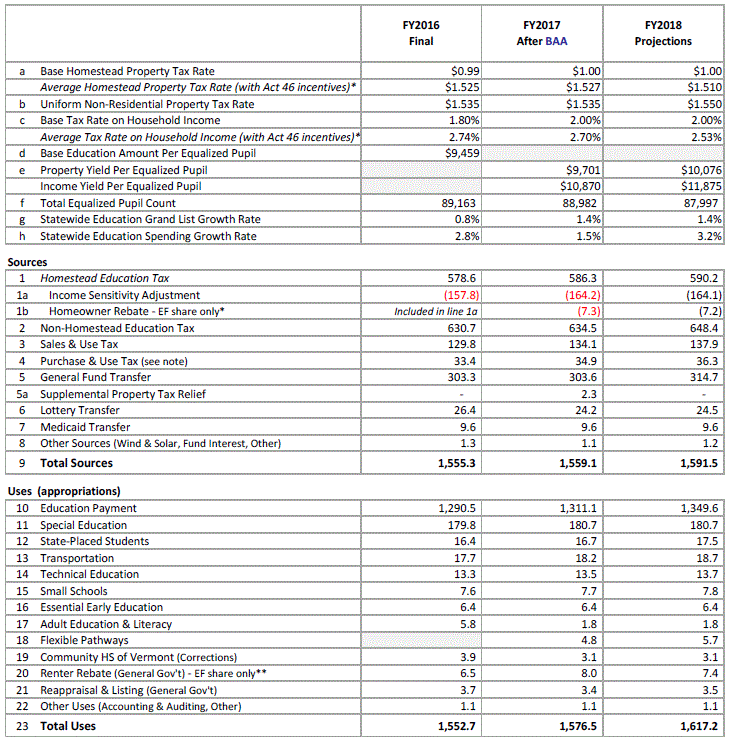
Vermont Business Magazine Property tax values are projected to increase next fiscal year, but so too are property tax bills an average of 2.35 percent, as local school spending growth (projected at 3.2 percent) is expected to outpace the increase in values. The Vermont Commissioner of Taxes today released her forecast related to education tax yields and rates for the upcoming fiscal year, FY2018. The statutorily required forecasts are a joint effort between the Agency of Education, Department of Taxes, Department of Finance and Management, and Joint Fiscal Office. Total Education spending in FY18 is expected to be $1.617 billion on revenues of $1.591 billion, which suggests a shortfall of $26 million (SEE TABLE BELOW).
This year’s projected homestead property yield is $10,076 compared to $9,701 last year. The projected income yield is $11,875 compared to $10,870 last year. The yield's going up mean that a district that spent $15,000 per pupil last year and plans to spend the same this year will see a six-cent decrease in its homestead property rate and a .23% decrease in its income rate. The nonresidential rate is projected to be $1.55 per $100 of property value in FY2018, compared to $1.535 last year.
However, current modeling suggests that the median bill for all three types of taxpayers – homestead property, income, and nonresidential property – will rise 2.35 percent. This is primarily because current forecasts suggest most districts will increase spending in FY2018. The impact of the projected yields/rate on the bottom line of one’s education property tax bill depends on a district’s locally-voted spending and whether the individual taxpayer’s income or property value has increased.
Property taxes force second-home owner to give up on Vermont
“It is important to remember that decisions made at the local level are still the primary factor in determining education tax rates in each town,” states Commissioner Mary Peterson. “Taxpayers may see more significant changes due to those local decisions.” Those decisions may include taking advantage of accelerated merger incentives, having a higher per pupil spending amount than last year, or exceeding the high spending threshold.
In response to the tax projections, Governor-elect Phil Scott issued the following statement: “The Tax Department’s letter to the legislature suggests Vermonters’ education taxes will increase again in the coming year,” Governor-elect Scott said. “Clearly, more work needs to be done to provide Vermonters with the property tax relief they have been calling for. I look forward to working with the legislature in the coming years to tackle this challenge and improve the overall affordability of Vermont,” Governor-elect Scott said.
Act 46 of 2015 changed the structure of the annual forecasting requirement. This is the second year of the new structure. Act 46 set the homestead property rate in statute at $1.00 per $100 of equalized education property value. Similarly, the rate for those paying on income is set at 2%. Therefore, the important numbers communicated by this letter are the property dollar equivalent yield, the income dollar equivalent yield, and a nonresidential rate.
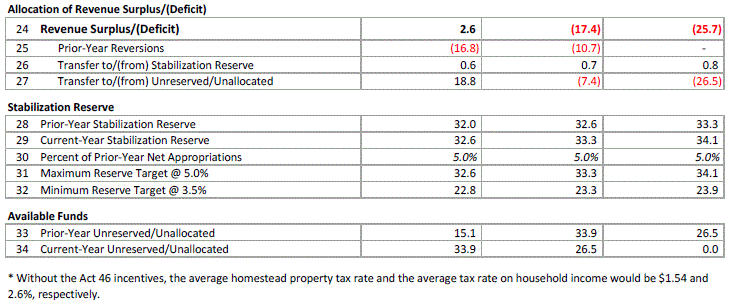
Preliminary Education Fund Outlook - December 1, 2016 (millions of dollars)
Source: MONTPELIER, Vt. – Commissioner of Taxes 12.1.2016