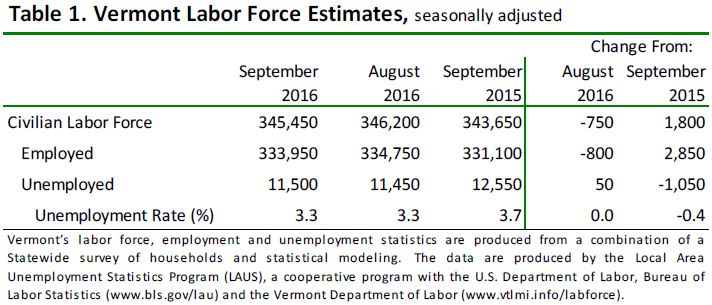
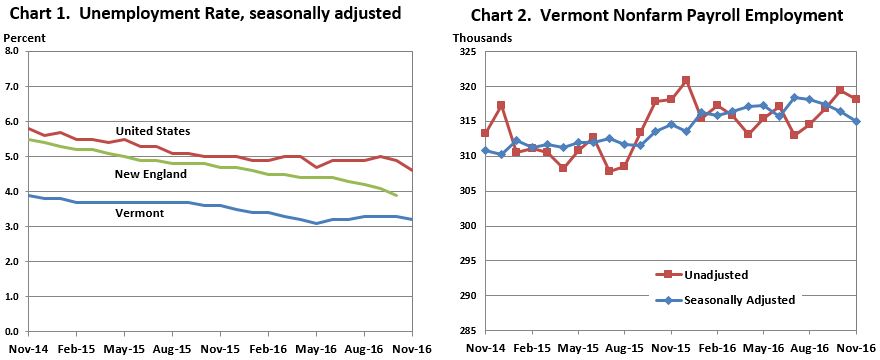
by Timothy McQuiston The unemployment rate was unchanged last month, but the key indicators were all slightly worse, as the labor force and employment both fell, while the number of jobless increased. The Vermont Department of Labor announced today that the seasonally-adjusted statewide unemployment rate for September was 3.3 percent, the same as the revised August rate. The national rate in September was 5.0 percent, up one tenth.
State
|
||||||||||||||||||||||||||||||||||||||||||||||||||||||||||||||||||||||||||||||||||||||||||||||||||||||||||||||||||||||||||||||||||||||||||||||||||||||||||||||||||
As of the prior month’s initial data, the Burlington-South Burlington Metropolitan NECTA was tied for the eighth lowest unemployment rate in the country for all metropolitan areas at 2.8 percent (not-seasonally-adjusted). Overall, Vermont’s unemployment rate was tied for fifth lowest in the country for the same time period. New Hampshire, which is now tied for lowest rate in the US with South Dakota, is at 2.9 percent.
“Preliminary data for the first three quarters of 2016 show a stable economy in Vermont and a continuation of the positive economic growth seen in 2015. For the United States, this has been an extended period of economic expansion at a modest rate of growth. Vermont has mirrored the nation in this respect. The good news is that Vermont business leaders are interested in growing their operations and workforce. Vermont employers are hiring for vacancies at all skill levels, so this is an excellent time for people to be applying for jobs,” said Labor Commissioner Annie Noonan.
“The Department of Labor has many programs that can provide a job seeker with job counseling, skill training and placement support to connect job seekers to these vacancies. Employers should be calling their local VDOL office to ask for help in listing and filling vacancies, and job seekers should register with our JobLink and come in to the office for job placement help. These services are free to you as taxpayers, and can really make a difference in hiring, recruitment and placement efforts.”
The seasonally-adjusted Vermont data for September show the Vermont civilian labor force decreased by 750 from the prior month’s revised estimate. The number of employed decreased by 800 and the number of unemployed increased by 50. None of the over-the-month changes were statistically significant in the seasonally-adjusted series.
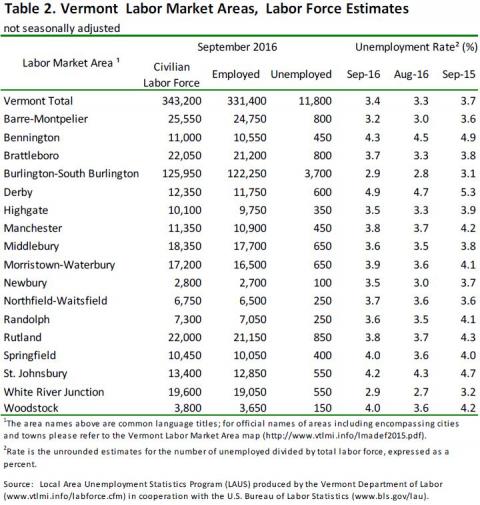
The September unemployment rates for Vermont’s 17 labor market areas ranged from 2.9 percent in White River Junction and Burlington-South Burlington to 4.9 percent in Derby (note: local labor market area unemployment rates are not seasonally-adjusted). For comparison, the September unadjusted unemployment rate for Vermont was 3.4 percent which reflects an increase of one-tenth of one percentage point from the revised, unadjusted August level and a decrease of three-tenths of one percentage point from a year ago.
Not-Seasonally-Adjusted
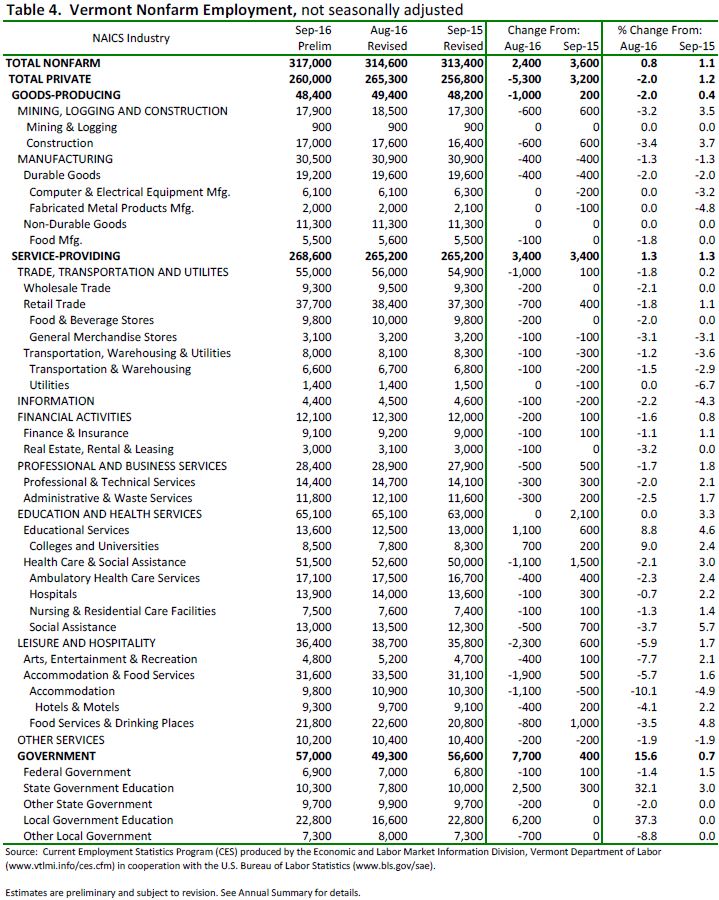
The preliminary ‘not-seasonally-adjusted’ jobs estimates for September show an increase of 2,400 jobs when compared to the revised August numbers. There was no change between the preliminary and the revised August estimates due to the inclusion of more data.
The monthly increase seen in the September numbers was attributable to the seasonal nature of the public and private Education sector. The broader economic trends can be detected by focusing on the over-the-year changes in this data series.
As detailed in the preliminary ‘not-seasonally-adjusted’ September data, Total Private industries have increased by 3,200 jobs (1.2 percent) and Government (including public education) employment has increased by 400 jobs (0.7 percent) in the past year.
Seasonally-Adjusted
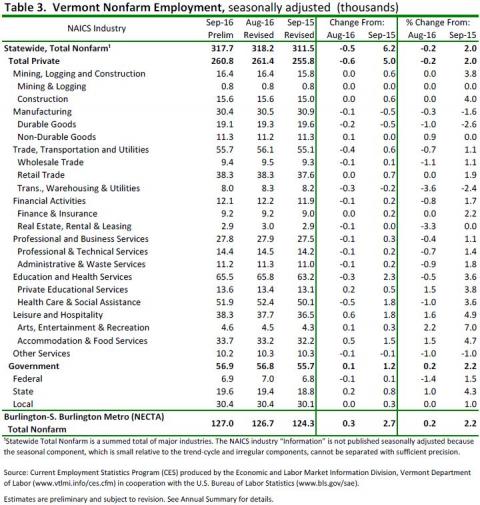
The seasonally-adjusted data for September reports a decrease of 500 jobs from the revised August data. As with the ‘not-seasonally-adjusted’ data, this over-the-month change is from the revised August numbers which also experienced no change from the preliminary estimates.
The seasonally-adjusted over-the-month changes in September were varied at the industry level. Those with a notable percent increase include: Arts, Entertainment & Recreation (+100 jobs or +2.2%), Accommodation & Food Services (+500 jobs or +1.5%) and Private Educational Services (+200 jobs or +1.5%). Industries with a notable percent decrease include: Transportation, Warehousing & Utilities (-300 jobs or -3.6%), Real Estate, Rental & Leasing (-100 jobs or -3.3%) and Federal Government (-100 jobs or -1.4%).
NOTE: Employment (nonfarm payroll) - A count of all persons who worked full- or part-time or received pay from a nonagricultural employer for any part of the pay period which included the 12th of the month. Because this count comes from a survey of employers, persons who work for two different companies would be counted twice. Therefore, nonfarm payroll employment is really a count of the number of jobs, rather than the number of persons employed. Persons may receive pay from a job if they are temporarily absent due to illness, bad weather, vacation, or labor-management dispute. This count is based on where the jobs are located, regardless of where the workers reside, and is therefore sometimes referred to as employment "by place of work." Nonfarm payroll employment data are collected and compiled based on the Current Employment Statistics (CES) survey, conducted by the Vermont Department of Labor. This count was formerly referred to as nonagricultural wage and salary employment.
The Unemployment and Jobs Report for October is scheduled to be released on Friday, November 18.