

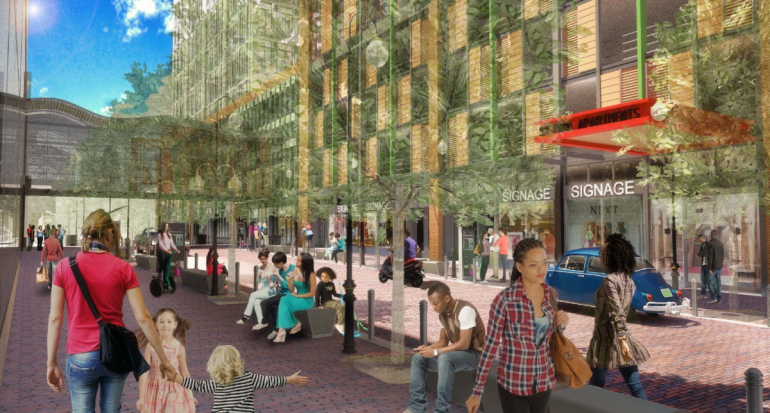
Burlington Town Center rendering of new St Paul Street, with Mall walkway overhead. Courtesy photo.
Vermont Business Magazine Mayor Miro Weinberger, joined by leading Vermont environmental advocates, addressed today the environmental benefits of redeveloping the declining Burlington Town Center (BTC) into a mixed-use, City neighborhood. The supporters announced at the event included the Conservation Law Foundation, the Vermont Natural Resources Council, the Vermont Energy Investment Corporation, the Burlington Electric Commission, and the Chittenden County Regional Transportation Commission.
“We face serious environmental concerns as a community,” said Mayor Miro Weinberger. “On November 8, Burlingtonians have a chance to vote for meaningful progress on both climate change and Lake Champlain protection by voting YES on ballot questions #3 + #4 and supporting the redevelopment of the core of our downtown. I am very grateful that leaders from Vermont’s environmental community are standing with us today to make sure voters understand what is at stake in these votes."
“This zoning district and this project present a wonderful vision of a City working with nature, setting a visionary standard for managing stormwater pollution and reducing the contribution of the City’s hardscape – its roads, sidewalks, buildings, and rooftops – to reduce the problems of combined sewer overflow and even more directly to the stormwater runoff from City streets that flows to the Lake,” said Chris Kilian, Vice President and Director of CLF Vermont. “Working with leadership with the City, this is an opportunity to start to address problems with the Lake and set example for an environmentally sustainable approach to both managing runoff, dealing with pollution, and creating livability benefits that come with green space and better city experience. We will remain in close dialogue with the City as the project advances.”
“We need to be thoughtful about where and how we use our land, and focusing growth in our downtowns and villages represents one of the best chances we have to protect the environment we love,” said Kate McCarthy, Sustainable Communities Program Director of the Vermont Natural Resources Council. “Multiple benefits come from investing in our downtowns with a project like this, which takes a site that's underutilized and turns it into a place where jobs, housing, and services are close together and give people more opportunities — for transportation but also for connecting with their community. This kind of “smart growth” takes the pressure off our undeveloped areas, like farmland and forests, while also creating great places for people.”
The event articulated the environmental benefits of the project and related zoning changes, including:
-
The reduced carbon footprint of hundreds of people living and working in the heart of Burlington’s downtown. Downtown residents consume dramatically less fossil fuel than their suburban counterparts. For, example, the UC Berkeley CoolClimate Network estimates that the average annual household carbon footprint of Charlotte residents is more than 50% greater Burlington residents (http://coolclimate.berkeley.edu/maps; this figure understates the environmental benefits of downtown living as the Burlington figure includes the entire municipality). Reduced consumption of fossil fuels for housing and transportation needs are the major drivers in this difference.
-
The reduced energy consumption of modern, high-performance green buildings. The new zoning will require all new construction to meet LEED Gold standards or equivalent building requirements. Such buildings consume substantially less energy than conventional buildings. The current zoning has no such requirements.
-
The potential 20 percent reduction in the City’s overall carbon footprint that would result from the implementation of a District Energy System. The new build of the redeveloped BTC is a “game-changer” that may finally allow the City to achieve the long-held goal of productively using waste heat from the McNeil Plant.
-
Vast improvements in stormwater protections for the Lake. The proposed initiatives will improve stormwater in two ways:
-
-
The proposed zoning change on the ballot (Question #3) would require improved stormwater management on the redeveloped site. In fact, the new project would be required to act as if it were 100 percent green field. Current regulations require only half of that threshold.
-
The tax increment financing (TIF) investment in public infrastructure eight blocks of the downtown (Question #4) will create one of the state’s leading Green Infrastructure opportunities in a part of the City that currently faces challenges both with overall phosphorous run-off and contributes to Combined Sewer Overflow events.
-
-
Clustered development keeps land open and makes environmentally-friendly transit stronger. If we want to protect our forests and farm fields from sprawling development, and create more livable, affordable, and accessible housing options for residents, thoughtful redevelopment in downtown Burlington offers the best path forward. The additional transit riders that will come from hundreds of homes and jobs in the redeveloped Burlington Town Center will strengthen the overall system and could support service expansions.
Source: The Partnership For Burlington’s Future. 10.20.2016