

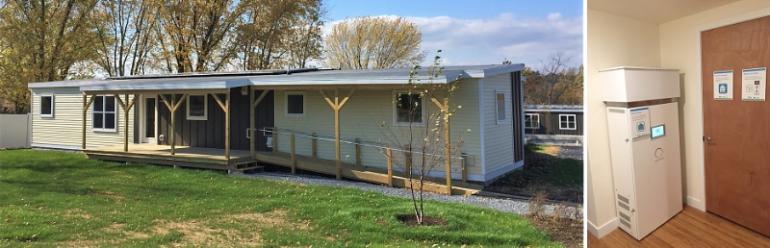
Affordable housng in Waltham features a sonnenBatterie (right), providing resiliency for Zero Energy Development in Vermont (PRNewsFoto/sonnen)
Vermont Business Magazine sonnen celebrated a milestone Wednesday at the ribbon cutting ceremony for the McKnight Lane Affordable Housing Development in Waltham, the first net-zero, low-income rental housing development in the country. The project is led by the Addison County Community Trust and Cathedral Square. It represents the efforts of a coalition of stakeholders from community development agencies, industry, Vermont government, philanthropy, and the nonprofit sector to transform a blighted mobile home community into an energy resilient community using solar plus the sonnenBatterie smart energy storage technology.
This innovative project showcases fourteen customized net-zero modular homes, constructed by VERMOD, aVermont company, and demonstrates how the combination of energy efficiency, solar PV, and energy storage brings greater energy independence and economic benefits to customers. The sonnenBatterie home battery system installed in each of these homes is paired with small-scale solar rooftop panels and stores excess locally generated solar energy. Therefore, by using sonnen's cutting edge battery technology, customers achieve greater energy resilience and the local utility, Green Mountain Power, reduces peak demand on the grid, providing cost savings to all customers. During grid outages caused by storms or emergencies, the battery is able to keep the solar system running to power essential parts of the home like lights, a refrigerator, and furnace during the day in addition to storing excess solar for use at night. Green Mountain Power will partner with customers to utilize the batteries during peak energy times to directly lower costs for customers by reducing transmission and capacity costs.
"At sonnen, our goal is clean, affordable, and reliable energy for all. Projects like the McKnight Lane development enable us to bring new technologies like solar + storage to lower income communities, providing cost savings and peace of mind for these homeowners, bolstering the local utility grid and contributing to greater clean energy equity," said Christoph Ostermann, global CEO of sonnen.
"Solar paired with battery storage is a relatively new technology, so highlighting the many benefits of such projects is very important," said Clean Energy Group Project Director Todd Olinsky-Paul. "The McKnight Lane Housing Development is unique because it enables low-income rural communities to access these technologies today, not years from now."
The addition of the solar battery storage systems to the McKnight Lane homes came about thanks to a collaboration between sonnen, Green Mountain Power, the Addison County Community Trust, Cathedral Square, Clean Energy Group, Clean Energy States Alliance (CESA), and Efficiency Vermont. sonnen in partnership with the High Meadows Fund and The Vermont Community Foundation Sustainable Future Fund funded the inclusion of the sonnenBatterie smart solar energy storage systems. CESA will work with sonnen and Green Mountain Power to collect and analyze data from the battery systems and develop system optimization analysis; and Clean Energy Group, with foundation support for its Resilient Power Project, will share lessons learned to improve this and future, similar projects.
Project Highlights
-
The housing developers are the Addison County Community Trust (ACCT) and Cathedral Square.
-
6kWh/4kW AC smart solar energy storage systems will be installed in each of the 14 modular home units.
-
The smart energy storage systems, supplied by sonnen, will work in conjunction with a 6-kW rooftop solar PVsystem to provide resilient power to tenants.
-
The energy storage systems in each home are able to automatically disconnect from the grid and enable powerfrom the solar panels to provide resilient, reliable, and clean electricity to tenants during a grid outage, such asthe widespread outages from severe weather.
-
This is the first resilient zero-energy modular housing development for a rural, low-income community.
Projected Financial Benefit
-
Electricity cost savings to McKnight Lane homes are expected to be 100 percent. In other words, averaged over ayear, power from the solar and smart energy storage systems should provide more electricity than is needed bythe McKnight Lane residents, resulting in a net energy cost of zero.
Project Implementation
-
Construction started in May 2016, and the homes will be ready for occupancy by November 2016.
-
The 14 modular homes will be available for rent to qualified low- and middle-income households through theAddison County Community Trust.
-
Efficiency Vermont and VERMOD, the manufacturer of the modular home units, have already identified twoadditional low-income communities in Vermont where this pilot project could be replicated.
-
Clean Energy Group and Clean Energy States Alliance will provide technical assistance to analyze and improveupon the clean energy systems in these units, and apply the lessons learned to similar, future projects.
Project Support
To make this zero-energy, low-income housing development possible, funds were needed for the site cleanup, the new infrastructure, and the 14 new VERMOD homes, totaling $3.6 million. Funding was secured by project developers ACCT and Cathedral Square from many sources, including: Vermont Housing Finance Agency, Vermont Housing and Conservation Board, Vermont Community Development Program, HOME Investment Partnership, People’s United Bank, VLITE, Clean Energy Development Fund, Vermont Community Loan Fund, Vermont Department of Environmental
Conservation, Agency of Commerce and Community Development, City of Vergennes, National Association of Realtors, Efficiency Vermont, and in kind support from the Town of Waltham and the City of Vergennes.
Permanent Funding Sources:
-
People’s United Bank Tax Credit Equity: $2,135,000
-
Vermont Community Development Program: $498,000
-
HOME Investment Partnership: $440,000
-
Vermont Housing & Conservation Board: $370,000
-
Efficiency Vermont: $119,000
-
Clean Energy Development Fund: $60,480
-
VLITE: $50,000
Smart Solar Energy Storage System Support Clean Energy Group/Clean Energy States Alliance, Efficiency Vermont, Green Mountain Power, sonnen, and other partners worked to secure funding to add the smart energy storage systems to these units, thereby providing the tenants with reliable backup power in the event of a grid outage.
-
Efficiency Vermont: $30,000
-
Green Mountain Power: $45,000
-
High Meadows Fund and the Vermont Community Foundation Sustainable Future Fund, through Clean Energy Group: $27,156
-
Sonnen has discounted the cost of the smart energy storage systems for this project by 25 percent
-
Clean Energy Group, Efficiency Vermont, Green Mountain Power and VerMod will work together to use lessons learned from this project as a template for clean energy resilient power projects at other low-income housing facilities across the state and region.
Energy Storage System Partners
-
Addison County Community Trust (www.addisontrust.org)
-
Cathedral Square (https://cathedralsquare.org/)
-
Clean Energy Group (www.cleanegroup.org) and Clean Energy States Alliance (www.cesa.org)
-
Efficiency Vermont (www.efficiencyvermont.com)
-
Green Mountain Power (www.greenmountainpower.com)
-
High Meadows Fund (www.highmeadowsfund.org)
-
Sonnen (www.sonnen-batterie.com)
-
VerMod (http://vermodhomes.com/)
-
Vermont Community Development Program (http://accd.vermont.gov/community-development/funding-incentives/vcdp)
-
Vermont Community Foundation Sustainable Future Fund (www.vermontcf.org)
-
Vermont Housing and Conservation Board (www.vhcb.org)
About Clean Energy Group
Clean Energy Group is a leading national, nonprofit advocacy organization working on innovative technology, finance, and policy programs in the areas of clean energy and climate change. Clean Energy Group also manages the Clean Energy States Alliance, a coalition of state and municipal clean energy funds. Clean Energy Group's Resilient Power Project is designed to help states and municipalities with program and policy information, analysis, financial tools, technical assistance, and best practices to speed the deployment of clean, resilient power systems in their communities. For more information, visit www.cleanegroup.org andwww.resilient-power.org.
About the Clean Energy States Alliance
The Clean Energy States Alliance (CESA) is a national, nonprofit coalition of public agencies and organizations working together to advance clean energy. CESA members—mostly state agencies—include many of the most innovative, successful, and influential public funders of clean energy initiatives in the country. CESA's Energy Storage Technology Advancement Partnership (ESTAP), supported by U.S. DOE Office of Electricity and Sandia National Laboratories, is a federal-state funding and information sharing project that aims to accelerate the deployment of electrical energy storage technologies in the U.S. Learn more at www.cesa.org.
About sonnen
At sonnen, we believe clean, affordable, and reliable energy for all is one of the greatest challenges of our time. With 15,000 sonnenBatterie systems installed worldwide, sonnen Group is a proven global leader in intelligent energy management solutions that provide greater energy control for residential and commercial customers through increased solar self-consumption, reduced peak energy usage and reliable backup power during outages – contributing to a cleaner and more reliable energy future. sonnen has won several awards for its energy innovations and sonnenBatterie products, including MIT's Technology Review's 50 Smartest Companies 2016, Cleantech Global 100 for 2015 and 2016, Greentech Media's 2016 Grid Edge Award for innovation, and Cleantech's 2015 Company of the Year Award in both Israel and Europe. Learn more at https://www.sonnen-batterie.com/ or follow us on Twitter.
SOURCE LOS ANGELES, Oct. 19, 2016 /PRNewswire/ -- sonnen