

Vermont Business Magazine Most Vermonters have expressed concern about utility costs and stress the need for better ratepayer representation in regulating power companies and setting rates, according to survey data released today by AARP Vermont. The responses also revealed that many ratepayers would vote for a candidate that supports implementation of an independent ratepayer advocacy office. The findings were part of opinion surveys conducted by AARP of Vermonters over age 35 as well as an AARP member survey. AARP has been a vocal opponent of Vermont Gas System's Addison pipeline project because of the potential rate impact to existing customers.
Following is a summary of key findings:
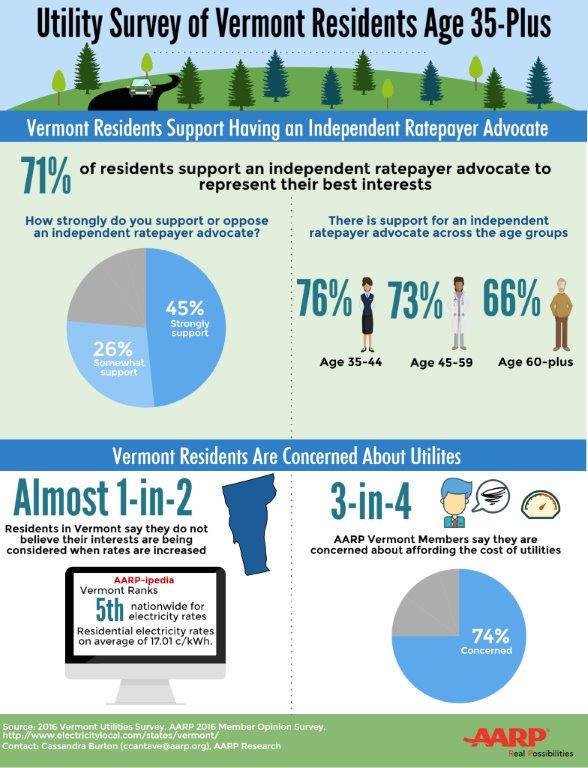
- 71% support an independent ratepayer advocate
- 48% do not believe their interests are being considered when rates increase
- 75% of respondents are concerned about affording utility costs
- Over 80% between age 35-60 support establishing an independent ratepayer advocate
“It is clear from this survey that Vermonters are worried about the cost of utilities and want to have better representation as consumers when issues impacting them come before regulators,” said Greg Marchildon, AARP Vermont state director. “We have been working hard to make the case for an independent ratepayer advocate that operates outside the Department of Public Service,” he said. “We will be joining with others to push this concept forward in the coming legislative session and hope this survey data – and recent events -- will help inform lawmakers.”
Green Mountain Power spokesperson Dorothy Schnure said in a statement: "Green Mountain Power is incredibly focused on delivering cost-effective power to its customers, and has lowered bills for customers three times in the past four years. Our rates currently rank second lowest in New England and we continue to work hard to provide stable rates, while achieving the highest customer satisfaction in the east, according to JD Power, an unbiased national survey company."
Beth Parent, Communications Manager for Vermont Gas, said in a statement: "Vermont Gas is always glad to talk about affordability when it comes to energy because we have a good story to tell and Vermonters deserve to hear the whole story. Our rates have decreased by more than 15% since early 2012, saving the average family $300/year. In fact, our customers are paying less today on natural gas then they were just four years ago. In addition, our efficiency programs are helping customers save about $14 million each year. The company is also focused on helping our neighbors in need. That is why we offer income-eligible customers a 20% reduction on their natural gas bills. We should also point out that in the communities we serve, Vermonters who choose natural gas pay less than those who are limited to fuel or propane."
Marchildon also said that his office has been pressing the gubernatorial candidates to take a position on this issue in hopes that the incoming administration will support better consumer representation. The question was put to Phil Scott and Sue Minter at a recent gubernatorial debate and in a published voter guide produced by AARP Vermont.
PUBLIC UTILITIES - CONSUMER PROTECTION
What measures will you support to make sure utility customers have a voice in cases about their utility
rates and other proceedings related to their utility service?
| AARP’s Position: Few government agencies affect consumers’ like the Vermont Public Service Board that regulates utility services. Their decisions affect the cost and availability of electricity and natural gas. Frequently regulators make decisions without meaningful consumer input. Vermont should make regulatory proceedings more accessible to consumers with limited funds, and should reduce the complexity and cost of consumer input. To ensure consumers are informed about the cost of utility services, Vermont should require utilities to notify customers of rate changes that impact monthly bills and hold multiple local public hearings. |
|
Sue Minter (D):
|
|
Phil Scott (R):
|
PUBLIC UTILITIES - ACCOUNTABILITY AND TRANSPARENCY
For the past decade, Vermont’s two shareholder utility companies have operated under plans that adjust
gas and electric rates without the accountability and transparency of a full rate case. What measures will
you take to assure that these plans benefit residential ratepayers and that consumers are paying only what
is fair and reasonable?
|
AARP’s Position: The danger for residential electric and gas consumers is that these rate plans contain formulas that automatically adjust rates and limit the ability of regulators to evaluate costs. These plans can also lessen the utility’s incentive to control costs between rate cases. Before allowing utilities to recover costs, regulators should ensure that utility rate changes occur within the context of a full rate case review and depart from this approach only when a utility can demonstrate extraordinary circumstances. Regulators should consistently ensure that the utility is accountable to its customers. |
|
Sue Minter (D): I believe there are benefits and drawbacks to traditional and alternative utility regulation. We will ensure that under the statutory alternative regulation program ratepayers are getting a fair deal. My Department of Public Service will communicate with the public about its efforts to create transparency around the rate regulation process. I will have a goal to reduce rates whenever feasible and that on average we hold utility rate growth at or under the rate of inflation. This will help make energy more affordable and keep prices more stable, which is a benefit for residential customers and businesses. |
|
Phil Scott (R): I am aware of, and share, concerns about alternative regulation. AARP-VT helped bring this issue to the forefront. If I am elected, I will commit to examining the benefits and disadvantages of alternative regulation – with the priority of protecting ratepayers – and will encourage the legislature to do the same. It is also important to acknowledge that alternative regulation, when employed properly & transparently, can allow utilities to move more nimbly and this agility – when used for the benefit of ratepayers - can benefit the state’s economy. It appears, however, that alternative regulation policy may need reform. |
PUBLIC UTILITIES - CONSUMER ADVOCATE As Governor will you commit to take a leadership role in establishing a strong independent consumer advocate to represent residential customers and ensure Vermonters are paying fair electric and natural gas rates?
|
AARP’s Position: Increases in the monthly utility bills of older Vermonters often means they have to make tough choices between paying for food, medicine and heat. Utility customers need a strong independent consumer advocate who will question whether utility rates are fair and reasonable and whether rate proceedings preserve valuable consumer protections. The advocate should have the expertise to understand rate-setting proceedings and the impact of rate adjustments on utility customers. AARP advocates for a transparent process for utility rate reviews, including the establishment and funding for an independent consumer advocate. |
|
Sue Minter (D): Vermont now has the second-lowest overall electric rates in our six-state New England region, which is important as we compete for jobs with our neighbors. However, I know we can continue to improve upon our competitive position in the region, and I know that even modest rate increases in gas or electric service can be very challenging for Vermont's families, our seniors, and our businesses. My administration will strengthen the existing Public Advocate office and work with the Department of Public Service, the Public Service Board and stakeholders to ensure Vermonters are paying fair electric and natural gas rates. |
|
Phil Scott (R): The Department of Public Service must act as an advocate for ratepayers, including residential customers. There is clearly room for improvement in advocating for residential customers and I will make sure my Commissioner is a strong voice for all consumers. To learn more about my energy priorities, please read my comprehensive economic plan posted on my campaign website. |
Source: AARP 10.17.2016. AARP is a nonprofit, nonpartisan membership organization with 138,000 members in Vermont and 40 million members nationally. Through a wide array of special benefits, services, and information resources, we help our members make important choices, reach their goals and dreams, and make the most of life after 50. (voter-guide-gov-2016)