

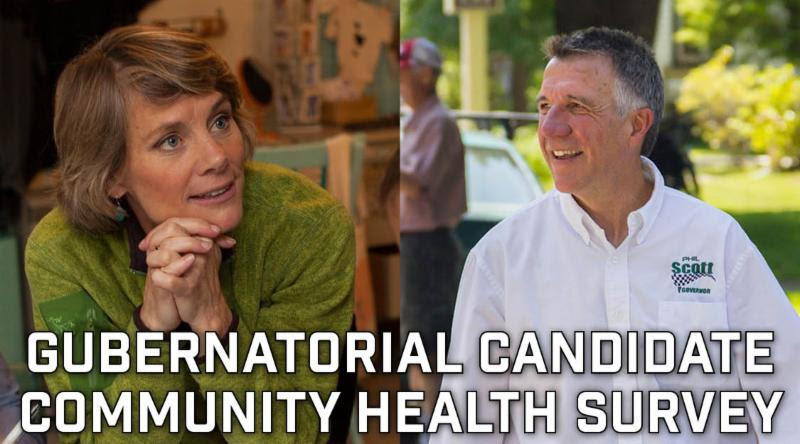
Vermont Association for Mental Health and Addiction Recovery The Vermont Association for Mental Health and Addiction Recovery has partnered with a number of other organizations - Vermont Association of Area Agencies of Aging, NAMI-VT and Vermont Care Partners – in developing the topics and questions related to home and community-based health care services. Here are the responses from Republican candidate Phil Scott and Democratic candidate Sue Minter. The surveys are informational. There is no rating of the candidates.
Introduction
The majority of health care takes place in our homes and communities. Community-based health care providers such as Home Health Agencies, Area Agencies on Aging and the Designated and Specialized Developmental and Mental Health Agencies are meeting a broad array of health care needs with a particular focus on the social determinants of health. The social determinants of health have a far greater influence on the triple aim of reducing health costs, improving health outcomes and improving the experience of health care than both genetics and medical care.
A significant portion of Vermont’s population access home and community-based services each year, particularly seniors, individuals with disabilities, student with special needs, and individuals and families coping with mental health conditions and substance use disorders. The success of these services is reflected in the Vermont’s low use of nursing homes and institutional placements. Greater progress in reducing emergency room utilization, inpatient care, out-of-state placements for children with special needs, as well as incarceration could be achieved with greater investments in these resources.
The purpose of this survey is to give the candidates for Governor an opportunity to state their positions on some of the most critical issues related to home and community-based services. The sponsoring organizations will then share the survey results with our provider networks, including our employees; community stakeholders, advocates and Vermonters who use these publicly funded services. The candidate’s responses will not be altered, summarized or evaluated by the sponsoring organizations in any way. Our sole goal is to simply share the responses to these questions.
Phil ScottHealth and Payment Reform
We have seen the negative impact to our healthcare system when we undertake costly experiments based on speculation, and as Governor I will not allow that to happen again. My first focus will be to stabilize Vermont’s healthcare system, especially around Vermont Health Connect. Secondly, I am concerned that power and resources are becoming too concentrated and the result is Vermonters are being pushed to have a health care relationship with a large institution rather than a health care provider of their choosing. We have yet to find the proper balance between top down cost containment and bottom up relationships between providers and their patients. Given this dynamic, I am approaching the All Payer Waiver with caution and have called for the Administration to delay the approval until Vermonters have a much better idea of how the proposal will work. For example, some of the questions I have are how, and how soon, will community and mental health services be integrated into the model? I want to make sure that such a system does not force a wedge between patients and their providers, including those Vermonters now receiving Medicare and those receiving care from community based providers. How ever we proceed, it will be important to hear from Vermont’s well-established community health providers.
“Improving wellness” entails more than just health care reform. I believe we can achieve cost containment and improve wellness by breaking down the walls and better integrating the multitude of separate services government now provides separately through our health care system, our human services system and our education system. Better intra-agency coordination and simplification of benefit administration can reduce human service costs across the board as well as health care and education costs. This reform, also known as “the common view of the client,” requires integration of the benefit silos within the Agency of Human Services and a new integrated benefit management system to replace the outdated ACCESS technology implemented in 1983. This integration would allow frontline social workers and other providers to work more efficiently and creatively with their clients in crafting benefit packages that speed the client’s transition to a higher level of wellness and independence and better address the social determinants of health. It would also allow the state to better manage the total cost of the combined benefit streams. And it would give the client the opportunity to see exactly what array of services they are eligible for and package them toward their specific needs while providing taxpayers a transparent window of how much such services cost and their cost effectiveness. Efficiency means doing the same for less investment or more for the same investment. By working to find savings through efficiencies among the many services state government provides, we can ensure a more stable provision of benefits, easier access to these benefits and empower our providers with management tools that focus on overall wellness and not just on unique silo driven benefits streams.
Mental Health, Substance Abuse and Developmental Services
There is no doubt that Irene decentralized our mental health system in a major way – and we’ve still not recovered. This is a very serious issue. I’m told there is now a higher demand for level one beds, and that some patients are experiencing lengthy waits because other complex cases are remaining in level one beds for long periods, creating a bottleneck. From what I understand, hospitals, mental health professionals and advocates agree that these extended emergency department wait times are not in a patient’s best interest. You may not hear this from other candidates – I’m not an expert in this area and I don’t know what the perfect solution is. But I know we can figure it out – and we will. I’ve always been a leader who listens, learns, and then work towards solutions, and that’s exactly what we need to do in this case. One determination my administration would work to make is whether spending more money to increase the number of inpatient beds maximizes the utility of scarce healthcare dollars and actually addresses the problem. As I understand it, inpatient facilities are the most expensive option. So instead, we should perhaps invest in the community health networks, and in expediting a safe process for transitioning out of inpatient care. Finally, I believe that making the economy a priority is critical to helping ensure we have the resources we need to get this job done and protect our most vulnerable, and that’s why the economy will be a top priority for me as Governor.
This is a very troubling statistic, and one we need to understand further so we can identify what factors are contributing to these deaths and what approaches will help prevent them. These challenges are complex, but it is clear we need a more robust community network of mental health care providers, as well as more robust system for accepting and transitioning patients that seek inpatient care. However, I do believe that a more integrated management system of our benefit streams as described above will help prevent those seeking or needing mental health services from “getting lost” in the maze of government programs. While everyone feels the same pressure of Vermont’s high costs of living, there are also recruitment and retention challenges unique to the healthcare sector. As laid out in my healthcare plan, I will work with hospitals, health professionals, and other provider groups to understand why many positions go unfilled in the health and mental health sector, why doctors are leaving and how we reverse this trend. We need to ensure that Vermonters have access to the highest quality health and mental health care, and that starts with the highest quality providers. Also, like so many other areas across the health care continuum, staffing and funding are limiting factors, which is why it is so important for Vermont to focus on the economy as a top priority.
My budget philosophy says that we have to live within our means, while also caring for the vulnerable. While I will not propose or sign a budget that grows faster than the economy or wages, I have an aggressive plan to increase government efficiency and grow the economy so that we have the resources to address our most critical challenges. However, I don’t think the solution to these problems rests just within the Medicaid program. Though a large portion, Medicaid is only a portion of what we spend on human services, education, and other programs serving the Medicaid population. In education, for example, the Picus Report indicated over $160 million in savings could be achieved. The Hsiao Report recommended tort reform indicating such proposals would save 2.6% in health care costs, or over $150million. Further, I’m convinced that implementation of “common view of the client” systems at AHS will achieve millions in savings as well. To solve this problem, we need to think globally within our current systems, not just focus upon one benefit stream. We need to set priorities about what’s most important and fund those efforts at a high level. We need to exert the political will to implement possible efficiencies, which have already been identified by knowledgeable observers. However, when it comes to the Medicaid program, we simply cannot make the budget or the reimbursement problems worse, and we need both short and long-term solutions. Over the short-term, we need to reduce the administrative cost of Medicaid - which are about 15% of the total budget and have steadily increased over the last six years – among other costs. In the long-term, the best way to reconcile the state budget pressure of Medicaid – and raise reimbursement rates – is to increase economic opportunities across the state by making the economy and affordability the top priorities. As I’ve said, there are recruitment and retention challenges unique to the healthcare sector that must be addressed to ensure Vermonters are getting the highest quality care. Solving these challenges will not be easy, but I’m confident we can get there together.
Substance Abuse
The opioid epidemic we face here in Vermont and throughout the country is one of our most serious health and safety challenges, and one that impacts every person in our state. Frankly, this is an area in which Governor Shumlin deserves credit for his leadership. He did the right thing when he made this issue the focus of his State of the State address – it really set the agenda for this issue. I will always be a leader who looks to outcomes to evaluate success of a program, and the state’s study has shown the Hub and Spoke approach to MAT to be effective in reducing general healthcare expenditures. As Governor, I would also advocate for the expansion of this approach as needed. Recently, the federal government rightly increased that cap on the number of MAT patients a doctor could oversee to 275 to reduce barriers to treatment. Since such treatment is often the foundation for long-term rehabilitation for substance use disorder, it is important for Vermont to continue to communicate to our federal partners when we need flexibility. As Governor, I will monitor this change to make sure it is implemented properly and encourage the U.S. Congress to continue to assist states in combating the opiate crisis.
I’m proud to have put forth a comprehensive plan to continue our state’s leadership in the fight against opioid abuse, and find new ways to make progress – because we clearly need to do more. My plan would work to address this crisis from all sides, including education, prevention, treatment and enforcement. It’s one reason I have the support of the Vermont Sheriffs Association. As I detailed in that plan, my administration will encourage communities to provide law enforcement with additional tools to address this challenge and allow them more flexibility when it comes to those with mental health and addiction challenges. For example, the Gloucester, MA police department has a program that gives police the latitude to refer people to treatment instead of sending them to jail for petty crimes motivated by a drug addiction. Communities across the country, including Montpelier, are having success with this approach. It recognizes the importance of getting someone into treatment while they may be having a moment of clarity, when they believe they’ve “hit bottom.” For many, that bottom comes when they’ve been arrested. But, if we make someone wait until they’ve completed a jail sentence to seek treatment, chances are we’ll be too late. For this model to work for Vermont, however, we need to expand treatment options and eliminate waiting lists.
Being placed on a waiting list for treatment poses many challenges for people with an addiction. That is why treatment is another priority area in my plan, in addition to our efforts to reduce demand for treatment with prevention and education. My budgets will prioritize expanded treatment options. We will also work closely with treatment professionals at Vermont’s Recovery Centers to develop tools for increasing the number of licensed professionals and reducing employee churn in this important segment of our healthcare system. Make no mistake, reducing churn and increasing the number of licensed counselors is no easy task. Nevertheless, we must remain focused on this important piece of the puzzle. To this end, I’ve committed to meeting with each of Vermont’s hospitals, treatment centers and designated agencies before I’m sworn into office to determine how the state can further assist them in recruitment and retention, and I will make a specific proposal to the Legislature in January.
Support for Seniors Vermont has one of the fastest growing elder populations in the nation.
For my entire career I have committed to listening to Vermonters about their challenges, learning more about the issue from experts and getting to work to identify and implement solutions in Montpelier. And when I talk to Vermonters of all ages, they want quality, affordable healthcare that allows them flexibility to choose their doctor and the services that work for them, including in-home care. Healthcare reform under my Administration will focus on ways to deliver those outcomes. Further, I will always consider any idea or proposal that will increase affordability for Vermonters. If in-home care is more cost effective, and is the choice of the patient, that is something I would want to explore further, and would work with healthcare and homecare professionals and advocates to learn more and understand the barriers our seniors face when seeking these services.
Vermont’s crisis of affordability affects all of us, but for seniors who are on a fixed income, it is especially hard. When the legislature raises taxes and fees every single year, as they’ve done over the last six years, how do seniors on a fixed income make those additional payments? Many can’t. Recently I ran into a man I knew in Montpelier, who was working although I thought he had retired. He told me, he was 72 years old and he had to go back to work full time in order to afford to live and stay in the state. We have to reduce that burden on seniors, and that’s what I will work to do as Governor. Higher property taxes, higher taxes on retirement incomes, the elimination of income tax deductions used by seniors, among others, are not a recipe for keeping seniors in their communities and in their homes. More specifically, one proposal I’ve put forward is to fight for a federal safety net for long-term care. The largest portion of the Medicaid budget (about 33%) is spent on long-term care. The reason this expenditure is so high is largely the result of the federal government’s refusal to provide a meaningful long-term care safety net. In other words, the state Medicaid program is the “payer of last resort” and Vermonters (and all Americans) are often forced to spend all of their savings in order to qualify for state assistance at the end of their lives. As Governor, I will work with a bipartisan task force of Governors to work with the federal government to address this growing problem. This issue is especially important due to our state’s aging population. No state should be forced into choosing between care for aging neighbors and other essential services, but the lack of federal leadership has made that a very real budgetary challenge. |
Sue MinterHealth and Payment Reform 1. Do you support moving forward with the All Payer Waiver? If so, how will you ensure that community health providers including Home Health Agencies, Area Agencies on Aging and Designated and Specialized Mental Health and Developmental Service Agencies receive investments to strengthen home and community based care? The All Payer Waiver (APW) allows us to set the pace for building a comprehensive system of care, redefining how we pay for health care and how we support providers. It is my understanding that most community services will come into the APW in the 3rd year, but that there is a negotiation for “transformation dollars” to invest in community services. Advocating for those transformation dollars and supporting their use for community based care, which I see as the foundation for health care, will be an important component of this reform and a way to support full/comprehensive system build-out. 2. What do you see as government’s role in improving wellness through preventative human services, not just preventative medicine? How does Medicaid payment reform fit into this plan? Strategies and investment around prevention are critical to helping bring better overall health outcomes as well as long run fiscal savings. Health and wellness should be a community conversation. As Secretary of Transportation, I worked to ensure we invested in sidewalks & bike lanes and promoted biking and walking to school through our Safe Routes to School program. Activities in communities, nutrition in schools, and healthy offerings through social programming are all important for prevention. Wherever possible, Medicaid dollars should be invested in worthy programming with proven outcomes. Mental Health, Substance Abuse and Developmental Services 1. There is an ongoing problem of people in psychiatric crisis left waiting for days in hospital emergency rooms with psychiatric inpatient beds filled to capacity. How would your Administration address this problem? I want to address this important challenge with a thorough analysis of system gaps and the variables creating them. I hear countless stories (particularly from nurses) of acute needs for additional space and support for patients with mental health challenges in the hospital settings. I will ask for recommendations from a large stakeholder group tasked with coming together to address this issue. I’d want to know if all psychiatric beds are filled to capacity or if it’s just Level I beds that are regularly filled. We need to understand the flow of needs in step down facilities to determine how to fully address the overall need across the state. 2. In Vermont there are 80 suicides annually. This is higher than the number of motor vehicle deaths or homicides in Vermont. If elected, how will you make sure everyone has access to the mental health care they need to help prevent these tragedies? I will work to help lead conversations in our communities about suicide and reducing the stigma of those seeking mental health services. It is not just about access but also about people feeling comfortable seeking access. If there are waiting lists for receiving services, we should address how we can best support community services. We also need to raise awareness of this silent story and encourage more school-based counseling & support including peer mentoring & dialogue. In addition, my proposal to require background checks for all gun sales will help reduce suicide by guns. In states with background checks there is a correlation of 46% fewer suicides by firearm. 3. Home and community based providers care for the some of the most vulnerable Vermonters with scant resources because of poor reimbursement from public payers like Medicaid and Medicare. The result is high turnover and high vacancy rates among staff. In the light of growing demands for care and concerns about access to quality care, how would you invest resources into home and community based services so they have the staff to meet the needs of Vermonters. I look forward to hearing the ideas from providers on how to address this. My ideas include, shifting money in health care from areas where there is a surplus to areas where there is need (which the APW has the potential to help us implement) and creating parity in salaries to attract staff and equal value given to community based providers. Substance Abuse 1. What do you think about the policy approach to the opiate crisis so far? Is the Hub and Spoke approach to Medication Assisted Treatment successful? We need to continue the conversation. Hub and Spoke has been extremely helpful; counseling is an extremely important complimentary treatment approach. At the start of my tenure I will appoint an Opiate Crisis Manager to be in charge of oversight & management of the state effort to prevent and treat addiction and restrict access to these drugs. This crisis manager will convene a multi-jurisdiction task force to bring together leaders and expertise from the many sectors engaged in this crisis: from prevention & treatment, to health providers and the pharmaceutical industry as well as the enforcement community. As I learned with managing the Irene crisis, we need someone in the Governors office to direct this mission, be focused on improvement 24/7 and joined by leaders from all the areas that intersect with this debilitating addiction and the many impacts it is having on our state, community and families. 2. What proposals would you have to improve the approach of the Department of Corrections to addictions and mental health conditions? Is there more we can do to reduce incarceration of people with mental health and addictions? I believe we need to have a health contract that addresses mental health care. (My understanding is that the current contractor has not met our needs on this count). We will also work with the judiciary to better screen the mental health needs of those incarcerated and work to ensure that the services are available when we make referrals. I also want to work to improve the transition from corrections to the community. 3. How do you think the State should support the Recovery Centers in Vermont? Given the acute and growing needs for substance abuse and addiction recovery, I want to assess current needs and outcomes of the Recovery Centers. I will work with the Congressional delegation for more funding and demonstration projects from Federal initiatives. I will also work to share best practices throughout the state. For example, Rutland's Project Vision is already seen as a model for other communities. We need to build upon our successes, continue collaborating, and working to provide hope for those in recovery (including their family members) as we work to move afflicted Vermonters from addiction to recovery.
Support for Seniors Vermont has one of the fastest growing elder populations in the nation.
1. How would you work with stakeholders to ensure elder care social services are as effective as possible at supporting people to meet their needs and stay in their homes? Our state policy of Aging In Place requires that we provide adequate supportive services for elders in their homes and communities. These services range from preventive health care, to nutritious meals, activities and access to transportation. I have been an early and ongoing supporter of the SASH program. However, I also want to expand collaboration between & among senior service providers to ensure that we are working in tandem and not in competition or with duplication of services. Under my administration DAIL will review surveys answered by Vermonters; assess the current construct of organizations and review outcomes and future pressures. We will also work to collaborate with transportation providers, health & social service providers for seniors (Council on Aging, AAAs, Senior Centers, etc.) and senior housing providers to facilitate a successful network of services to meet needs. The APW should also include assessment of reinvestment in prevention for seniors. 2. What key policies or programs that support seniors would you work to strengthen as governor? Please see Sue’s senior affordability plan at www.sueminter.com. |
Source: pear-vt.org 10.12.2016. Sponsoring Organizations: Vermont Association of Area Agencies of Aging, NAMI-VT, VAMHAR, Vermont Care Partners. VAMHAR photo.