

by Michael Bielawski and Emma Lamberton Vermont Watchdog Governor Peter Shumlin announced Wednesday that his administration has a draft agreement with the federal government to make Vermont the first state to adopt an all-payer health care model. Since failing to create a single-payer health care system that would have cost Vermonters $2.6 billion in new taxes, Shumlin has been working on a slightly more modest proposal to change how health care services are paid. Under the draft agreement with the feds, Centers for Medicare and Medicaid (CMS) authorizes Vermont to create an All-Payer ACO Model. The plan is described as “a test” to see if health care quality can be improved by tying payment for that care to health outcomes instead of individual health procedures, the current fee-for-service payment model.
The agreement projects that innovative payment and service delivery models will “reduce Medicare, Medicaid, or Children’s Health Insurance Program expenditures while maintaining or improving the quality of beneficiaries’ care.”
Under an all-payer system, the state, rather than providers, will receive and control the distribution of reimbursement funds from private insurance, Medicaid and Medicare. The Green Mountain Care Board will be the primary overseer of all those funds.
Under the supervision of the GMCB, a statewide Accountable Care Organization will distribute reimbursement to providers based off of patient health outcomes rather than individual procedures. The structure will be similar to OneCare Vermont, which up to this point has largely dealt with hospitals. The board will determine how payments are calculated, supervise quality assurance, and decide which doctors are responsible for segments of the population.
At Wednesday’s news conference with reporters, health care officials warned that costs under the current system are predicted to rise at about 6 percent annually, or about double the rate of wages. The estimates under the the draft agreement project that an all-payer model can hold cost increases to about 3.1 percent, potentially saving the state about $10 billion over the next decade.
The skyrocketing cost of family plans was also used as justification for embracing the all-payer model. A premium health plan for a family of four uses up about 38 percent of household income, but will reach 56 percent by 2025 under the current system.
“If you think we receive a lot of public comment about affordability today, imagine in 2025 when you are at $42,000 (for a family of four),” said Green Mountain Care Board Chairman Al Gobeille.
Gobeille said in his business one decade ago he was paying employees just over $10,000 for health care for a family of four. Today that amount has grown to $23,957.
Shumlin said the all-payer model is the only option on the table.
“My question to all is, if we don't do this, what do we do?” he said. “I don't think that any reasonable person would look at these numbers and say ‘let's just keep doing what we are doing and hope for the best.’”
Gobeille said 86 cents of every health care dollar is spent on chronic ongoing conditions. He added that the opioid and drug abuse epidemic is hitting Vermont harder than the national average, adding to rising health care costs.
Shumlin’s negotiation with the federal government marks the culmination of the governor’s efforts as he nears the end of his term, creating the first statewide all-payer system in the nation.
The Vermont Association of Hospitals and Health Systems said in a statement that Vermont's hospitals are committed to affordable health care for all Vermonters and to ensuring that everyone has access to the doctor and hospital of their choice. The all-payer model concept builds on existing efforts by providers to integrate primary care services, partner with community organizations, and use technology to better care for patients regardless of where they are.
"We have an opportunity with this reform initiative to move the health care system in a direction that can reduce costs by focusing more on wellness than on illness," said VAHHS President and CEO Jeff Tieman. "At the same time, there are still many important but unanswered questions. For an all-payer model to work, Medicaid must be a reliable and adequately funded partner; we must have a plan for containing Medicare cost growth that accounts for our state's aging population; and we must make sure that the contractual structure of the model is sensible and workable."
"And of course," Tieman added, "creating a successful plan out of this proposed agreement will take time, leadership, collaboration and goodwill."
As the association reviews the plan and asks key questions, Tieman said each hospital will continue to evaluate the plan based on whether it best meets the needs of their communities.
Critics, however, say the move is another Shumlin experiment bound to fail.
“Medicare beneficiaries are going to be an experiment, a petri dish, for the new health care system that no other state has experienced,” said Darcie Johnston, president of Vermonters for Health Care freedom.
The new, statewide ACO will be risk-bearing, meaning that if health care expenses come in under budget, the ACO keeps the profits. If providers overspend, the ACO takes the loss. While ACOs are at the center of the new plan, recent reports have found that ACOs have not, in fact, been able to cut costs or control spending.
“You put another administrative body into the system. How can that not cost more?” said Johnston. “Risk bearing ACOs are a risky venture. Who ultimately takes those losses? The taxpayer?”
The Shumlin administration says the new system encourages results rather than expensive testing, and should cut health care costs. Planning for the all-payer waiver began in 2014, after the governor faced the defeat of his single-payer proposal, which proved to be too costly for lawmakers to stomach. Shumlin called the collapse of the single-payer experiment “the greatest disappointment of my political life so far.”
Within the next 10 years, the federal government wants 80 percent of Vermonters to receive care from ACO entities.
Gobeille has said before that the system requires a “critical mass” of providers to function fully, and so the board must incentivize providers to join. The incentives could take the form of higher pay rates for doctors in the organization, or added fees to those not in the ACO.
Private practice doctors are concerned they will be disenfranchised in the new system. Hospitals like UVM Medical Center essentially create medical monopolies in the health system, with greater negotiating powers than small private practices. This, independent physicians say, will limit choices for Vermont patients.
Opponents of the plan say a top-down capitation system controlled by GMCB and a large hospital monopoly will benefit a few large organizations and hurt non-hospital affiliated providers, such as independent physicians and federally-qualified health centers. They also say a centrally controlled system limits patients’ choice of providers and snuffs out consumer-based input.
“I cannot condone Gov. Shumlin’s rushed attempt to memorialize his tenure by turning our state into a laboratory for healthcare experiments yet again,” House Republican Leader Don Turner said in a statement.
“After spending four years and over $2 million on the single-payer model, he ultimately abandoned his signature project. Instead, his Administration spearheaded the chronically dysfunctional Vermont Health Connect, which has cost over $300 million in taxpayer funds since its launch in 2013,” he said.
Health officials at the meeting said Medicare and Medicaid beneficiaries would be able to maintain all their benefits, services and choice of providers under the plan. Providers will also get performance incentives on top of the base-pay, to help promote higher quality.
Officials emphasized the preliminary and evolving status of the agreement. “Our lawyers are have gone through it, their lawyers are working through it. But the substance in it should not,” Gobeille said.
Green Mountain Care Board meetings will take place at the City Center in Montpelier over the next three weeks. The first is Thursday at 1 p.m. Three public forums also will be held during the same time period at a time to be determined.
“The administration and the Green Mountain Care Board intend to work collaboratively on the three public forums that will be had throughout the state,” Gobeille said.
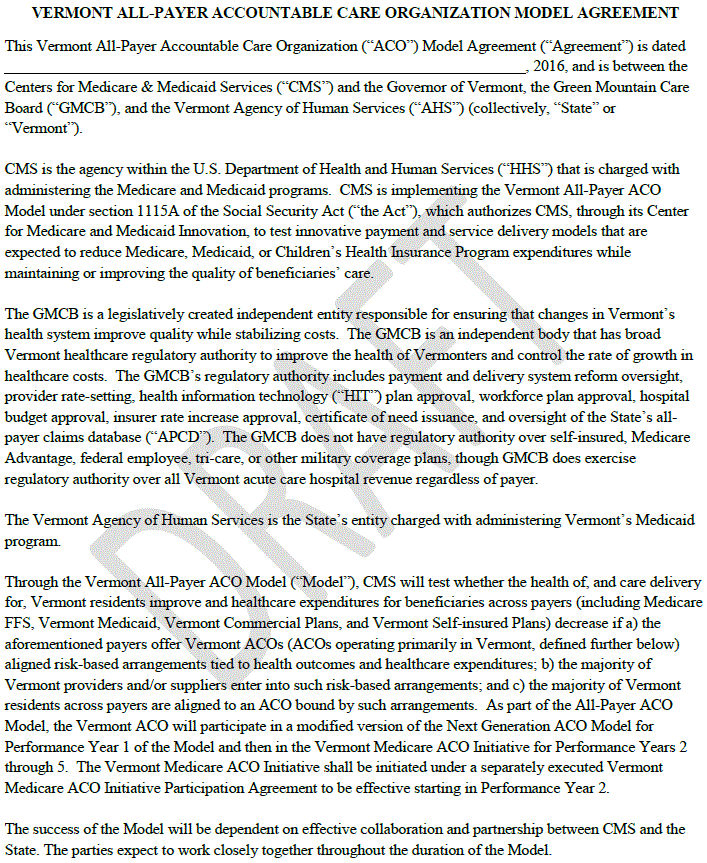
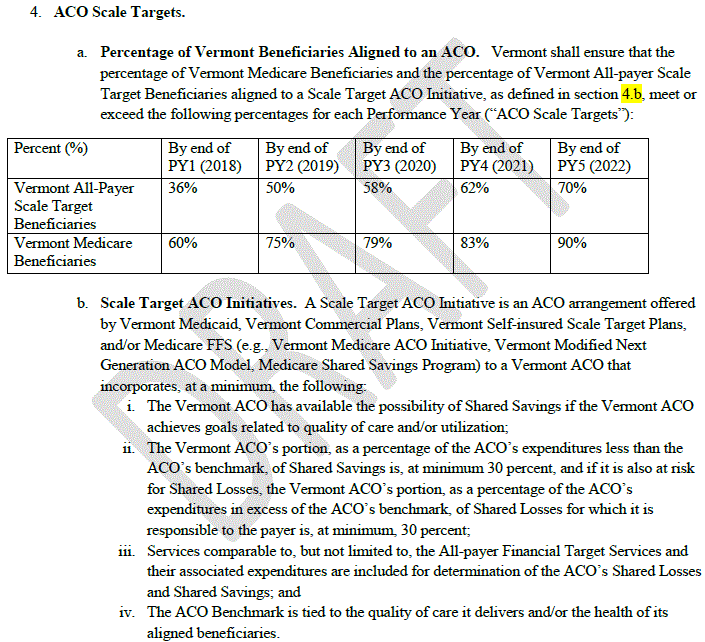
The Full Draft Agreement is available HERE.
Source: Vermont Watchdog September 28, 2016. http://gmcboard.vermont.gov/sites/gmcb/files/documents/payment-reform/DRAFT_APM_Agreement_UNDER_LEGAL_REVIEW.pdf