

Vermont Business Magazine Governor Peter Shumlin today announced a plan that would allow for lamprey treatment of the LaPlatte River – a tributary to Lake Champlain that has become a major source of lamprey – while protecting the drinking water supply serving the Champlain Water District. Joining the governor at the announcement was Jim Fay of the CWD, a representative of Senator Patrick Leahy’s office, Bill Archambault and Brad Young of the US Fish and Wildlife Service, and state Natural Resources Agency and Health Department officials.
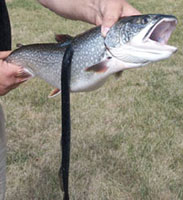 Lake trout with lamprey attached. New York DEC photo.
“I want to thank the US Fish and Wildlife Service and Senator Leahy, as well as the Champlain Water District, for working cooperatively with the State of Vermont on a plan to treat for lamprey in Lake Champlain this year,” Shumlin said. “I remain committed to a healthy fishery in the Lake and to ensuring we protect drinking water.”
Leahy found the funds necessary for sea lamprey control each year, as a senior member of the US Senate Appropriations Committee, and a great advocate for Lake Champlain.
“The sea lamprey control program has been the key to the resurgence in populations of both game and non-game fish in Lake Champlain in recent years, but public health and safe drinking water of course are the top priority,” Sen. Leahy said. “I want to thank Governor Shumlin and his teams at the Agency of Natural Resources and the Health Department, as well as Jim Fay at the Champlain Water District and the great team at the US Fish and Wildlife Service, for a solution that actively protects both public health and the Lake Champlain ecosystem. And thanks also to Governor Shumlin for finding the funds needed to implement this solution.”
"Given the lowering of the TFM standard, coupled with the potential for a "Do Not Drink Order," it is great to have all the various agencies work together on a fast track basis to protect public health while allowing the LaPlatte River to be treated this fall,” said Fay.
The US Fish and Wildlife Service, in cooperation with the Vermont Fish and Wildlife Department and the New York Department of Environmental Conservation, has long treated the rivers feeding both sides of the lake, including through the use of a pesticide known as TFM. This year, however, the Health Department lowered its allowable limit for TFM in drinking water from 35 to three parts per billion after concerns developed around the science underlying the previous standard. Although there is no evidence that TFM used in accordance with conditions posed or has posed a health risk, the lower standard for issuing an advisory that water should not be consumed has meant that Champlain Water District needs to install a Powdered Activated Carbon purification system to ensure that standard is met.
The plan announced today would allow the US Fish and Wildlife Service to treat the LaPlatte by installing such a system on the district’s water treatment plant as a further step to protect drinking water. The Burlington water system has a similar system in place.
"The US Fish & Wildlife Service has been committed to working with Vermont and New York to restore fish populations of Lake Champlain for over 30 years,” Brad Young, Sea Lamprey Control Manager at the USFWS. “The sea lamprey control program has allowed Atlantic salmon, lake trout, endangered lake sturgeon, and other species to reach population sizes and health not seen for over a century. We are pleased to have overcome recent challenges through cooperation with the state of Vermont and the Champlain Water District which will enable us to continue this successful program."
ANR Secretary Deb Markowitz said the state expects to issue a draft Aquatic Nuisance Control permit next week. Once the draft permit is finalized, a meeting will be scheduled to receive comments from the public before the final permit is issued.
“We have always collaborated with our Federal partners, with the Department of Health and with drinking water systems to ensure we can manage the population of sea lamprey in Lake Champlain in order to protect and improve populations of fish like landlocked salmon, lake trout and sturgeon,” said Louis Porter, commissioner of the Vermont Fish and Wildlife Department. “All of those partners have stepped forward this year to ensure that those goals continue to be met while ensuring that drinking water supplies are protected.”
Source: Governor's office 9.7.2016