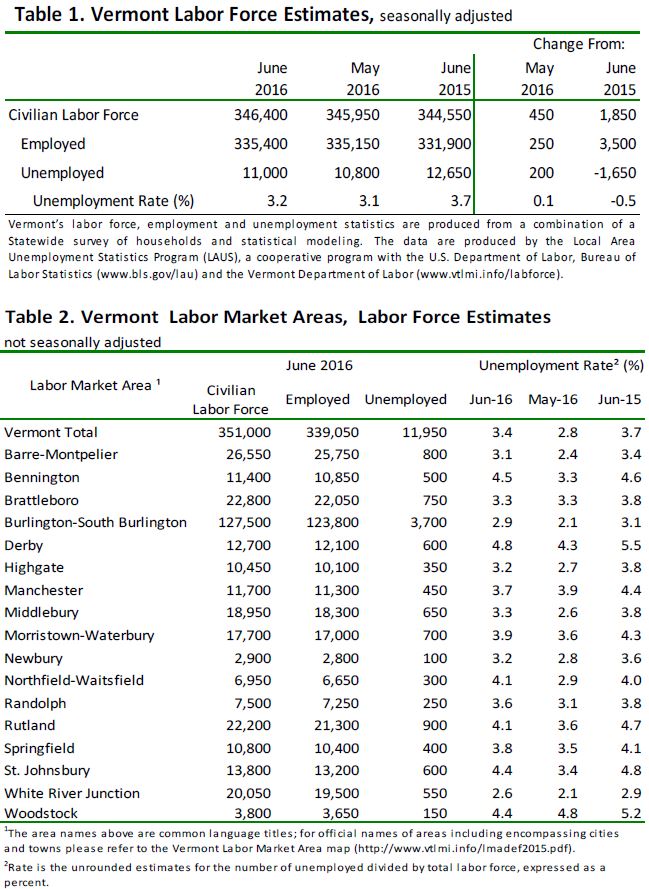
Vermont Business Magazine An increase in the Labor Force could indicate that potential workers are entering the workforce because of growth in the economy. At least that is one answer the state is offering to explain a rare increase in the jobless rate. The Vermont Department of Labor announced today that the seasonally-adjusted statewide unemployment rate for June was 3.2 percent. This is a one-tenth of one percentage point increase from the revised May rate.
|
|||||||||||||||||||||||||||||||||||||||||||||||||||||||||||||||||||||||||||||||||||||||||||||||||||||||||||||||||||||||||||||||||||||||||||||||||||||||||||||||
Overall, Vermont’s unemployment rate is tied fourth lowest in the country for the same time period (South Dakota is first at 2.7 percent and New Hampshire is second at 2.8 percent). Though preliminary data, this is the first increase to the seasonally-adjusted statewide unemployment rate in over seven years.
“The initial data shows a small rise to the overall unemployment rate after an unprecedented period of declining unemployment in Vermont, spanning more than seven years,” said Labor Commissioner Annie Noonan. "During a period of prolonged economic expansion, like the one the US economy is experiencing, increases to the labor force often occur as more and more people see job opportunities in their local communities. Individuals returning to the labor force can place upward pressure on the unemployment rate as they begin their job search. This one-month rise to the unemployment rate does not overshadow the significant economic progress Vermont has seen in the recent years.”
“Since May 2009, there are over 17,000 more jobs in Vermont and 14,000 fewer unemployed persons. Vermont employers are interested in hiring job seekers who are willing to learn and who demonstrate a solid work ethic. The Vermont Department of Labor staff in our 12 regional offices will help connect job seekers to available job openings, and help employers with recruitment and hiring incentives,” Noonan said.
The United States rate is 4.9 percent, an increase of two-tenths of one percentage point compared to the revised May estimate. The seasonally-adjusted Vermont data for June show the Vermont civilian labor force increased by 450 from the prior month’s revised estimate. The number of employed increased by 250 and the number of unemployed increased by 200. None of the over-the-month changes were statistically significant in the seasonally-adjusted series.
Compared to last June, the Labor Force is up 1,850, the number of employed is up 3,500, the number of unemployed is down 1,650 and the rate is down half-a-point.
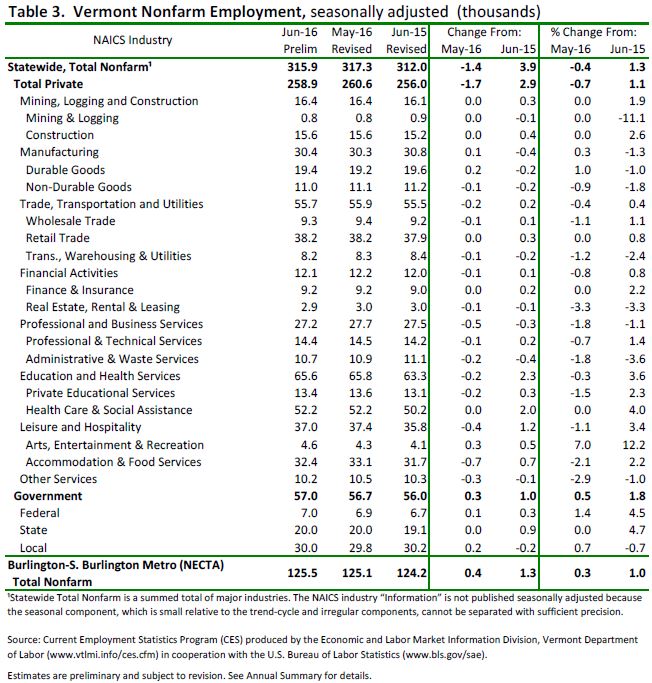
The June unemployment rates for Vermont’s 17 labor market areas ranged from 2.6 percent in White River Junction to 4.8 percent in Derby (note: local labor market area unemployment rates are not seasonally-adjusted). For comparison, the June unadjusted unemployment rate for Vermont was 3.4 percent which reflects an increase of six-tenths of one percentage point from the revised unadjusted May level and a decrease of three-tenths of one percentage point from a year ago.
Not-Seasonally-Adjusted
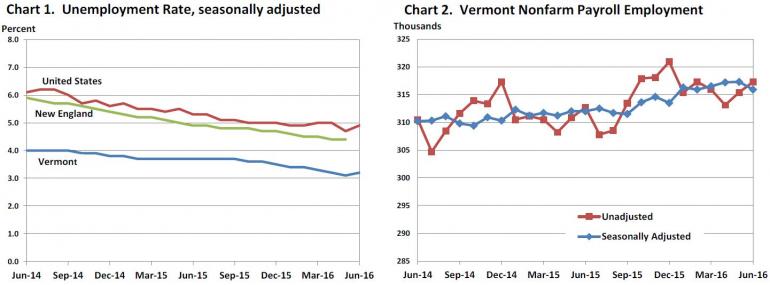
The preliminary ‘not-seasonally-adjusted’ jobs estimates for June show an increase of 1,900 jobs when compared to the revised May numbers. There was an increase of 900 jobs between the preliminary and the revised May estimates due to the inclusion of more data. The monthly increase seen in the June numbers was primarily attributable to Leisure & Hospitality activity. The broader economic trends can be detected by focusing on the over-the-year changes in this data series. As detailed in the preliminary ‘not-seasonally-adjusted’ June data, Total Private industries have increased by 3,600 jobs (1.4 percent) and Government (including public education) employment has increased by 1,000 jobs (1.8 percent) in the past year.
Seasonally-Adjusted
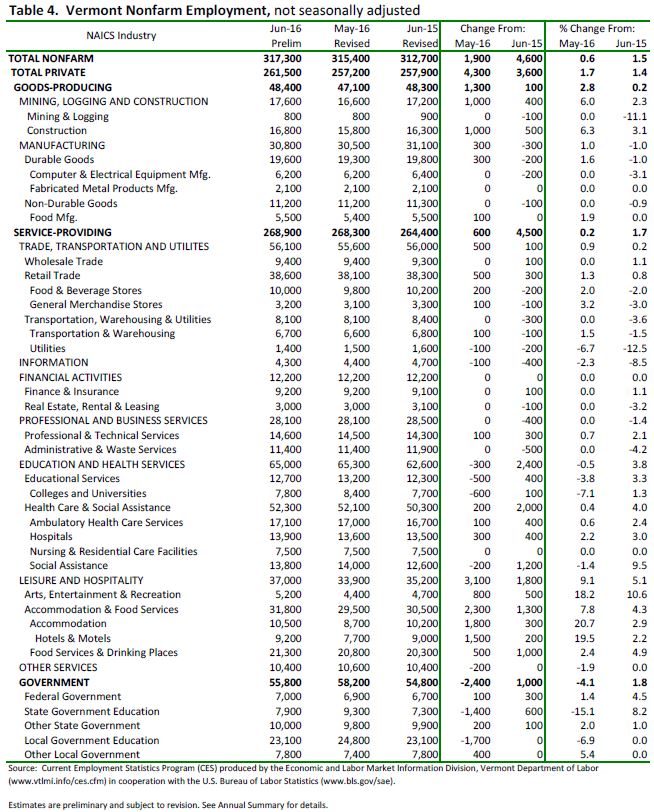
The seasonally-adjusted data for June reports a decrease of 1,400 jobs from the revised May data. As with the ‘not-seasonally-adjusted’ data, this over-the-month change is from the revised May numbers which experienced a 900 job increase from the preliminary estimates. The seasonally-adjusted over-the-month changes in June were mixed at the sectorial level. Those with a notable percent increase include: Arts, Entertainment and Recreation (+300 jobs or +7.0%), Federal Government (+100 jobs or +1.4%) and Durable Goods Manufacturing (+200 jobs or +1.0%). Industries with a notable percent decrease include: Real Estate, Rental & Leasing (-100 jobs or - 3.3%), Other Services (-300 jobs or -2.9%) and Accommodation & Food Services (-700 jobs or - 2.1%).
As of the prior month’s initial data, the Burlington-South Burlington Metropolitan NECTA was tied for the lowest unemployment rate in the country for all metropolitan areas at 2.1 percent (not-seasonally-adjusted).
NOTE: Employment (nonfarm payroll) - A count of all persons who worked full- or part-time or received pay from a nonagricultural employer for any part of the pay period which included the 12th of the month. Because this count comes from a survey of employers, persons who work for two different companies would be counted twice. Therefore, nonfarm payroll employment is really a count of the number of jobs, rather than the number of persons employed. Persons may receive pay from a job if they are temporarily absent due to illness, bad weather, vacation, or labor-management dispute. This count is based on where the jobs are located, regardless of where the workers reside, and is therefore sometimes referred to as employment "by place of work." Nonfarm payroll employment data are collected and compiled based on the Current Employment Statistics (CES) survey, conducted by the Vermont Department of Labor. This count was formerly referred to as nonagricultural wage and salary employment.