

Vermont Business Magazine State economists Jeff Carr and Tom Kavet lowered Fiscal Year 2017 tax revenue estimates by $21.1 million today in a presentation before the state Emergency Board, which accepted the revised numbers. The vast bulk of that shortfall will be made up by savings in the Medicaid program. FY 2017 began July 1. The economists also reported that Vermont’s revenues grew by 2.3 percent in fiscal year 2016 and Vermont employers added 4,400 jobs in the last year. The Legislative (Kavet) and Administration (Carr) economists said state revenues will grow by 4.8 percent in fiscal year 2017. The loss in revenue is somewhat, but not entirely, due to 1.5 million fewer skiers this past winter, a 32 percent drop. The downgrade means the state is projected to bring in about $21 million less in revenue than anticipated when the FY2017 budget was adopted. Governor Peter Shumlin said that the Administration will not need to enact budget cuts to meet the new target.
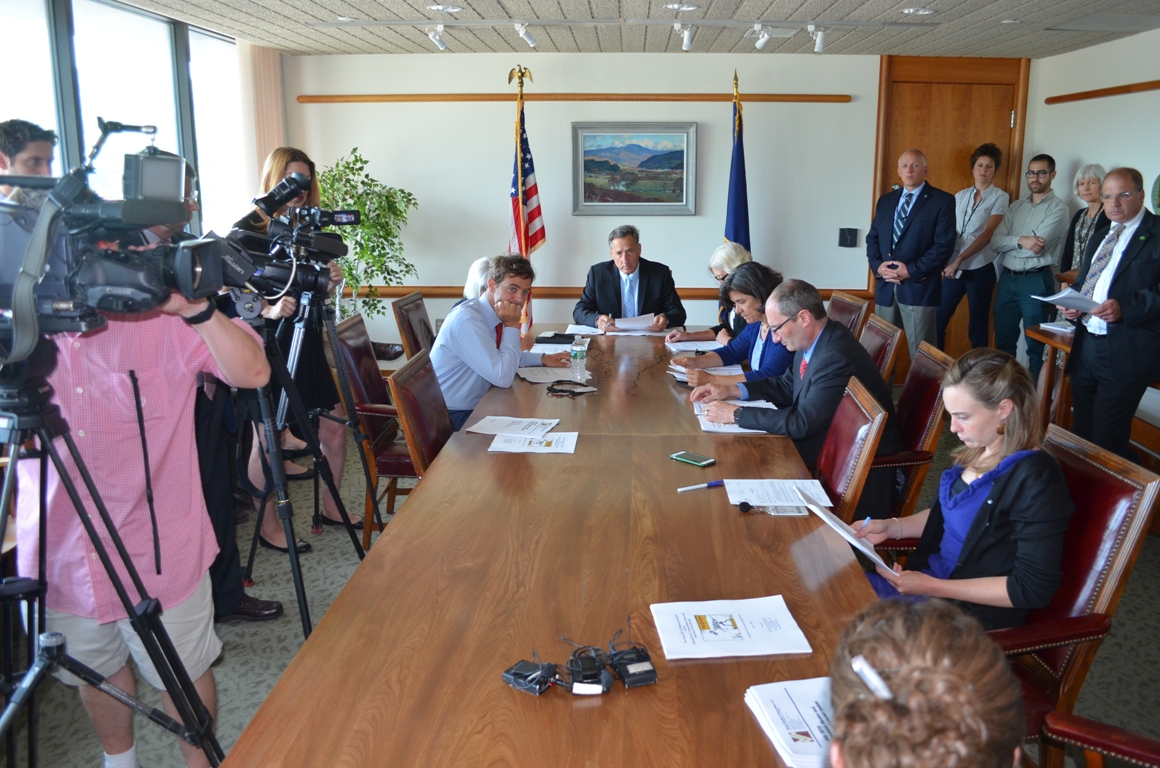
The Emergency Board is comprised of the governor and the chairs of the four legislative money committees. It is scheduled to meet twice a year, in January to set the next year's fiscal revenues from which lawmakers set the budget (and adjust the current one) and in July, after the actual FY revenue numbers can be reviewed. It can also meet at other times as needed.
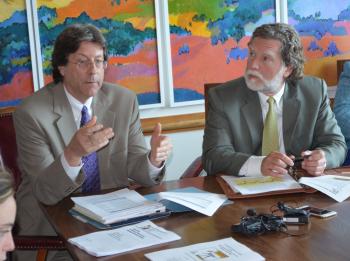 Jeff Carr, left, and Tom Kavet. Above: E-Board meeting in the governor's conference room. Vermont Business Magazine photos.
“While revenues continue to grow – and have done so every year since I have been governor – we knew there might be a downgrade when we received disappointing revenue numbers in April,” Shumlin said. “Since then, we have been managing spending closely, with an eye towards a potential downgrade. Now that such news has come, we are in a position where we are able to absorb the lower than expected growth without resorting to budget cuts or tapping into reserve funds.”
Vermont’s economy continues to show signs of strength, he said. Since January 2011, employers have added over 17,000 jobs, according to the Vermont Department of Labor. Vermont has one of the lowest unemployment rates in America. Personal per capita incomes have grown at or faster than the national average for each of the last five years, something that has never happened before. And Vermont's economy, defined as the Vermont Gross State Product, has grown at 3.1 percent since 2012. That compares with overall state budget growth since 2012 of 3.7 percent.
The economists are ambivalent about the economy as a whole, with Carr taking a wait-and-see approach, while Kavet is more optimistic as he sees more "upside" rather than "downside" risk.
They agreed, however, that the revised revenue numbers assume a more normal winter recreation season.
They revealed that Vermont's "skier days," which is the general measure of the ski season (one person spending one day on the slopes), was down from its record 4.7 million skier days in 2014-2015 to a "miserable" 3.2 million skier days in 2015-2016. This directly effects consumption taxes and ultimately the Personal Income Tax, the state's most important revenue source.
However, Carr noted that the bad winter tourism season is not all to blame. As the state gets older, consumption of goods and services changes, which likely will result in a weakening of the Sales & Use tax.
Kavet pointed out that more adults are living with their parents in the United States then at any time since the 1880s. The result of this, the economists said, is that those adults are not as good consumers and are not only not buying homes but not buying all those big ticket items that go into homes.
As for the FY2017 budget, it grew by 2.4 percent over the prior year’s budget. That compares with GSP growth in 2016 of 2.8 percent.
The governor announced that the state would introduce to the Joint Fiscal Committee on Monday a plan that would handle the $21.1 million revenue downgrade by:
- Using savings from lower than anticipated costs in the Medicaid program of $9.9 million in FY2016, which were carried into FY2017 to address the revenue downgrade. Medicaid is a $1.7 billion program and expenditures for the program in FY2016 were about 1.8 percent less than appropriated.
- Using funding from Medicaid that will not repeat in 2017 of $7.0 million – Every five to six years the State must cover an additional 53rd week Medicaid payment. That happened and was paid for in FY2016 but will not be needed in FY2017. Going forward, this anticipated future liability will be covered with a newly established reserve, which currently has a balance of $5.29 million.
- Move $3.6 million of Medicaid expenses from the General fund to the State Health Care Resources Fund.
A reconciliation of other items, including the property transfer tax, estimated direct applications and reversions, and the estimated transfer to the stabilization fund make up the remaining $600,000 needed to manage the downgrade.
The plan outlined by the governor today leaves the General Fund stabilization reserve at the statutorily required level, the balance reserve at $6.8 million, and the newly created reserve for next 53rd week of Medicaid payments with a balance of $5.29 million.
Following the report, House Republican Leader Don Turner (Milton) said, “While many are blaming the underperformance of certain taxes, the important role of Vermont’s ongoing spending crisis in this downgrade should not be overlooked. Time and again, Republican legislators have raised concerns over the overspending cycle perpetuated by the Shumlin Administration in the last six years.
“Though the Governor announced that his Administration would not need to enact further budget cuts, I remain skeptical. Even with the $95.3 million in increased taxes and fees over the last two years, approved by the Majority and Governor Shumlin, the state cannot maintain the current level of spending. So long as the state spends more revenue than it generates each fiscal year, such financial troubles will continue to plague our state.
“Without the support of Majority Democrats, we cannot take the necessary measures to rein in spending and grow our economy in sustainable ways. This is the need of the hour. Vermonters deserve better!”