

Vermont Business Magazine Governor Peter Shumlin today at Union Elementary School in Montpelier celebrated a law that guarantees access to pre-kindergarten for all three and four year olds in Vermont. The law, which the governor signed in 2014, goes into effect July 1 and will ensure all Vermont kids have access to Pre-K this coming school year. Vermont is the first state in America to guarantee access to Pre-K for all three and four year olds.
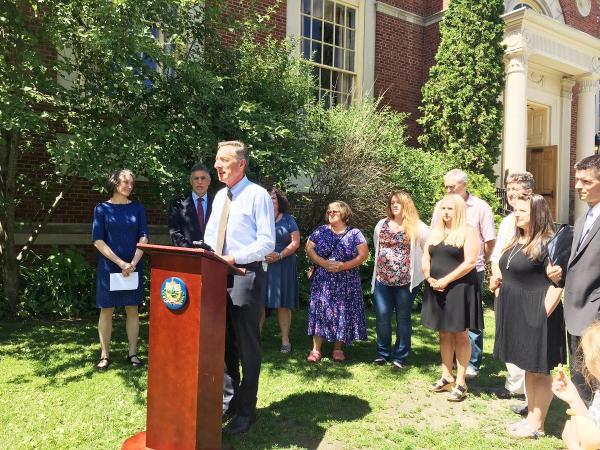 Governor Shumlin at Union Elementary School in Montpelier Thursday morning. Education Secretary Rebecca Holcomb is to the far left. Courtesy photo.
The law, Act 166, requires communities to offer at least 10 hours per week of high-quality, publicly funded pre-kindergarten education for 35 weeks annually to all “prekindergarten children.” Qualified pre-kindergarten programs include those operated by community programs, public schools, private early education and care programs, and Head Start.
After passage of Act 166, a third of Vermont’s school districts moved forward with implementation, even though the law allowed them until this year to begin that process. As a result, Act 166 has increased access to programs for parents and the number of children in state funded Pre-K by 1,079.
“Universal Pre-K is a win for children, taxpayers, working families, and employers,” Governor Shumlin said. “We all know that preparing children to enter elementary school ready to learn is one of the best ways and set up our next generation for success and avoid costly interventions later in life.”
Universal Pre-K in Vermont represents a broader culture shift in Vermont as well. With more than 70 percent of Vermont children under age six having all their parents in the labor force, universal Pre-K is critical to supporting working families.
Among the benefits of the law:
Parents who work in towns outside their home communities can access pre-kindergarten for their young children closer to their jobs and with more regular hours. No longer will parents have to forego enrolling their children in high-quality early education programs because they can’t transport their child to and from the irregularly scheduled available hours. Now they have flexibility in enrollment, transportation, and wrap-around care.
The cost of care and education is one of the biggest financial burdens to working families. Parents now have access to up to $3,000 of tuition reimbursement for each of their children. Accessibility to funding helps families of all income levels, while ensuring that their children are receiving quality care of the highest standards in Vermont.
Employers will have a quality workforce in the future, employees who are more confident of the quality of their child’s early learning and development program, and a state policy making Vermont attractive to young talent who are seeking employment in a family-friendly state.
Low-income children who have attended a pre-kindergarten program are more likely to be ready for kindergarten. Specifically, Vermont children from low-income backgrounds who don't attend pre-kindergarten have a 30 percent probability of being kindergarten ready, while Vermont students from low-income backgrounds with one or two years of pre-kindergarten have up to a 55 percent probability of being kindergarten ready. This relationship is also present for more affluent students, although it is not as pronounced.
At today’s ceremony, the governor made clear that this is the first step in ensuring equal access to Pre-K for all Vermont’s children and that work remains.
“Now that we have made access universal, we need to ensure all Vermonters, regardless of income, are benefitting from the new law,” Shumlin said. “To do this, I have challenged my Agencies to work hard to identify ways to ensure all Vermonters are utilizing this important law, especially those low-income Vermonters who too often fall through the cracks.”